
Patreon Blocks AI Crawlers, Demands Consent and Pay
Patreon partnered with Cloudflare to block AI training bots at the network level, moving past robots.txt requests that crawlers were already ignoring.
 6 min read
Patreon spent three years asking AI companies nicely. On July 17, it stopped.
The creator platform announced a partnership with Cloudflare that blocks AI training crawlers at the network level, replacing a robots.txt policy that bots had been ignoring for months. CEO Jack Conte broke the news on Instagram in characteristically blunt terms: "Creators deserve credit, compensation, and consent. If that's not on the table, the crawlers can stay the f*** off Patreon."
TL;DR
- Patreon now blocks AI training bots at the network level via Cloudflare's Crawl Control, instead of relying on robots.txt
- Individual crawlers' weekly access attempts dropped from thousands to zero during testing, per Patreon
- Search-indexing bots that send traffic back to creators remain allowed
- The move follows Cloudflare's own policy shift, which will block training and agent bots by default on new domains starting September 15
- It lands one week after Google was sued by Hachette, Cengage, Elsevier, and author Scott Turow over Gemini's training data
From Requests to Network-Level Blocks
Patreon first added anti-scraping language to its robots.txt file in 2023. That file is a voluntary instruction set, not an enforcement mechanism, and Patreon's own numbers suggest most AI crawlers treated it as exactly that: optional. According to TechCrunch, the company's internal testing found individual training crawlers making thousands of access attempts a week despite the robots.txt disallow rules. After switching on Cloudflare's blocking, that number fell to zero.
What Changed Technically
Cloudflare's AI Crawl Control sorts bots into three buckets: Search, Agent, and Training. Patreon's new setup blocks Training and Agent crawlers outright while leaving Search crawlers alone, so a Patreon page can still surface in Google search results even as it becomes invisible to a model's training pipeline. Drew Rowny, Patreon's SVP of product, framed the distinction as protecting discovery while cutting off extraction: creators should be able to grow an audience through search, he said, without having their posts vacuumed into a dataset they never agreed to.
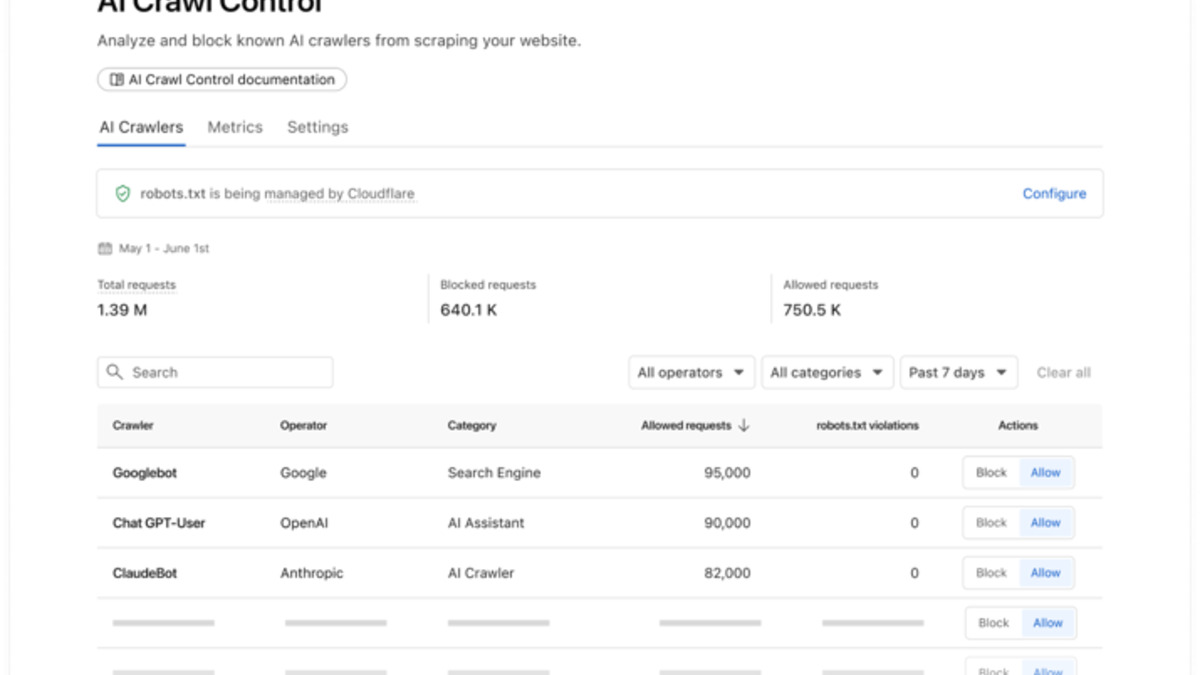 Cloudflare's AI Crawl Control dashboard sorts bots into Search, Agent, and Training categories, letting site operators block one without blocking the others.
Source: blog.cloudflare.com
Cloudflare's AI Crawl Control dashboard sorts bots into Search, Agent, and Training categories, letting site operators block one without blocking the others.
Source: blog.cloudflare.com
Why Now, Specifically
Patreon's timing tracks two things happening on its own platform and one happening industry-wide. Internally, the company has been rolling out a redesigned Home Feed and a short-form format called Quips, both of which surface more content in more places, and both of which widen the surface area a crawler could hit. Externally, Cloudflare has been building toward a harder default. Cloudflare's own Pay Per Crawl program, launched July 1, already puts a price tag on AI access to publisher content, and starting September 15, new domains onboarding to Cloudflare will have Training and Agent bots blocked by default on any page carrying ads. Patreon adopted early rather than waiting for the deadline.
Consent, Credit, Compensation
Conte has been building toward this for months. At SXSW in March, he called the AI industry's fair-use defense "bogus," arguing that companies signing multi-million-dollar licensing deals with large publishers while claiming fair use against independent creators were applying the law selectively, based on who could afford to sue. In May, he posted a 43-minute video laying out a three-part framework he wants applied uniformly: consent, meaning creators can opt out of training use; credit, meaning attribution when a model draws on their work; and compensation, meaning payment when it happens.
"Consent meaning, 'Do I get to opt out of my work being used by these models as training data?' Credit meaning, 'Do I get credit for that?' And then compensation, meaning, 'Do I get paid when that happens?' Unfortunately, the answer to all three of these questions right now is a big fat 'No.'"
None of that framework is new to platforms broadly. What's new is a company the size of Patreon backing the rhetoric with infrastructure, rather than leaving the question to a checkbox nobody enforces.
Patreon Isn't the Only One Doing This
Beehiiv has rolled out its own Crawl Control options, letting individual newsletter creators toggle bot access by category. Cloudflare's September default shift will push that same choice onto every new site the company hosts, whether the site operator asks for it or not. The pattern across all three: shifting the default from "scrape unless told otherwise" to "blocked unless explicitly allowed," which quietly reverses two decades of open-web assumptions about crawler access.
The Legal Backdrop Making This Urgent
The Anthropic Precedent
Patreon's stance echoes a legal fight that already produced a landmark number. In September 2025, Anthropic agreed to pay $1.5 billion to settle a class action from book authors over training data pulled from pirated libraries LibGen and PiLiMi, roughly $3,000 per book across an estimated 500,000 titles. Judge William Alsup's underlying ruling drew a specific line: training on legally acquired copyrighted work counted as fair use, but training on pirated copies didn't. That distinction is exactly the one Conte has been arguing platforms need to formalize before more lawsuits force it.
Google's New Lawsuit
The line got tested again on July 14, when Hachette Book Group, Cengage Learning, Elsevier, and author Scott Turow filed a class action against Google in federal court in New York, accusing the company of training Gemini on copyrighted books without permission and altering copyright metadata to obscure the sourcing. The complaint cites internal Google communications describing the practice as carrying "$10Bs-$100Bs in potential fines" exposure, a number Google itself apparently flagged before publishers did.
 Patreon's move comes as courts keep setting the terms of AI training data disputes, from Anthropic's $1.5 billion settlement to Google's newest publisher lawsuit.
Source: unsplash.com
Patreon's move comes as courts keep setting the terms of AI training data disputes, from Anthropic's $1.5 billion settlement to Google's newest publisher lawsuit.
Source: unsplash.com
Patreon's block doesn't resolve any of that litigation. It does something more immediate: it removes ambiguity about consent at the point of access, rather than leaving the question to be litigated after a model has already been trained. Whether other creator platforms follow Patreon's infrastructure-first approach, or whether the industry waits for courts to keep setting the terms case by case, is the open question the Suno leak and the GitLab scraping incident already suggested was coming.
Sources:
- Patreon stops asking AI bots not to scrape - and starts blocking them (TechCrunch)
- Patreon Blocks Crawlers From Stealing Creators' Work for AI Training (404 Media)
- Patreon CEO calls AI companies' fair use argument 'bogus' (TechCrunch)
- Your site, your rules: new AI traffic options for all customers (Cloudflare Blog)
- Introducing AI Crawl Control (Cloudflare Blog)
- Anthropic to pay authors $1.5 billion in settlement (CNBC)
- Google faces another AI training lawsuit from major publishers (TechCrunch)

