
Academy's New Rules Bar AI Performances and Scripts
The Academy banned AI-generated actors and human-authored scripts from the 99th Oscars, codifying union positions just weeks after the WGA secured its new four-year studio deal.
 6 min read
The Academy of Motion Picture Arts and Sciences dropped its clearest statement yet on artificial intelligence in film on May 1, closing a loophole that AI video companies had been quietly hoping would stay open.
"Only performances credited in a film's legal billing and demonstrably performed by humans with their consent will be eligible."
That single sentence, buried in the rule update for the 99th Academy Awards, rules out AI-created likenesses, posthumous digital recreations, and any performance where a synthetic actor carries a scene. A matching clause requires that screenplays "must be human-authored to be eligible." The Academy also reserved the right to request documentation about AI usage from any submitted film.
TL;DR
- Academy bans AI performances and AI-written scripts from the 99th Oscars (ceremony March 14, 2027)
- Films using AI actors or scripts can still be made and distributed - they just can't compete for awards
- The most direct trigger was "As Deep as the Grave," an independent film built around an AI recreation of Val Kilmer
- WGA reached a new four-year deal with studios on April 4, 2026, expanding written AI protections weeks before the ruling
- AI video companies lose their main Hollywood credibility argument
The 99th ceremony is set for March 14, 2027, at the Dolby Theatre.
The Val Kilmer Test Case
The rules didn't arrive in a vacuum. The production that forced the Academy's hand is "As Deep as the Grave," an independent film built around Val Kilmer, who died in 2025. Director Coerte Voorhees had cast Kilmer as a Catholic priest before the actor's illness made it impossible to film. Rather than recast, Voorhees used generative AI with images and audio provided by Kilmer's estate and family.
The project has all the hallmarks of a careful, consensual use of AI: the estate was compensated under SAG-AFTRA guidelines, Kilmer's daughter Mercedes publicly supported it, and Kilmer's character reportedly appears in over an hour of screen time. It is exactly the kind of good-faith AI production that might have seemed awards-eligible six months ago.
Under the new rules, it isn't. The Academy made no exceptions for estate consent or union compliance. Any performance that isn't "demonstrably performed by humans" is out.
"As Deep as the Grave" now sits in an odd position: a film with genuine craft, real consent, and proper compensation that's nonetheless locked out of the prestige track by a rule written to protect against exactly the opposite situation.
Impact by Stakeholder
| Stakeholder | Impact | Timeline |
|---|---|---|
| AI video startups (Sora, Runway, Veo, Pika) | Lose their strongest Hollywood pitch | Immediate |
| Studios with AI-heavy productions | Must choose between prestige and AI cost savings | Now through Q4 2026 |
| Actors and writers | Gain formal validation of union contract protections | 99th cycle onward |
| Streaming services | AI-heavy films can still land on streaming with no awards bar | No change |
| International directors | Easier path to nomination via expanded festival eligibility | 99th cycle onward |
Who Takes the Hit
AI Video Companies
The ruling lands badly for the companies that spent the past year pitching AI video as Hollywood's next production tool. Sora, Veo, Runway Gen-4, and Pika 2.0 all built their enterprise narratives around Hollywood adoption. OpenAI's Sora had its own set of problems earlier this year, pivoting away from creative markets after a bruising few months. The Academy's decision gives studios an institutional reason to keep AI generation off the prestige track - which is where the awards-season marketing budgets sit.
The argument that AI can be used tastefully, consensually, and at quality is now beside the point. The Oscar eligibility requirement doesn't weigh intent or quality; it weighs whether a human was on set.
 Film production is entering a two-tier structure: AI-assisted projects for streaming and budget markets, human-performance projects for the prestige track.
Source: pexels.com
Film production is entering a two-tier structure: AI-assisted projects for streaming and budget markets, human-performance projects for the prestige track.
Source: pexels.com
Studios Choosing Sides
Every studio currently in production now faces a quiet decision. AI-assisted filmmaking cuts costs; awards eligibility drives box office, talent recruitment, and library valuations. These don't have to conflict, but the Academy just made it harder to have both.
Studios can use AI in visual effects, editing, scoring, and post-production without hitting the eligibility rules. The restriction targets only AI in writing (credited) and AI in performance (on screen). That's a narrower constraint than it first looks, but it's also the constraint that matters most for the films that create awards heat. A studio making a $200 million drama with AI dialogue and an AI lead has just written itself out of the conversation.
Actors and Writers
For human talent, this ruling is straightforward good news. Claude's recent expansion into professional creative tools shows how AI is moving into every part of the production pipeline. The Academy ruling draws a firm line at the most visible and economically important point: what gets on screen and what gets credited.
The Union Connection
The Academy's move follows a direct line from the 2023 labor actions. SAG-AFTRA's 118-day strike - the longest actors' strike in Hollywood history - was partly fought over AI replica rights. The WGA strike that year produced the first written prohibition on crediting AI as a writer. Both unions walked away with contractual protections, but those protections only covered what studios could demand of their members. They said nothing about what the Academy would do with the finished product.
The WGA closed that gap on April 4, 2026, when it reached a tentative four-year deal with the Alliance of Motion Picture and Television Producers that expanded AI protections to include restrictions on using writers' scripts for AI training. The Academy's rule update, announced less than a month later, effectively stamped the union positions with Hollywood's most prestigious institutional seal.
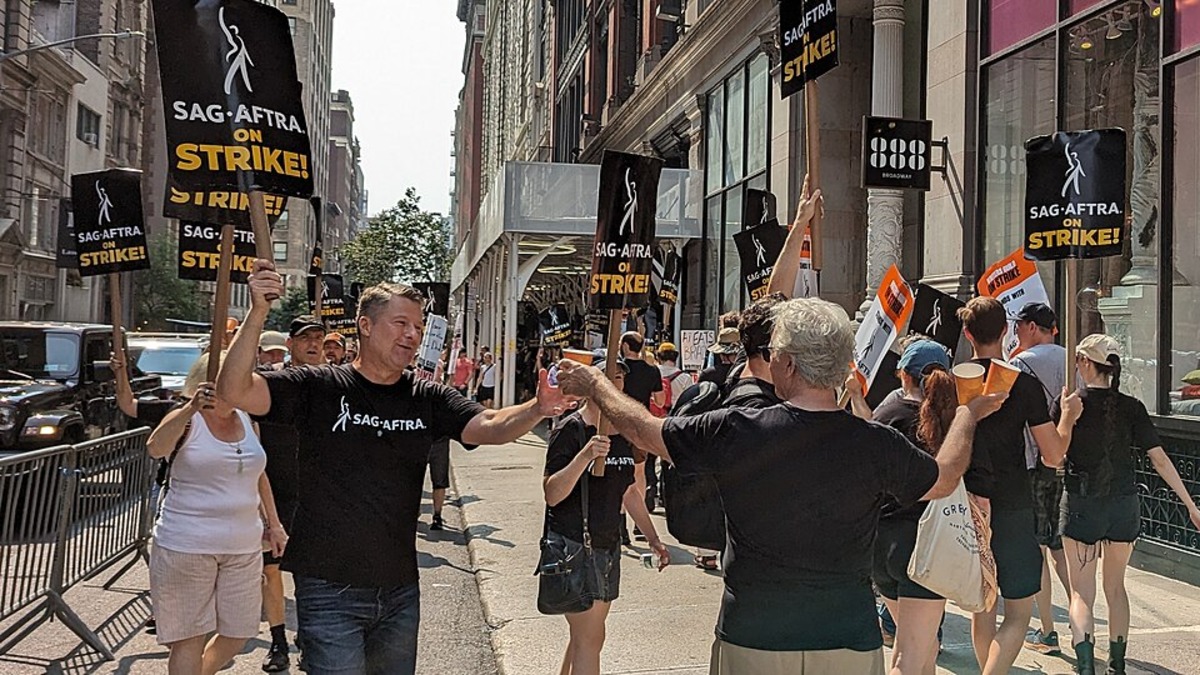 SAG-AFTRA's 118-day strike in 2023 secured the union protections that the Academy's new rules now reinforce.
Source: Wikimedia Commons / CC BY 2.0
SAG-AFTRA's 118-day strike in 2023 secured the union protections that the Academy's new rules now reinforce.
Source: Wikimedia Commons / CC BY 2.0
The Academy's ruling doesn't weigh intent or quality. It weighs whether a human was on set.
The connection matters economically. Oscar nominations move tickets. They also determine which films get the awards-season marketing push that can turn a modest release into a $200 million earner. By tying that access to human authorship and performance, the Academy has created a structural incentive for studios to keep AI off the prestige track - not because they oppose the technology, but because the math works against it.
What Happens Next
The immediate question is enforcement. The Academy has reserved the right to ask for documentation about AI usage, but hasn't described how it plans to verify claims. Synthetic performances can be invisible to audiences; the line between heavy VFX and AI-produced likeness isn't always obvious from a finished cut. The Academy will need an audit mechanism before the September 2026 submission deadlines, and so far hasn't announced one.
The longer-term question is where this leaves AI video companies. Sora's Disney partnership collapse signaled that the Hollywood play was already harder than the press releases suggested. The Academy's ruling removes the implicit argument that enough taste and consent could get an AI production into the awards race. It can't. The market for AI-produced film now has clearer walls: streaming and direct distribution, not prestige festivals.
The 99th Oscars will be the first test of how well the rules hold in practice. Submissions open September 17, 2026.
Sources:
- Academy of Motion Picture Arts and Sciences rule update, May 1, 2026
- Oscars Rules 2027: AI Actors, Screenplays - Variety
- Academy Bans AI Actors and Overhaul International - The Wrap
- AI-generated actors and scripts ineligible for Oscars - TechCrunch
- Val Kilmer in "As Deep as the Grave" - Variety
- WGA four-year deal with studios - Hollywood Reporter
- Oscars rule changes - Hollywood Reporter

