
Orbital Plans 10,000 GPU Satellites for AI Inference
a16z-backed Orbital wants to run AI inference from low Earth orbit using NVIDIA Blackwell GPUs, targeting 10,000 satellites and 1 GW of compute at full scale.
 6 min read
Euwyn Poon has built and sold a startup before. Spin, the e-scooter company he co-founded, sold to Ford for roughly $100 million in 2018. His next bet is much larger in scope and a lot smaller in funding: a $5 million seed round to put NVIDIA GPUs in orbit and sell AI inference from 500 kilometers up.
The startup, Orbital, announced the raise today. Lead investor is a16z's Speedrun accelerator program. Twelve other firms joined the round, including Basis Set, Human Element, Wayfinder, and Antler.
TL;DR
- $5M seed from a16z Speedrun for Orbital, building AI compute satellites
- 10,000-satellite constellation planned, delivering 1 GW of GPU compute in aggregate
- Inference-only by design: radiation bit-flips make training unacceptable in orbit
- First test mission (Orbital-1) launches April 2027 on a SpaceX Falcon 9
- Each satellite draws 100 kW from continuous solar arrays; cooling is radiative into the vacuum
Why Orbit?
The premise is the energy ceiling. Land-based AI data centers are running into power grid limits faster than new capacity can be built. Cooling a dense GPU cluster requires water, air conditioning, and real estate. Orbital's argument is that space removes all three constraints at once.
"The energy ceiling on AI isn't theoretical," Poon said in the announcement. "It's a real constraint that will impede the advancement of intelligence."
Each satellite in the planned constellation would carry GPU hardware powered by 100 kW of continuous solar generation. Cooling is handled by radiating heat directly into the space vacuum - no chillers, no fans, no water towers. At 500-600 km altitude in sun-synchronous orbit, a satellite sits in near-continuous sunlight, keeping solar panels productive around the clock.
The company is planning 10,000 satellites at full build-out, for a total of 1 gigawatt of compute across the constellation. That's roughly equivalent to a mid-size hyperscale data center campus - but spread across low Earth orbit rather than concentrated in a power-hungry ground facility.
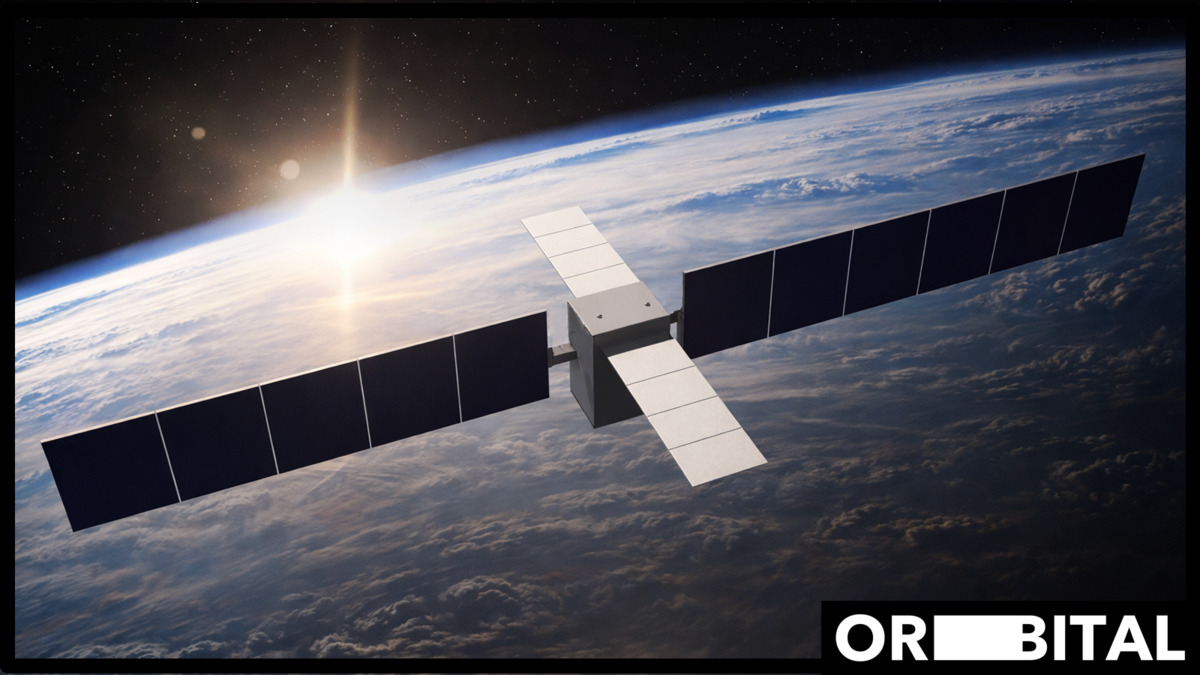 Artist's concept of an Orbital satellite, showing the solar array and compute module. The satellite is designed for replacement rather than on-orbit servicing.
Source: globenewswire.com
Artist's concept of an Orbital satellite, showing the solar array and compute module. The satellite is designed for replacement rather than on-orbit servicing.
Source: globenewswire.com
The Radiation Problem - and Why Inference Solves It
Putting GPUs in space isn't a new idea, but the engineering challenge is real. At orbital altitudes, cosmic rays and solar particle events cause bit flips - random single-bit errors in memory. For training workloads, those errors are fatal. A corrupted gradient propagates through the entire model and destroys the run. Even a 0.001% error rate per hour compounds into disaster over a multi-week training job.
Poon's team chose inference-only to sidestep this completely. An inference request is stateless: each request is processed independently, and a bit flip that corrupts one response doesn't affect the next. The constellation can detect faulty satellites and re-route around them without any single error cascading into broader failure.
GPU Hardware
The demo hardware uses NVIDIA Blackwell chips. Operational satellites launching in 2028 target NVIDIA's Space-1 Vera Rubin-class GPUs - a variant designed for the radiation environment of orbit. Orbital hasn't disclosed thermal design power figures for the space-hardened chips, but the 100 kW solar budget per satellite sets the ceiling.
Latency and Orbital Parameters
At 500-600 km altitude, the round-trip propagation delay is 20-40 milliseconds - comparable to a transatlantic API call. That makes orbital inference viable for the vast majority of LLM workloads, which are tolerant of latency at the human-response timescale.
Altitude:          500-600 km (sun-synchronous orbit)
Round-trip delay:  20-40 ms
Power per node:    100 kW (continuous solar arrays)
Cooling:           Radiative (space vacuum, no coolant)
GPU (demo):        NVIDIA Blackwell
GPU (2028):        NVIDIA Space-1 / Vera Rubin class
Fault model:       Replace, not service
FCC status:        Filing in progress
Orbital vs. the Orbital Compute Field
Orbital isn't the only startup betting on space-based AI compute, and it enters the field dramatically underfunded compared to its competitors. Starcloud raised $170M after launching a H100 into orbit last November. Cowboy Space raised $275M and is building its own rockets to reduce dependence on SpaceX. Google's Project Suncatcher is putting TPU-equipped spacecraft into orbit through a SpaceX partnership.
| Company | Raised | Hardware | Launch vehicle |
|---|---|---|---|
| Orbital | $5M seed | NVIDIA Blackwell / Space-1 | SpaceX Falcon 9 |
| Starcloud | $170M | NVIDIA H100 | SpaceX |
| Cowboy Space | $275M | NVIDIA Blackwell | Own rockets (planned) |
| Google Suncatcher | Undisclosed | Google TPUs | SpaceX |
Poon's answer to the funding gap is sequencing: verify the concept with Orbital-1 in April 2027, then raise the capital the proof of concept attracts. "We will get to full scale when Starship comes online," he said - an explicit acknowledgment that the 10,000-satellite vision depends on Starship driving launch costs down far enough to be economical per kilogram.
 Euwyn Poon previously co-founded Spin, the e-scooter company acquired by Ford in 2018.
Source: globenewswire.com
Euwyn Poon previously co-founded Spin, the e-scooter company acquired by Ford in 2018.
Source: globenewswire.com
The Team
Orbital's roughly 12-person team comes from Amazon LEO satellite operations, SpaceX, and Northrop Grumman. The team is building at Factory-1, a R&D facility in Los Angeles, and has filed with the FCC for constellation deployment approval - a multi-year process that SpaceX navigated for Starlink across several years of back-and-forth.
A16z General Partner Andrew Chen backed the round: "The harder the problem, the better. Orbital is taking on AI's biggest constraint with a bold and radical idea."
Where It Falls Short
The $5M seed doesn't close the numbers. A single Falcon 9 launch costs roughly $70 million at current commercial rates; a 10,000-satellite constellation would require launch economics that don't exist yet outside of Starship projections. Starcloud and Cowboy Space each raised 34x-55x more capital, and they're still in early validation stages.
Radiation hardening for GPU compute at scale is still unsolved. NVIDIA's Space-1 chips are planned, not shipping. The Blackwell architecture was designed for controlled data center environments with active liquid cooling and regulated power delivery. How it performs in a radiation environment with passive thermal management remains untested at any meaningful scale.
The FCC approval timeline is long. SpaceX spent years securing Starlink's constellation license. Orbital is at the back of an increasingly crowded queue.
Competition from the ground is accelerating too. AirTrunk just committed $30B to land-based AI data center expansion across India alone. Ground infrastructure doesn't need a rocket to add a node. Orbital needs to show a capability that ground facilities genuinely can't replicate - not just a different form factor with a compelling rendering.
The Orbital-1 test mission in April 2027 is the first real data point. Until then, the 10,000-satellite constellation exists only in press kit renders.
Sources:

