
OpenCode Hits 8M Users, a Year from a Toronto Meetup
OpenCode reaches 8 million monthly users and 172K GitHub stars in one year, displacing Claude Code as the most-starred open-source coding agent.
 7 min read
About a year ago, Jay V stood in front of 30 developers at a DevTools Toronto meetup and showed them a terminal-based coding agent. No launch party. No Product Hunt campaign. Just a GitHub repo and a curl command.
OpenCode now has 8 million monthly active users.
The company disclosed the milestone in a June 8 interview with BetaKit, alongside a projection of $25 million in expected annual revenue. On GitHub, the repository sits at 172,000 stars - ahead of Claude Code, ahead of Codex CLI, more than any other open-source coding agent on the platform.
Key Specs
| Metric | Value |
|---|---|
| Monthly active users | 8 million |
| GitHub stars | 172K (June 2026) |
| Contributors | 900+ |
| Commits | 13,000+ |
| LLM providers supported | 75+ |
| License | MIT |
| Latest release | v1.16.2 (June 5, 2026) |
The Architecture
OpenCode's adoption is easier to understand once you look at what it actually does differently from every other coding agent in the category. The core design decision is separation of concerns: the agent orchestration layer and the model layer are fully decoupled.
Model-Agnostic Orchestration
Every major coding agent ships with model opinions baked in. Cursor defaults to its own fine-tuned stack. Codex CLI recommends GPT-5.5. Xcode 26.3's agentic coding mode runs Apple Intelligence models locally.
OpenCode does none of that. You configure whichever provider you want - Claude, GPT, Gemini, DeepSeek, or anything running locally via Ollama. The company also maintains models.dev, described as the largest catalog of AI model metadata, with community-contributed integrations for new providers. When a lab releases a new model, contributors usually have an OpenCode integration open within hours.
This matters at the enterprise level. Cloudflare - an early adopter - uses OpenCode across teams with different model preferences and compliance requirements. Air-gapped deployment is supported for regulated industries that can't send code to third-party APIs.
LSP Integration
Most coding agents work by pasting your code into a context window. OpenCode integrates with the Language Server Protocol to feed compiler diagnostics, type errors, and import resolution data directly to the model as structured tool results.
The practical effect is that the model knows which line is broken and why before it attempts a fix. The documentation claims support for 20+ languages. This is unusual among CLI agents - most tools in the category that security researchers flagged earlier this year also lack real-time diagnostic feedback loops.
Agent Modes
OpenCode ships two built-in agents. "Build" runs with full filesystem access and can create, edit, and delete. "Plan" is read-only, useful for reviewing a proposed change before it executes. A third agent, Scout, handles external research without touching the local codebase.
Background subagents landed in v1.15 in May 2026, enabling parallel execution across multiple tasks in the same session. Shareable session links let you hand off a conversation mid-task to a collaborator.
From a Meetup to 8M Users
The company behind OpenCode is Anomaly, founded by Jay V (CEO) and Frank Wang (CTO), both University of Waterloo alumni. They started their first company together - also called Anomaly - then took their second project, Serverless Stack (SST), through Y Combinator. SST raised $1 million after demo day, grew to 25,000 GitHub stars, and turned profitable by 2025.
SST was infrastructure tooling for AWS. OpenCode applies the same philosophy: build something developers use directly, make it MIT-licensed, and monetize around the edges.
 Jay V at Toronto Tech Week's Homecoming, May 2026. The interview was published the following week.
Source: betakit.com
Jay V at Toronto Tech Week's Homecoming, May 2026. The interview was published the following week.
Source: betakit.com
Within five months of the DevTools Toronto debut, OpenCode had 650,000 monthly active users and 50,000 GitHub stars. The jump to 8 million MAU represents a 12x increase on top of that already fast start.
Jay V, speaking to TechFundingNews earlier this year, described the structural call behind the growth: "OpenCode is not an AI product. It's a product designed to use AI. That distinction matters because we're not betting on any single model or provider winning."
On open source specifically, V told BetaKit that he worries the industry is concentrating talent at a handful of Western labs: "if AI is going to have the impact that it's going to have in every single part of the economy... the diversity of these things really matters."
The other key decision was making provider contributions open. Rather than manually curating a model list, Anomaly created a public repository where anyone can submit a new integration. When Cohere or MiniMax ships a model, the community adds it - no waiting for the core team.
The Business Model
The core tool is free and MIT-licensed. Anyone can fork it, self-host it, or build on top of it without restriction. Revenue comes through two paid tiers:
- OpenCode Go at $10/month: curated model access without managing API keys directly
- OpenCode Black at $200/month: higher-tier model access and enterprise support
The company projects around $25 million in annual revenue based on current path. These are self-reported figures without independent audit - the same caveat applies here that applies to most private company growth claims. For comparison, Cursor crossed $2B in ARR this year with a substantially larger team. Anomaly appears to run lean.
How to Run It
# Install via shell script
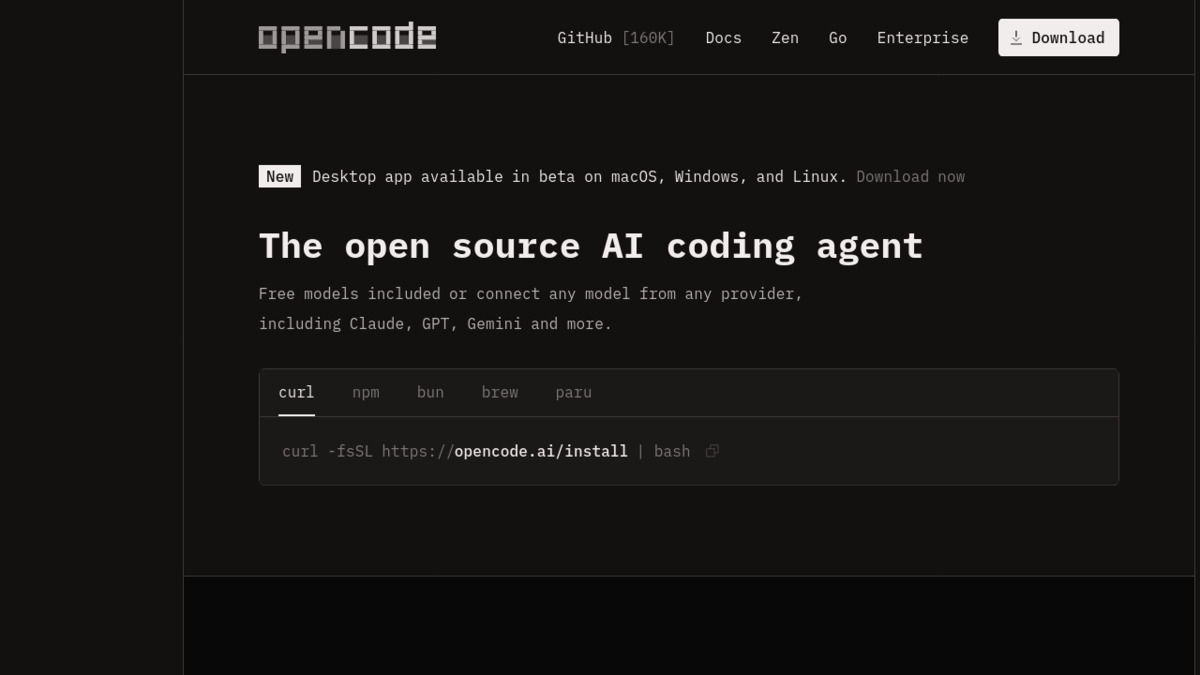
curl -fsSL https://opencode.ai/install | bash

# Or via npm
npm i -g opencode-ai
Also available through Homebrew, the AUR, and Nix. The desktop app - a Tauri-based wrapper - supports macOS, Windows, and Linux.
Connecting to a model takes one command:
opencode auth login --provider anthropic
Point it at any OpenAI-compatible endpoint by setting the base URL in config for local or custom models. The HTTP API mode allows mobile device control, which is how some teams use it for remote review workflows.
 OpenCode runs across terminal, IDE extension, and desktop app - all pointing at the same model config.
Source: opencode.ai
OpenCode runs across terminal, IDE extension, and desktop app - all pointing at the same model config.
Source: opencode.ai
OpenCode vs the Field
| Tool | GitHub Stars | Monthly Users | License | Provider Flexibility |
|---|---|---|---|---|
| OpenCode | 172K | 8M MAU | MIT | 75+ providers, local Ollama |
| Claude Code | 122K | Not disclosed | Proprietary | Anthropic only |
| Codex CLI | 83K | 3M weekly active | Proprietary | OpenAI + Amazon Bedrock |
| Cursor 3 | IDE-native | Not disclosed | Proprietary | Multi-model (curated) |
On raw benchmark speed, Codex CLI finishes comparable tasks in roughly 7 minutes versus OpenCode's 26 minutes with Claude. Codex CLI is written in Rust; OpenCode is TypeScript. The throughput gap is real and matters if you run OpenCode in agentic loops across large codebases.
Where It Falls Short
Speed is the most measurable gap. The 26-minute versus 7-minute benchmark difference is significant at scale, and it's structural - TypeScript agent orchestration won't close that gap through incremental optimization alone.
The growth and revenue numbers are self-reported without third-party verification. 8 million MAU doesn't automatically mean 8 million active daily or weekly users. The definition of "active" in monthly figures varies widely across companies and usually counts anyone who opened the tool at least once.
Background subagents and the Scout research agent are both recent additions. The GitHub repository shows 5,000+ open issues and 973 open pull requests - normal for a fast-moving open-source project, but not a signal of a settled codebase. Teams that need stability guarantees should test against their specific workflows before committing.
Browser automation is absent. Codex CLI ships a Chrome extension for browser-driven tasks. OpenCode doesn't have an equivalent, which matters for full-stack web development where frontend interaction is part of the loop.
The free MIT core is also a durability question. A large enough developer community can fork an MIT project and route around paid tiers completely. Anomaly's long-term monetization depends on whether Go and Black subscribers stick around once they understand the underlying architecture. At $10/month for Go, the price is low enough that most won't bother self-hosting - but the option exists, and that overhang is real.
Star counts are a noisy signal. But 172,000 stars built up in one year, on an MIT-licensed terminal tool with no vendor lock-in, is a different kind of signal than a proprietary tool with built-in distribution. OpenCode got here by making the agent layer cheap to adopt and the provider choice completely open. The question now is whether the monetization layer on top of that base is durable enough to support the team that built it.
Sources:

