
OpenAI Drops Sora to Chase Enterprise Revenue
OpenAI is shutting down its Sora video app and killing a $1B Disney deal as it pivots aggressively toward enterprise clients ahead of a public listing.
 7 min read
On March 24, OpenAI announced it was shutting down Sora. Not pausing it, not scaling it back - shutting it down completely. The Sora app closes in April 2026. The API goes dark in September. A $1 billion partnership with Disney, struck just three months earlier, died with it. Disney found out less than an hour before the public announcement.
That's a sharp reversal for a product OpenAI spent a year promoting as a breakthrough in AI creativity. The real story is what comes after: a company burning through capital at scale has decided consumer video isn't where the money is.
TL;DR
- Sora app shuts in April 2026, API in September - Disney's $1B licensing deal never closed
- Cost ran to roughly $1M per day; users fell from 1 million to fewer than 500,000
- CFO Sarah Friar wants revenue split to shift from 60/40 consumer/enterprise to 50/50 by end of 2026
- An additional $10B tranche confirmed on March 24, pushing total raised to over $120B at a $730B valuation
- Codex, not Sora, is the product OpenAI is betting on - 1.6 million weekly active users and growing
The Calculus Behind the Shutdown
Sora launched to paying subscribers in December 2024. Within six months it had attracted roughly 1 million global users. By January 2026, US App Store downloads had fallen 45% month-on-month. The compute cost of running video generation at that scale ran to around $1 million per day.
Those economics were always going to force a decision. Video generation is among the most compute-intensive tasks in AI - each generated clip pulls from the same pool of GPU capacity that OpenAI needs for its growing roster of enterprise clients. When those pools compete, video loses.
CFO Sarah Friar made the constraint explicit in a CNBC interview on March 24:
"We just are facing a lack of compute. We're having to make those really difficult decisions. It doesn't mean we won't get back into areas of creativity. It's not a 'never.' It's just a, 'We have to make hard choices.'"
The compute pressure is real at the macro level too. OpenAI initially touted $1.4 trillion in planned infrastructure commitments; that number has since been revised down to roughly $600 billion through 2030. Choices are being made, and video generation didn't survive the triage.
 The Sora video generation interface, shown at launch in late 2024. The app closes in April 2026, just over a year after its consumer debut.
Source: nbcnews.com
The Sora video generation interface, shown at launch in late 2024. The app closes in April 2026, just over a year after its consumer debut.
Source: nbcnews.com
The Disney Wreckage
The collateral damage extends well beyond the product itself. In December 2025, Disney announced a deal with OpenAI that included a $1 billion investment and a license for more than 200 characters across Disney, Marvel, Pixar, and Star Wars for use on Sora. Disney was also set to become a major API customer and roll out ChatGPT internally for its employees.
None of it closed. No money changed hands.
Disney's public statement was diplomatic: "We respect OpenAI's decision to exit the video generation business and to shift its priorities elsewhere. We appreciate the constructive collaboration between our teams and what we learned from it."
Behind that statement is a significant breakdown in execution. A company that negotiated a billion-dollar partnership failed to give its counterpart more than an hour's notice before a public shutdown announcement. That isn't a minor coordination error - it is the kind of thing that makes future partners cautious about commitments and timelines.
Following the Money: Sora vs. Codex
| Metric | Sora | Codex |
|---|---|---|
| Estimated monthly compute cost | ~$30M | Not disclosed |
| Weekly active users | <500,000 (peak ~1M) | 1.6M+ and growing |
| Revenue model | Consumer subscription | Enterprise B2B |
| Strategic direction | Shutting down | Actively expanding |
| Notable customers | General public | Cisco, Nvidia, Ramp, Rakuten, Harvey |
The numbers tell the story. Codex has more than three times Sora's remaining user base, a business revenue model, and an enterprise client list that reads like a target account sheet. Weekly active users tripled after the latest model release. The Mac desktop app hit 1 million downloads in its first week.
Friar's target is a 50/50 consumer/enterprise revenue split by the end of 2026. OpenAI currently sits at roughly 60% consumer, 40% enterprise. Getting to parity means accelerating enterprise revenue substantially - or actively culling consumer products that don't convert to business value. Sora's shutdown is an example of the latter.
 Sarah Friar, OpenAI's CFO, confirmed an additional $10 billion in funding on March 24 - the same day as the Sora shutdown announcement.
Source: wikimedia.org
Sarah Friar, OpenAI's CFO, confirmed an additional $10 billion in funding on March 24 - the same day as the Sora shutdown announcement.
Source: wikimedia.org
The $10 Billion Day
The Sora announcement shared a date with something else: Friar confirmed an additional $10 billion tranche in OpenAI's ongoing funding round, bringing the total raised to over $120 billion. New participants in this tranche include Andreessen Horowitz, D.E. Shaw Ventures, MGX, TPG, T. Rowe Price, and Microsoft.
The original round, closed in February at a $730 billion pre-money valuation, was anchored by Amazon's $50 billion commitment, plus $30 billion each from Nvidia and SoftBank. The round has now topped its initial $100 billion target. Post-money valuation sits at around $850 billion.
For context: OpenAI reported $13.1 billion in revenue for 2025. That puts the current valuation at roughly 65 times last year's revenue - a multiple that only works if enterprise growth is rapid, sustained, and margins improve clearly.
Friar on the IPO trajectory: "We have to build a company that's ready to be a public company... We do view this as all part of an access journey."
No exchange named, no timeline committed. But companies preparing for public markets don't carry consumer video products burning $1 million a day.
Counter-Argument: Is This Really an Enterprise Pivot?
The skeptical reading goes like this: OpenAI has 900 million weekly active users on ChatGPT. Consumer revenue is large and growing. Killing Sora isn't a pivot away from consumers - it's a decision that one specific consumer product, video generation, wasn't economically viable given current compute constraints. That's a product cut, not a strategy reversal.
That reading has merit. OpenAI is also merging its web browser, ChatGPT app, and Codex into a single desktop super-app - a heavily consumer-facing strategy. Friar's 50/50 target isn't a retreat from consumer revenue; it's an acceleration of enterprise revenue to catch up with a consumer business that's already large.
The counter-argument doesn't fully land, though. Video generation competed directly with enterprise GPU time and lost. If compute remains constrained - and the infrastructure spending revision suggests it is - other consumer products will face the same math. Sora was the first to fail it, not necessarily the last.
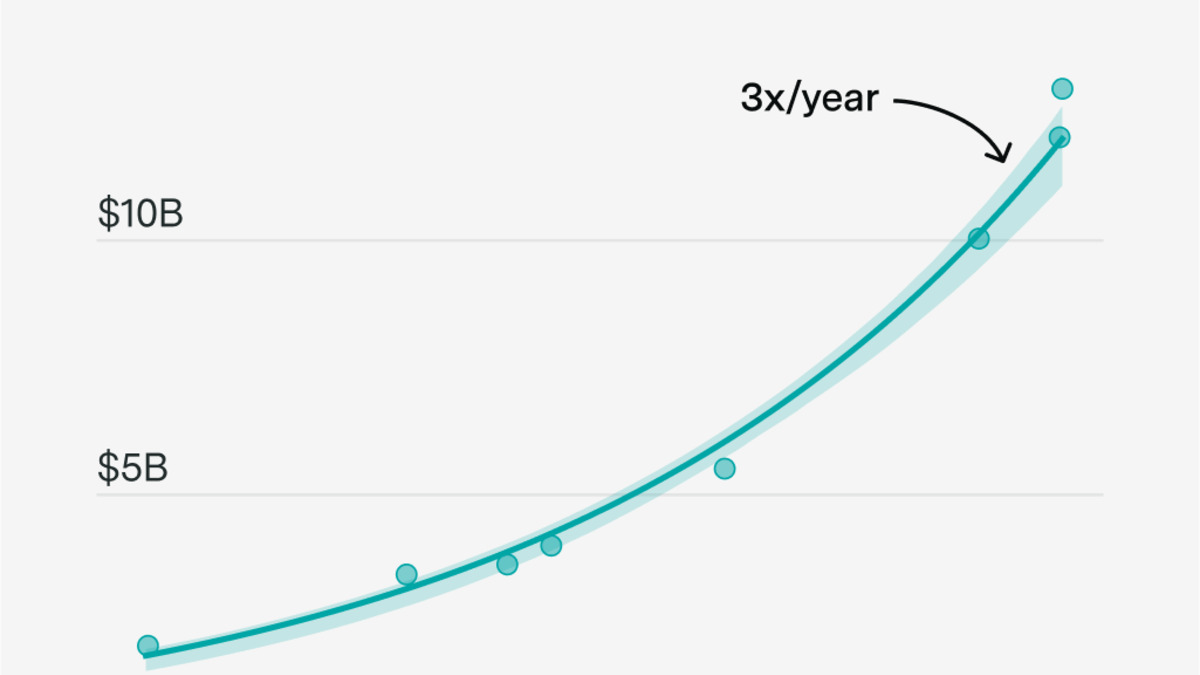 OpenAI's projected revenue trajectory, as analyzed by Epoch AI. Hitting those numbers requires enterprise adoption accelerating sharply through 2026.
Source: epoch.ai
OpenAI's projected revenue trajectory, as analyzed by Epoch AI. Hitting those numbers requires enterprise adoption accelerating sharply through 2026.
Source: epoch.ai
What the Market Is Missing
The Sora shutdown is being framed as a cost-cutting story. It's a prioritization story - and the thing being prioritized is the public listing.
At an $850 billion valuation, OpenAI needs a credible path to profitability. Consumer video with $30 million in estimated monthly compute costs and a shrinking user base isn't that path. Enterprise software is. Gross margins in B2B SaaS run 70-80%; enterprise AI at scale is structurally more attractive than subsidized consumer products, and the ARR trajectory across the major AI labs suggests the enterprise market is real and accelerating.
Fidji Simo, CEO of OpenAI's Applications division, told staff the company is "orienting aggressively" toward high-productivity enterprise use cases. That aligns exactly with what Friar is telling investors. When two senior executives use the same framing in the same week, with a product shutdown and a $10 billion funding announcement as backdrop, it's a coordinated positioning exercise, not a coincidence.
The open question is whether enterprise revenue can actually reach 50% of the total by year-end. If it falls short, the valuation arithmetic gets uncomfortable - and the discipline behind decisions like Sora's might need to become a recurring feature rather than a one-time correction.
Sources:
- TechCrunch - Why OpenAI really shut down Sora
- TechCrunch - Sora's shutdown could be a reality check moment for AI video
- Variety - OpenAI Will Shut Down Sora Video App; Disney Drops Plans
- The Decoder - OpenAI sets two-stage Sora shutdown
- Silicon Canals - Sora is dead: OpenAI cuts video division and a $1B Disney partnership

