
OpenAI Targets NATO Networks After Pentagon Deal
Days after securing a Pentagon classified network deal, OpenAI is exploring a contract to deploy AI on NATO's unclassified systems - a 32-nation alliance spanning North America and Europe.
 5 min read
The Pentagon ink was barely dry. Days after OpenAI secured a classified network deal with the US Department of Defense, Sam Altman told staff the company was looking at another military contract - this time with NATO.
The Wall Street Journal broke the story on March 4. An OpenAI spokesperson right away clarified a key detail: Altman had described the potential deployment as covering "all NATO IT environments," including classified systems. The actual opportunity is limited to unclassified networks.
That correction matters more than it sounds.
Key Specs
| Detail | Value |
|---|---|
| Status | Exploratory - no agreement signed |
| Scope | NATO unclassified networks only |
| Alliance size | 32 member nations |
| Use cases | Intelligence analysis, logistics, cyber defense, comms |
| Restrictions | No mass surveillance, no autonomous weapons |
| Context | Follows Pentagon classified deal (Feb 28, 2026) |
The Deal Shape
What Altman Said
At an internal company meeting, Altman acknowledged the reputational fallout from the Pentagon deal while framing the NATO interest as a natural extension of it.
"I think this was an example of a complex, but right decision with extremely difficult brand consequences and very negative PR for us," Altman told staff, according to reports.
He also described the Pentagon agreement as "definitely rushed," and admitted "the optics don't look good." The NATO expansion, from his framing, is more of the same: strategically necessary, PR-damaging, worth doing anyway.
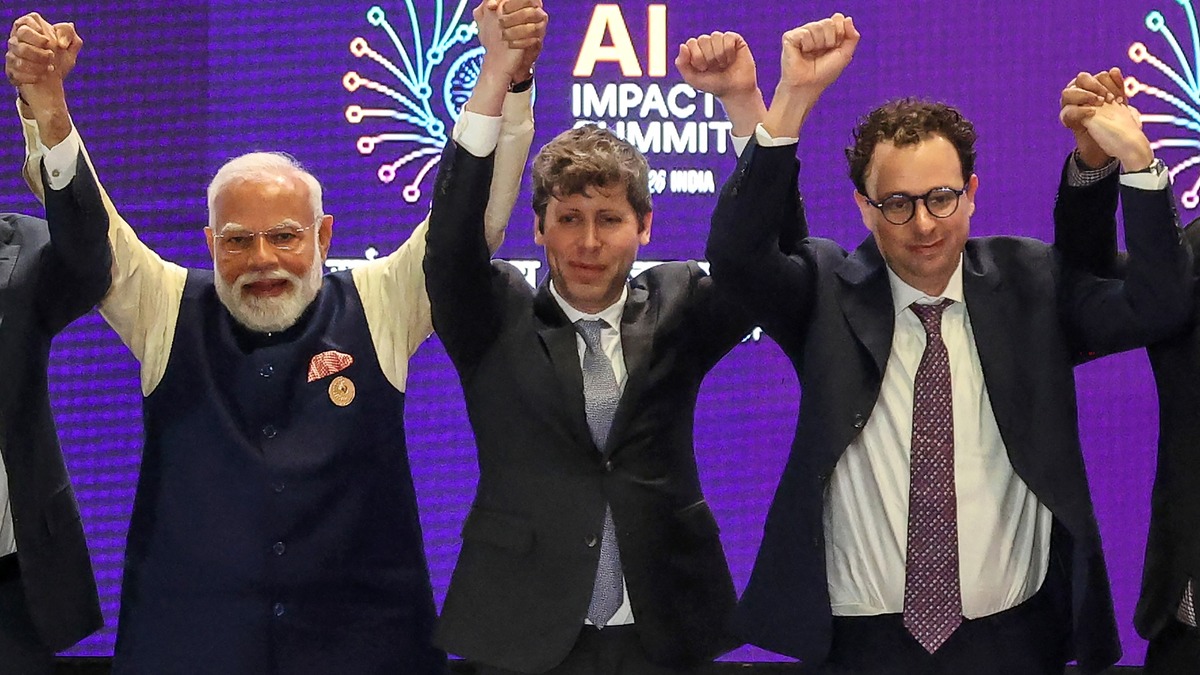 Sam Altman (center) at the India AI Impact Summit in New Delhi, February 2026 - a sign of OpenAI's aggressive push into international government relationships.
The context for why OpenAI is suddenly everywhere in defense: the Trump administration's decision to ban Anthropic from all federal agencies - after Anthropic refused to drop its restrictions on autonomous weapons and mass surveillance - effectively cleared the field for OpenAI in US defense AI contracts.
What NATO Gets
The proposed agreement would deploy OpenAI models on NATO's unclassified network infrastructure for four main categories of work:
- Processing large intelligence datasets across member states
- Logistics planning and supply chain coordination between allied forces
- Cyber threat detection and network security monitoring
- Communication analysis and translation across 32 nations
None of that touches the classified side. Weapons targeting, intelligence collection, and command-and-control systems are outside this scope - those require classification levels this contract explicitly doesn't cover.
The Infrastructure
OpenAI for Government
OpenAI launched its government-specific product tier in June 2025, initially limited to US agencies. The NATO exploration would mark its first non-US defense expansion. Government deployments run on a separate track from the commercial API, with additional access controls and audit logging.
The standard architecture for government deployments keeps model weights on government-controlled infrastructure, with access gated through federal identity management systems. Whether NATO's multi-nation environment - spanning 32 separate IT authorities with independent procurement rules - can accommodate that cleanly is an open engineering question that no spokesperson statement has addressed.
Unclassified vs Classified - the Line That Matters
NATO operates a strict separation between its unclassified infrastructure (routine coordination, logistics, open-source intelligence) and its classified networks (SECRET and COSMIC TOP SECRET, used for military operations and intelligence sharing). The Pentagon deal covers classified systems. The NATO proposal doesn't.
That distinction defines what's actually at stake here. Unclassified NATO networks handle a significant volume of administrative and coordination work - but the high-value intelligence and operational systems stay out of scope.
 NATO's unclassified networks handle inter-alliance coordination, logistics, and communication - distinct from the classified systems used for military operations.
Pentagon vs NATO - Deal Comparison
| Dimension | Pentagon Deal | NATO Proposal |
|---|---|---|
| Network classification | Classified | Unclassified |
| Status | Signed (Feb 28, 2026) | Exploratory |
| Geography | US only | 32 nations |
| Oversight authority | US DoD | Multi-nation NATO command |
| Documented use cases | Broad (unspecified) | Logistics, cyber, comms |
| Mass surveillance ban | No US person surveillance | Not yet specified |
| Autonomous weapons ban | Prohibited | Not yet specified |
| Public contract text | Not released | N/A |
The Pentagon deal's full contract text remains non-public, making direct comparison of technical safeguards difficult. OpenAI's stated red lines - no mass surveillance, no autonomous weapons - are the same conditions that got Anthropic banned from federal contracts when it asked for them.
What To Watch
32-Nation Consensus Is Hard
Launching AI across NATO's membership isn't like onboarding a single government customer. Each of the 32 member states maintains its own sovereign IT infrastructure, data sovereignty requirements, and regulatory environment. Germany operates under GDPR with strict requirements for data residency and algorithmic transparency. Turkey has its own domestic data laws. The US has completely separate frameworks for AI procurement.
Getting all 32 nations to agree on a single AI vendor's terms - and route coordination traffic through that vendor's models - is a governance challenge that no spokesperson statement has addressed.
The EU AI Act Question
A large share of NATO's unclassified infrastructure is operated from European soil, which means the EU AI Act's classification of AI systems in "law enforcement and border control" use cases could apply. The Act names many such systems as "high-risk," requiring transparency, human oversight, and technical documentation that OpenAI hasn't publicly committed to for its government tier.
OpenAI hasn't commented on how its government deployment complies with the EU framework for AI systems in security-adjacent applications.
Employee Backlash Is Not Over
The Pentagon deal triggered a 1.5 million person boycott petition and significant internal staff dissent. A NATO expansion - even restricted to unclassified networks - extends the company's military footprint across a 32-nation alliance. Whether OpenAI's technical workforce accepts the framing that "unclassified" makes this flatly different from weapons-adjacent work is unclear.
Altman's acknowledgment that the Pentagon deal had "very negative PR" suggests the company anticipates more of the same response here.
NATO Has Not Confirmed Anything
As of publication, the alliance has not responded to requests for comment. "Exploratory discussions" reported by one party do not constitute a deal in progress. Also, the original characterization - classified networks - was simply wrong. OpenAI's public communications on military partnerships have been consistently imprecise, requiring correction after the fact.
The gap between what Altman tells staff and what a spokesperson later confirms has become a pattern worth tracking.
Sources:
- Techzine: After Pentagon deal, OpenAI sets its sights on NATO
- Domain-B: OpenAI weighing contract to deploy AI on NATO networks
- The Star: OpenAI looking at contract with NATO, source says
- ResultSense: OpenAI in Talks for NATO AI Contract on Unclassified Networks
- StartupNews: OpenAI eyes NATO networks deal
- MarketScreener: Microsoft-Backed OpenAI Reportedly Eyeing Contract With NATO
