
OpenAI Launches GPT-Live, Bets Voice Beats Text
OpenAI launched GPT-Live-1 and GPT-Live-1 mini on July 8, replacing Advanced Voice Mode and making an explicit bet that voice will become AI's primary interface.
 6 min read
On July 8, OpenAI replaced its existing Advanced Voice Mode with two new models - GPT-Live-1 and GPT-Live-1 mini - and made a claim that cuts to the center of where the industry is heading: voice isn't a feature. It is, in the company's words, "the primary interface to computing."
That framing isn't incidental. OpenAI is positioning this as an infrastructure bet, not a product upgrade.
TL;DR
- GPT-Live-1 mini is now the default voice model for free ChatGPT users; GPT-Live-1 goes to paid Go, Plus, and Pro tiers
- Full-duplex design means the model listens and speaks at the same time, handling interruptions naturally, with complex tasks delegated to GPT-5.5 in the background
- OpenAI's strategic claim: voice will displace text as AI's default channel - worth taking seriously, with some caveats
A New Kind of Conversation
The old Advanced Voice Mode worked the same way most voice assistants do: speak, wait, hear a response. GPT-Live breaks that pattern. The full-duplex architecture means the model processes audio input while producing speech output simultaneously. Users can interrupt naturally. The model can acknowledge with a "yeah" or "mhmm" without losing its thread, or stay quiet while processing before responding.
For complex queries - web searches, multi-step reasoning, code generation - GPT-Live hands off to GPT-5.5 running in the background. Three configuration variants cover different use cases: GPT-Live-1 Instant uses GPT-5.5 Instant for speed-sensitive tasks, while the Medium and High variants route to GPT-5.5 Thinking with escalating reasoning depth. The model then brings those results back into the voice stream without breaking the conversation.
The benchmark case for improvement is τ³-Voice Telecom, a multi-turn customer support evaluation where GPT-Live beats its predecessor. On GPQA (expert-level science reasoning) and BrowseComp (agentic web search), OpenAI also reports sizable gains over Advanced Voice Mode. None of those benchmarks have been independently audited yet.
Safety constraints are baked in from launch. The model won't impersonate a named person's voice and operates from a limited set of approved voices. OpenAI says that protection is technical, not just policy.
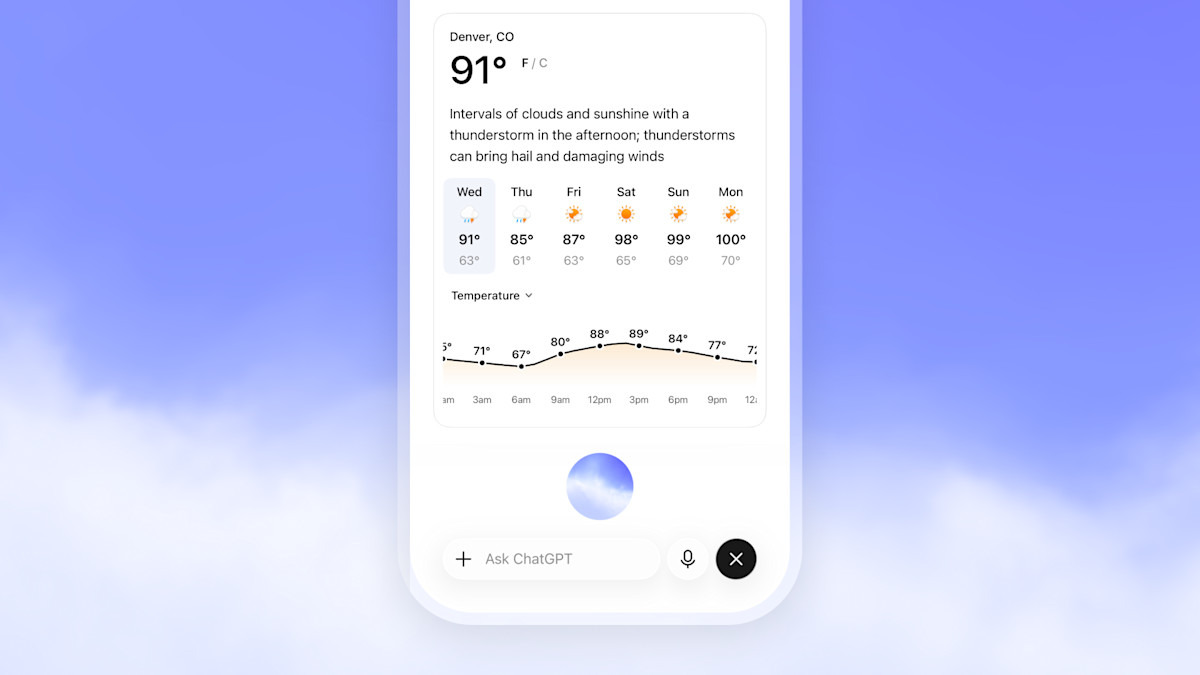 GPT-Live can surface visual answer cards - weather, maps, sports scores - during voice conversations, without breaking the audio stream.
Source: openai.com
GPT-Live can surface visual answer cards - weather, maps, sports scores - during voice conversations, without breaking the audio stream.
Source: openai.com
The Race for Your Ears
OpenAI isn't the first to run full-duplex voice at scale, but it's the first to put it in front of hundreds of millions of users as the default experience. The competitive landscape shows why the timing matters.
| Player | Product | Architecture | Reach | Remarkable Edge |
|---|---|---|---|---|
| OpenAI | GPT-Live-1 / mini | Full-duplex + GPT-5.5 backend | 900M weekly voice users | ChatGPT default; paid/free split |
| Gemini 3.1 Flash Live | Audio-to-audio | Google ecosystem | 90+ languages, Cloud integration | |
| xAI | Grok Voice | Not disclosed | Grok app / X platform | Built-in to X social layer |
| Cartesia | Sonic 3.5 Turbo | Specialized TTS/voice | API / enterprise | ~40ms latency for real-time apps |
| InWorld AI | Voice agents | Not disclosed | Gaming and simulation | Sub-250ms for interactive scenarios |
| Mistral | Voxtral | Open-source | Self-hosted / API | Developer control, no vendor lock-in |
OpenAI's position is structural, not just technical. Serving 900 million weekly voice users gives it training signal that no startup or even Google can easily copy. Every conversation where GPT-Live-1 handles a ten-minute phone call or a walk-and-talk session becomes data for the next iteration. The moat is the user base.
Google's Gemini 3.1 Flash Live is the most direct rival on capability - 90+ language support and tight Cloud integration give Google an enterprise angle that OpenAI's current product doesn't match. GPT-Live's Hindi demo at launch showed "a heavy American accent" with what one reviewer described as "unnatural sounding, bookish tone." That isn't a minor rough edge in a global market.
Users have been conducting 30- to 40-minute-long conversations with the voice feature during walks.
Atty Eleti, OpenAI's product lead for GPT-Live, said that to make the case for voice as a serious interface - not a novelty. Half-hour conversations on a walk are not a search query use case. They're closer to having an assistant who travels with you.
The Counter-Argument
Voice has real advantages for a specific set of tasks: accessibility, hands-free operation, long-form thinking out loud, language learning. OpenAI's data on extended conversations suggests genuine engagement beyond simple lookups.
However, the use cases where voice loses to text are several. Open offices and shared spaces make spoken AI interaction impractical for most knowledge workers. A typed ChatGPT conversation is searchable, quotable, and shareable. A voice conversation isn't, unless the product adds transcription (which GPT-Live doesn't yet emphasize). Legal, medical, and financial contexts often require a text trail by policy.
The API is also not available at GPT-Live's launch. Developers and enterprise teams who want to build products on this architecture can sign up for a notification list. That gap matters - most of the enterprise voice agent market runs on API integrations, not direct ChatGPT usage. Mistral's Voxtral, released open-source, is already building mindshare in the developer community exactly because it doesn't come with a waitlist.
The multilingual gap is the hardest one to wave away. If voice is the primary interface, then 80% of the world's internet users, who don't speak English as a first language, get a worse product. That isn't a launch-day limitation that fixes itself in two weeks.
 OpenAI's launch video focused on accessibility use cases - extended conversations for users who find text-based AI harder to navigate.
Source: openai.com
OpenAI's launch video focused on accessibility use cases - extended conversations for users who find text-based AI harder to navigate.
Source: openai.com
What the Market Is Missing
The consumer ChatGPT story is the obvious angle. The less obvious one is what happens when the API goes live.
Voice agents for enterprise customer service, healthcare intake, and accessibility tooling represent a market that production deployments have grown 340% year-over-year across 500+ organizations, according to industry data. OpenAI's API pricing for previous realtime models ran at $4 per million input tokens and $64 per million audio output tokens - expensive enough that specialized vendors like Cartesia and ElevenLabs built businesses around the cost gap. GPT-Live's API pricing hasn't been set yet, which gives OpenAI room to reprice the market once the waitlist opens.
The earbuds angle is also real. Reports through 2026 have flagged potential OpenAI hardware including an audio device. If GPT-Live-1 becomes the engine in an always-on earpiece, the "primary interface" claim stops being a marketing line and becomes a literal product description.
Voice AI agents market is projected to grow from $2.4 billion in 2024 to $47.5 billion by 2034 at a 34.8% annual rate. OpenAI is shipping today to capture the consumer end of that curve. The API delay means it's ceding the enterprise end to competitors for now - though probably not for long.
Sources:
- Introducing GPT-Live - OpenAI
- OpenAI Releases GPT-Live and GPT-Live-1 mini - MarkTechPost
- OpenAI releases new voice models for natural conversations - TechCrunch
- OpenAI bets voice will become AI's primary interface - Axios
- OpenAI Unveils GPT-Live as Voice Competition Heats Up - Benzinga
- GPT-Live targeting 300ms latency - Silicon Report
- Voice AI Statistics 2026 - Ringly.io
- Voice AI Market Trends and Growth - VoiceAIWrapper

