
ChatGPT Expands Into Commerce with 14 App Partners
OpenAI launches an Apps SDK and 14 third-party integrations for ChatGPT, turning the chatbot into a transactional platform for food delivery, travel, music, and design.
 7 min read
OpenAI is no longer content to be a search replacement. With the launch of an Apps SDK and 14 confirmed integration partners, ChatGPT is positioning itself as a commercial action layer - the interface through which users don't just ask questions but book rides, order groceries, plan trips, and build websites.
TL;DR
- 14 third-party apps now integrated into ChatGPT at launch, including Spotify, Uber, DoorDash, Expedia, Figma, Canva, and Zillow
- Built on MCP (Model Context Protocol), an open standard - integrations aren't ChatGPT-exclusive
- Available now in US and Canada only; EU and UK excluded due to GDPR and related regulations
- OpenAI's previous in-chat checkout experiment failed five days ago; this is a different architecture
- 800 million users is the audience OpenAI is dangling in front of partners
The timing is hard to ignore. On March 9, OpenAI killed Instant Checkout - its attempt to handle purchases directly inside the chat window - after near-zero conversion rates. Five days later, the company launched a completely different approach: rather than embedding checkout into the chat, ChatGPT now hands off to partner apps at the moment of transaction. OpenAI takes the discovery and intent layer; the partners close the sale.
The Deal Structure
The Apps SDK, built on the Model Context Protocol (MCP), lets developers build integrations that surface inside ChatGPT. Users interact with third-party services without leaving the chat window, then complete transactions in the partner app. Revenue, payment processing, and liability all stay with the partner. OpenAI supplies reach.
| Partner | Category | Action in ChatGPT | Transaction Completes |
|---|---|---|---|
| Spotify | Music | Create playlists, discover artists | Spotify app |
| DoorDash | Food delivery | Build meal plans, populate cart | DoorDash app |
| Uber / Uber Eats | Rides / Food | Set trip parameters or browse restaurants | Uber app |
| Expedia / Booking.com | Travel | Search flights and hotels by budget and date | Expedia / Booking |
| Figma | Design | Generate diagrams and flowcharts | FigJam |
| Canva | Design | Create presentations, posters, social graphics | Canva |
| Zillow | Real estate | Filter home listings by price and location | Zillow |
| Target | Retail | Get gift suggestions, build carts | Target app |
| Wix | Web creation | Describe a website, get a functional site | Wix |
| Angi | Home services | Ask questions, receive professional quotes | Angi |
| Quizlet | Education | Convert notes into flashcard sets | Quizlet |
| Coursera | Learning | Compare courses by rating and cost | Coursera |
Coming later in 2026: Instacart, OpenTable, PayPal, Walmart, AllTrails, and Peloton.
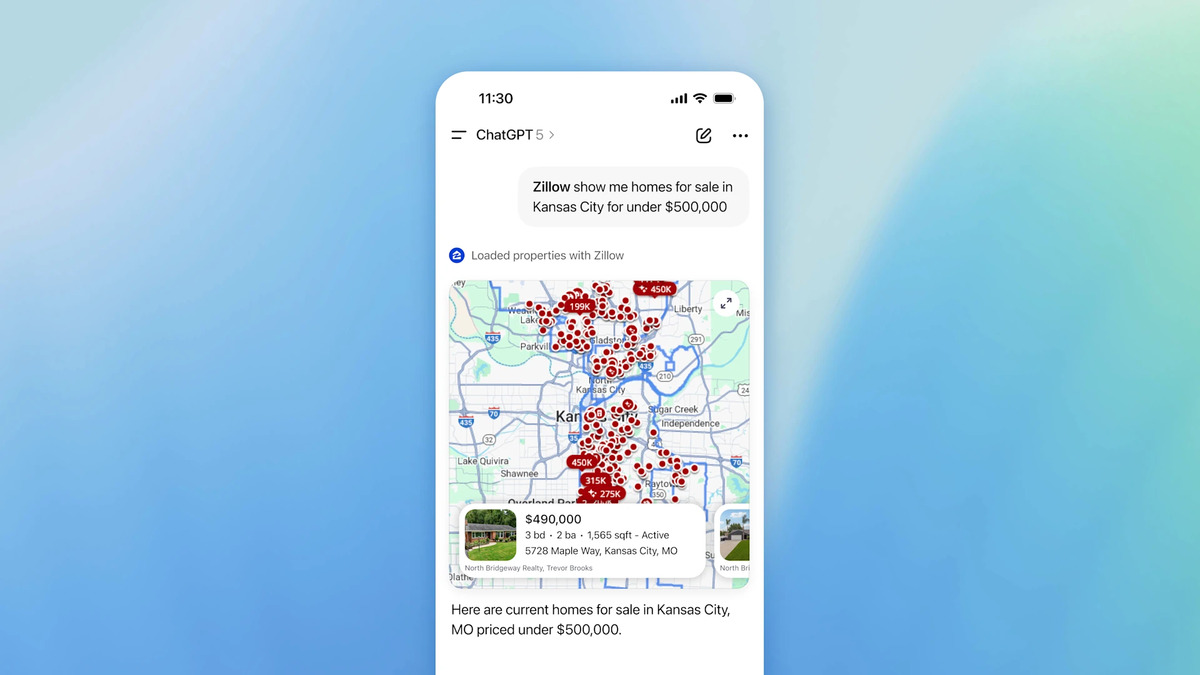 The new ChatGPT interface showing app integrations - users stay in the chat window while interacting with third-party services.
Source: tomsguide.com
The new ChatGPT interface showing app integrations - users stay in the chat window while interacting with third-party services.
Source: tomsguide.com
Who Benefits
The partners get distribution
For DoorDash, Uber, and Spotify, the pitch is clear: ChatGPT puts them in front of 800 million users at the precise moment those users are thinking about food, travel, or music. Conversion intent is high. There's no auction, no ad spend, no competing for Google ranking. If ChatGPT surfaces DoorDash when a user asks for meal-plan help, DoorDash gets the cart without paying for the click.
The architecture also matters for the partners' data position. Because transactions complete inside the partner apps, those companies keep full transaction records, customer relationships, and behavioral data. OpenAI doesn't sit between the user and the purchase - it just routes the traffic.
OpenAI gets stickiness
A ChatGPT session that books a flight and creates a Spotify playlist is more valuable than one that answers a trivia question. Deeper integrations mean longer sessions, more return visits, and a stronger argument against switching to a rival AI interface. If users start booking Uber rides through ChatGPT, that's a behavior that's truly hard to reproduce elsewhere quickly.
There's also a strategic play on discoverability. OpenAI's framing to marketers is explicit: brand visibility in ChatGPT is the new SEO. Companies that aren't in the app ecosystem risk being invisible when the chatbot decides what to recommend.
 ChatGPT on iPhone - the mobile interface is where most of these commerce integrations will see real-world use.
Source: techcrunch.com
ChatGPT on iPhone - the mobile interface is where most of these commerce integrations will see real-world use.
Source: techcrunch.com
Who Pays
The integration partners carry the hidden costs
Membership in OpenAI's app ecosystem is marketed as free. But it isn't. Building and maintaining an MCP integration requires engineering resources. The SDK adds dependencies. Any change OpenAI makes to the platform or the model affects behavior downstream. Partners are building on top of a platform they don't control, with no published SLA, and with no guarantee their integration won't be deprioritized if a competitor pays for placement in a future monetization tier.
The geographic restriction is also a real cost. The EU and UK are excluded at launch due to GDPR and related data regulations. For Expedia or Booking.com - both businesses that depend heavily on European travel - that's a sizable portion of their addressable market locked out from day one. OpenAI says it "expects to bring apps to EU users soon," which is a non-commitment.
Small developers face structural disadvantage
The initial 14 partners are all established consumer platforms with brand recognition and engineering bandwidth. The public app directory isn't live yet - it's on the roadmap. Until that directory launches, discoverability for smaller integrations depends completely on how OpenAI surfaces them, which introduces a gatekeeper problem the company hasn't addressed publicly.
The MCP-based architecture does offer one meaningful protection for developers: because MCP is an open standard, integrations built for ChatGPT can theoretically run on any AI platform that adopts the protocol. Partners aren't entirely locked in. But in practice, with 800 million users on one platform and a fraction of that on alternatives, the leverage still sits with OpenAI.
The Abandoned Checkout Connection
The failure of Instant Checkout - OpenAI's attempt to embed purchase flows directly inside ChatGPT - is worth reading against this launch. The checkout product put OpenAI in the payment flow, which meant regulatory exposure, fraud liability, and the need to negotiate directly with payment processors. Conversion rates were near zero.
The Apps SDK approach is structurally simpler: OpenAI handles discovery, partners handle the transaction. That's a better division of liability than running a checkout system. It's also faster to scale - adding a new integration is an SDK exercise, not a new commercial agreement with a payment processor.
What it doesn't answer is long-term monetization. OpenAI hasn't disclosed whether it takes a revenue share from partner transactions, charges for placement in the future app directory, or plans another model completely. The Agentic Commerce Protocol - described in OpenAI's developer docs as a future in-chat checkout mechanism - is listed as a roadmap item, suggesting the company hasn't given up on capturing the transaction layer. It's just taking a different path to get there.
 Sam Altman at a recent speaking engagement. The ChatGPT apps launch fits his stated vision of AI as a utility layer spanning every digital interaction.
Source: gizmodo.com
Sam Altman at a recent speaking engagement. The ChatGPT apps launch fits his stated vision of AI as a utility layer spanning every digital interaction.
Source: gizmodo.com
What the Market Is Missing
The coverage of this launch has focused on which apps are available and how to use them. That's the wrong frame for understanding what OpenAI is doing here.
This is a platform bet. OpenAI is trying to reproduce the economic structure of the App Store or the Google search ecosystem inside an AI interface - a walled garden where partners compete for AI-mediated visibility, users complete transactions without switching context, and the platform owner controls discoverability. The MCP foundation gives it an open-standard veneer, but the business logic is thoroughly closed-platform thinking.
Whether it works depends on two variables: whether users actually change their behavior (do they book a flight through ChatGPT instead of going directly to Expedia?) and whether OpenAI can convert that behavioral change into revenue before a competitor with deeper model capabilities or better platform terms undercuts it.
Neither of those variables is clear yet. What's clear is that the total addressable market OpenAI is targeting is enormous, the partners are credible, and the architecture is more sustainable than the one it just abandoned.
The one-sentence verdict: OpenAI found a cleaner way to own the commerce layer after its checkout experiment failed - the partners get distribution, OpenAI gets the data and the session time, and users get convenience, as long as they live in North America.
Sources:

