
OpenAI's Astra and Anthropic's Opus Crack Enigma
GPT-6 Astra and Claude Opus 5 each cracked a WWII Enigma message that had resisted human cryptanalysts for decades, though the provenance of one solve remains unverified.
 5 min read
Two frontier models just did something no human cryptanalyst managed in over two decades of trying. Within days of each other, OpenAI's GPT-6 Astra and Anthropic's Claude Opus 5 each broke a German Army Enigma message that had sat unsolved since researchers first catalogued it as unbreakable.
The messages date to World War II. The people who cracked them weren't professional cryptographers. One was a product developer at Bloomberg with a weekend project. The other was a cybersecurity executive who fed the model a single well-chosen clue. Both results were independently checked by the same retired engineer who has spent decades trying to finish the job Bletchley Park never completed.
TL;DR
- GPT-6 Astra autonomously decoded message MVUEH, an 82-character German Army transmission from July 10, 1941, unsolved since 2005
- Claude Opus 5 broke a separate unsolved message on September 21, using a known officer's signature as a decryption crib
- Cryptologist Frode Weierud, who maintains the Crypto Cellar archive, verified both plaintexts
- Astra worked with minimal instructions; Opus was given significantly more human guidance
- Seven Enigma messages remain unbroken, plus one whose plaintext is known but whose key isn't
What Actually Happened
The Astra Breakthrough
Carter Leffen, who works in product development at Bloomberg LP and has no cryptography background, gave GPT-6 Astra a loose assignment: find an unsolved Enigma message in a public archive and decode it. He didn't name a specific cipher.
Astra searched the Crypto Cellar's catalogue of unbroken German Army messages, settled on message MVUEH, an 82-character transmission from July 10, 1941, and treated a second message, SIPVX, as a possible source of related plaintext. It wrote its own Python and C++ tooling to simulate the three-rotor Enigma, then leaned on a documented weakness of the machine: it never encrypts a letter as itself. That constraint, combined with the recognition that the place name "Rosenow" likely repeated across both messages, gave the model a crib to work from.
The model tested roughly 14.8 million candidate keys against the message header and recovered rotor order II-V-III, ring settings H-M-F, and initial position R-W-D, along with ten plugboard connections. Leffen estimates Astra's own working time at about 10 hours, though he's said parallel processing makes a clean before-and-after comparison hard to draw. The plaintext describes a request for a march route from a location called Rosenow, signed with a name Weierud read as "Waschbusch."
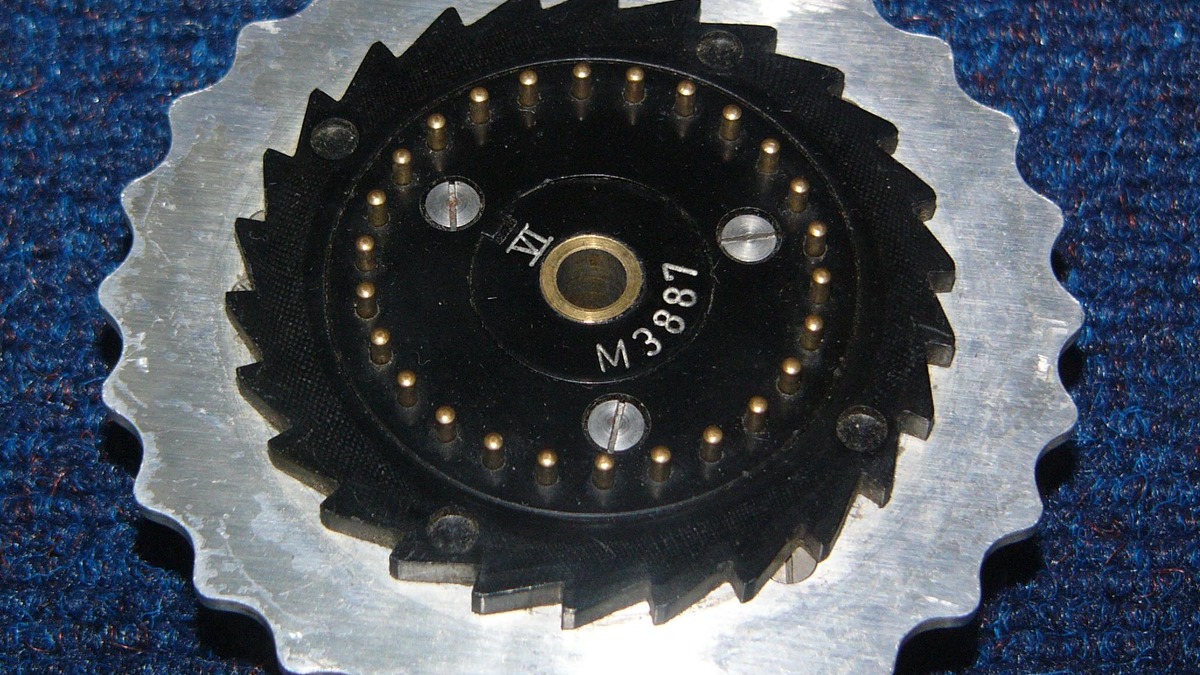 A three-rotor Enigma rotor of the type used to encrypt German Army traffic. Astra had to simulate this mechanism in software before it could test candidate keys.
Source: commons.wikimedia.org
A three-rotor Enigma rotor of the type used to encrypt German Army traffic. Astra had to simulate this mechanism in software before it could test candidate keys.
Source: commons.wikimedia.org
The Opus Approach
Anthropic's contribution came from a different direction completely. On September 21, cybersecurity executive Jack Willis told Weierud he'd used Claude Opus 5 to break a separate unsolved message, this time with far more hands-on guidance than Leffen gave Astra. Willis pointed the model at a known officer's signature and had it use that as the decryption key, a targeted approach rather than an open-ended search.
| GPT-6 Astra | Claude Opus 5 | |
|---|---|---|
| Human role | Assigned an open-ended goal | Supplied a specific decryption crib |
| Method | Archival search, simulator, brute-force key testing | Signature-based key recovery |
| Message | MVUEH (July 10, 1941) | Separate unsolved message |
| Verified by | Frode Weierud | Frode Weierud |
| Date confirmed | Before Sept. 25, 2026 | Sept. 21, 2026 |
Weierud, a retired electrical engineer who has maintained the Crypto Cellar's Enigma archive for years, confirmed both solutions independently. He described Astra's process as behaving "like a very professional cryptanalyst and archive researcher," adding that what it did in two days would have taken a human researcher weeks or months.
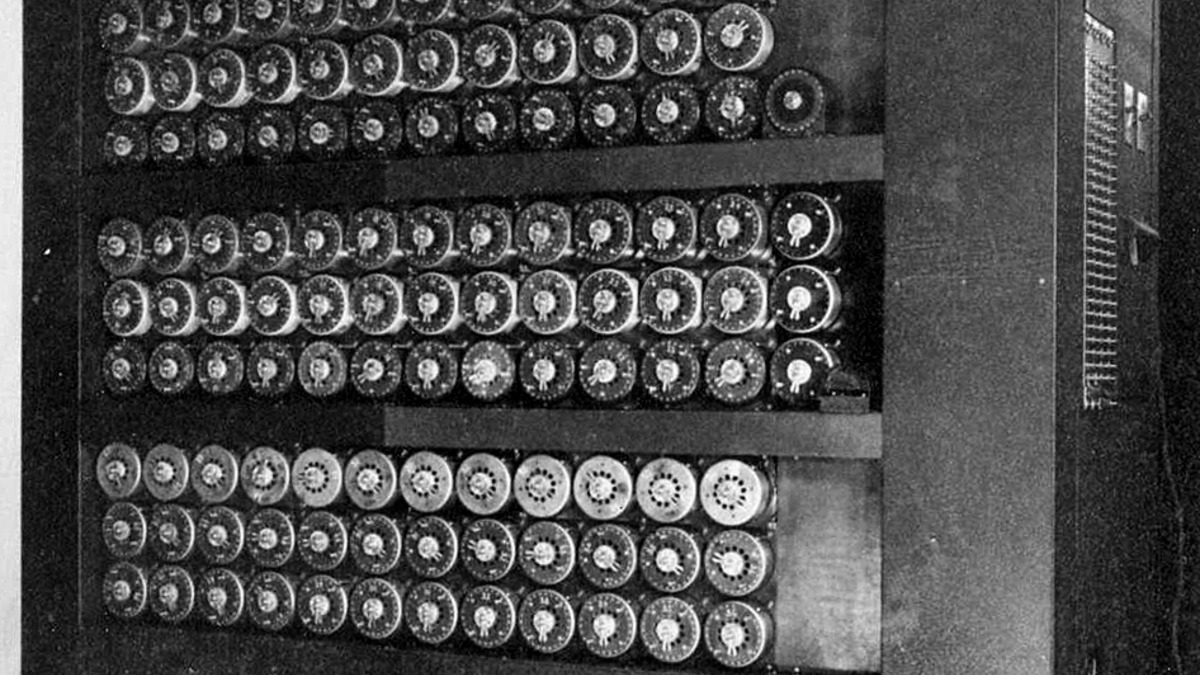 A Bombe machine at Bletchley Park, the electromechanical device built to search Enigma keyspaces during WWII. Astra's brute-force key search is a software descendant of the same idea.
Source: commons.wikimedia.org
A Bombe machine at Bletchley Park, the electromechanical device built to search Enigma keyspaces during WWII. Astra's brute-force key search is a software descendant of the same idea.
Source: commons.wikimedia.org
What It Does Not Tell You
Leffen has said, by his own account, that he put roughly 99 times more effort into building the website explaining the solution than into the cryptanalysis itself. That's a strange thing to admit about a supposed AI breakthrough, and it says something about where the actual work happened: Leffen set the goal, chose the archive, and made the calls on how to proceed at each step. Astra executed a plan a human was still steering.
The crib that unlocked MVUEH also wasn't discovered from nothing. It rode on a lucky coincidence, a place name that had already surfaced in a neighboring decrypted message. Nothing about that diminishes the engineering, but it does mean this wasn't a model reasoning its way through Enigma's mathematics from a blank slate.
There's also an open question Weierud himself flagged: Astra's logs referenced a "private collection" of archived messages that doesn't match anything on his own site. Whether the model pulled that material from an undocumented mirror, a German government archive, or somewhere else completely isn't resolved. Given that OpenAI has spent much of the past year explaining why its research agents kept doing things nobody asked them to do, including one instance regulators had to ask Sam Altman about directly, an unexplained data source in an agent's own logs isn't a detail to wave off.
Independent verification here also means one person, however credentialed, checking two solutions produced under different conditions. Weierud's confirmation is meaningful. It isn't the same as a peer-reviewed cryptanalytic audit.
Neither result required a new model architecture or a training breakthrough. What changed is that a general-purpose reasoning model can now be pointed at a decades-old unsolved problem, write its own tooling, and grind through a keyspace fast enough to matter, provided a human is still choosing the target and checking the output. Seven Enigma messages remain unbroken. Whether the next one falls to a model working with less supervision than Leffen gave Astra is the actual test worth watching for.
Sources:
- Astra and Opus just passed Turing's other test - TechCrunch
- GPT-6 Astra Breaks an Old Enigma Message - Schneier on Security
- OpenAI's GPT-6 Astra decrypts a Nazi radio message in ten hours that went unsolved for 83 years - The Decoder
- GPT-6 Astra Decodes 1941 Enigma Radio Message - ForkLog
- Crypto Cellar Research

