
OpenAI Acquires Astral - uv and Ruff Join Codex
OpenAI is acquiring Astral, the startup behind Python's dominant uv package manager and Ruff linter, folding critical developer infrastructure into its Codex coding agent team.
 6 min read
OpenAI has agreed to acquire Astral, the startup behind two tools that have quietly become load-bearing infrastructure for modern Python development. The deal, announced March 19, 2026, brings uv, Ruff, and the newer ty type checker under the same roof as the Codex coding agent - the product OpenAI has explicitly positioned as the future of software development.
Financial terms weren't disclosed. The acquisition is subject to regulatory approval and customary closing conditions. Until the deal closes, the two companies will operate separately.
TL;DR
- OpenAI acquiring Astral in a deal of undisclosed size; terms not public
- Astral's three tools - uv, Ruff, and ty - are downloaded hundreds of millions of times per month
- Astral team joins OpenAI's Codex engineering group
- Founder Charlie Marsh says all three tools will remain open source
What Astral Actually Built
Astral was founded to solve one problem: Python's toolchain is slow and fragmented. The company wrote three tools in Rust to fix that.
uv: The Package Manager
uv replaces pip, pip-tools, and Poetry for dependency resolution and package installation. It claims speeds 10 to 100 times faster than pip - a number that holds up for anyone who has run both on a large project. It also handles Python version management, virtual environments, and project metadata in a single binary. As of early 2026, it had crossed 500 GitHub contributors.
Ruff: The Linter
Ruff replaces Flake8, Black, isort, pydocstyle, and a dozen other tools. It runs 800+ lint rules and formats code in under 10ms per file. Adoption was unusually fast: projects that took months to migrate from older tools moved to Ruff within weeks once developers clocked the speed difference. It now ships as the default formatter in various Python-first projects and editors.
ty: The Type Checker
ty is Astral's newest product - a type checker built to compete with mypy and pyright. It has not reached the same adoption as uv or Ruff, but the same Rust-based performance approach applies. Combined, the three tools reach hundreds of millions of downloads per month.
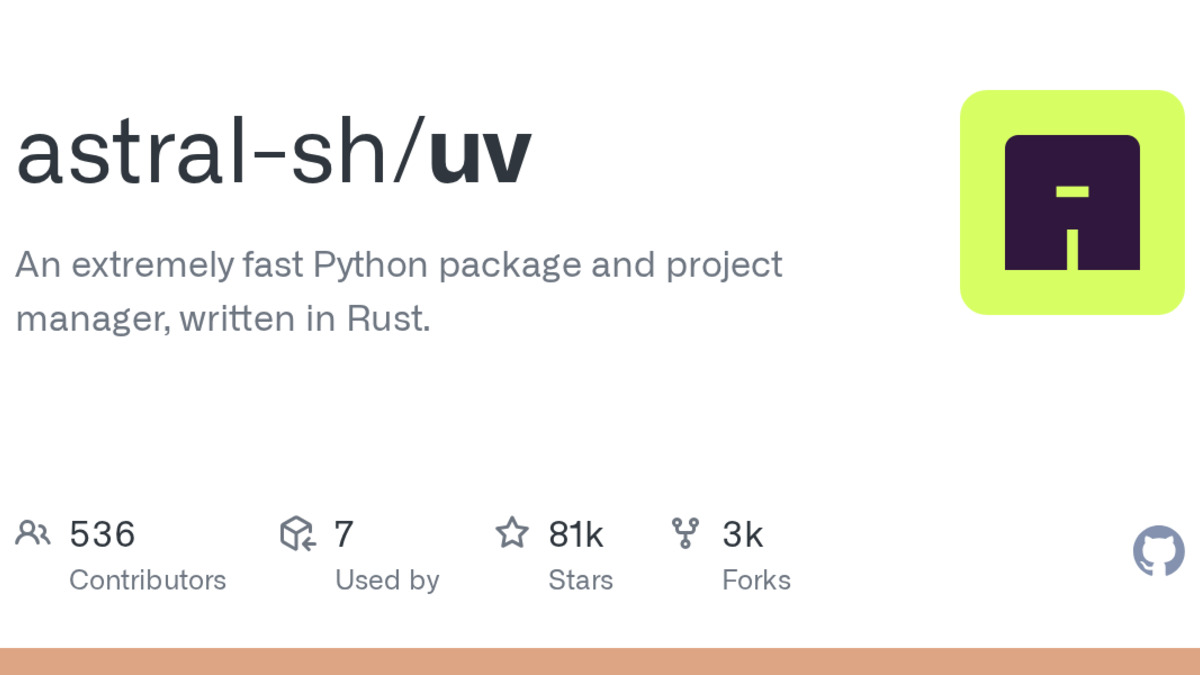 The astral-sh/uv repository on GitHub, with contributions from over 500 developers worldwide.
Source: github.com
The astral-sh/uv repository on GitHub, with contributions from over 500 developers worldwide.
Source: github.com
The Codex Connection
OpenAI's announcement ties the acquisition directly to Codex, its AI coding agent. Codex had 2 million weekly active users as of early 2026, with token usage up 5x since December 2025. The team is roughly 40 engineers, built specifically around the premise that AI agents should handle the entire software development lifecycle - not just produce code, but plan changes, run tools, verify results, and manage state.
Where uv and Ruff Fit
A coding agent that writes Python code eventually runs into the same problems any Python developer runs into: dependency conflicts, unformatted output, type errors, failing lint checks. Right now, Codex resolves those issues by calling external tools. With uv and Ruff part of the same organization, the integration path is shorter and the feedback loop tighter.
"As part of Codex, we'll continue evolving our open source tools to push the frontier of software development," Charlie Marsh wrote in the Astral blog post.
The stated goal is to have Codex "work more seamlessly" with the tools already in developers' workflows - meaning less configuration, more automatic handling of the packaging and linting steps that currently interrupt agentic coding sessions. Our review of the Codex app noted that multi-step task execution still required manual intervention on dependency issues; this acquisition addresses exactly that gap.
The Open-Source Question
Astral's tools are permissively licensed and have hundreds of contributors outside the core team. That community has a reasonable question: what happens now?
What Marsh Committed To
The Astral post is explicit. The tools will remain open source. The company will "keep building in the open, alongside our community." Marsh frames the acquisition as an extension of the original goal: "Open source is at the heart of that impact and the heart of that story."
These aren't empty gestures - the MIT and Apache licenses on the tools mean any fork is trivially legal. The community backstop exists.
What the Community Is Saying
Reaction on Hacker News was more cautious. The most upvoted thread reached 550 points but the comments center on a single concern: OpenAI, as a steward of critical Python infrastructure, is a company that by multiple accounts spends significantly more than it earns. A financially stressed owner doesn't make ideal infrastructure custodian.
Some comments went further, pointing to a broader pattern: AI labs acquiring the toolchain their agents create code with, creating vertical integration over the developer stack.
One commenter with over 20 years in the industry put it plainly: "Only time will tell if it will not affect the ecosystem negatively." Astral employees responded on the thread, pushing back on characterizations of the acquisition as forced by funding pressure.
 Charlie Marsh, Astral founder and creator of uv and Ruff, will join OpenAI's Codex engineering team.
Source: github.com
Charlie Marsh, Astral founder and creator of uv and Ruff, will join OpenAI's Codex engineering team.
Source: github.com
What This Deal Does Not Tell You
OpenAI's announcement page was behind a bot challenge at time of writing, which made independent verification of specific language harder than usual. Several points from the public-facing blog post warrant more scrutiny.
The Missing Numbers
Financial terms are undisclosed. That's common for acquisitions of this type, but Astral had backing from Accel and Andreessen Horowitz - two firms not known for exiting quietly unless the terms suit them. The absence of a number doesn't mean the deal is small. It also does not mean it is large.
The Regulatory Clause
The deal is "subject to regulatory approval and customary closing conditions." This is standard language, but given the current political and regulatory focus on AI company consolidation - especially in the US and EU - it's worth tracking. OpenAI has an ongoing AWS partnership worth tens of billions; a developer tools acquisition is less likely to attract scrutiny, but the clause is there.
The Timing
uv crossed 1 million daily active users sometime in late 2025. Ruff ships as a default in major Python projects. Astral could have raised another round at a strong valuation. The fact that it didn't - that the founders chose to sell now, to OpenAI specifically - is the part of this story that remains unexplained.
Codex has been OpenAI's most direct answer to Claude Code and competing AI coding tools. What this acquisition does is move the company from generating Python code to owning the tools that install its dependencies, check its types, and format its output. That's a meaningful difference in market position - and it is the kind of vertical move that looks gradual until it doesn't.
Sources:

