
OpenAI's $122B Round Adds Retail Access Before IPO
OpenAI closed its funding round at $122 billion and $852 billion valuation on March 31, with $3 billion going to retail investors via banks for the first time.
 6 min read
OpenAI's funding round, which closed in February at $110 billion, didn't actually stop there. On March 31, the company announced the round had grown to $122 billion and the valuation had risen from $730 billion pre-money to $852 billion post-money. The extra $12 billion came with two firsts: retail investors got in for the first time, and SoftBank began transferring its cash in quarterly tranches, the first of which landed today.
TL;DR
- Round grew from $110B (Feb close) to $122B (March 31 final close)
- Post-money valuation: $852 billion - up from $840B at the February close
- $3 billion went to retail investors via three unnamed bank channels, the first time private OpenAI equity has been accessible outside institutional investors
- SoftBank's $30B is split into three quarterly tranches; the first $10B transferred today, April 1
- Amazon's $50B includes $15B in immediate cash and $35B conditional on an IPO or AGI milestone
- OpenAI is targeting a Q4 2026 IPO and has disclosed plans for a consolidated "super-app"
The Round That Kept Growing
When OpenAI first announced the round in late February, it looked like a clean close. Three anchor investors, $110 billion, done. Instead, another month passed and the number kept climbing. By March 24, CFO Sarah Friar confirmed to CNBC that the round had grown by more than $10 billion. A week later, the final number came in at $122 billion.
The additional capital came mainly from the retail tranche - $3 billion distributed through three major bank channels, with names not yet disclosed. It also reflects upward pressure from later institutional entrants including ARK Invest, which will include OpenAI shares in multiple ETFs.
| Round stage | Total raised | Valuation | Date |
|---|---|---|---|
| Initial announcement | ~$100B discussed | $850B rumored | Feb 2026 |
| February close | $110B | $730B pre-money / ~$840B post | Feb 27, 2026 |
| CNBC top-up confirmation | $120B+ | Not stated | Mar 24, 2026 |
| Final close | $122B | $852B post-money | Mar 31, 2026 |
The $852 billion figure makes OpenAI one of the ten most valuable companies in the world by market capitalization - private or public. For context, that's roughly double what Mistral raised in a Paris data center deal for its entire year of fundraising, concentrated in one round.
 Sam Altman at TED. OpenAI's Q4 2026 IPO is now firm company guidance.
Source: commons.wikimedia.org
Sam Altman at TED. OpenAI's Q4 2026 IPO is now firm company guidance.
Source: commons.wikimedia.org
Who Benefits
Retail investors - sort of
The $3 billion retail tranche gets the headline for novelty, but the numbers require context. Three billion dollars out of $122 billion is 2.5%. Retail investors, accessed through bank intermediaries rather than a direct platform, aren't getting a seat at the table - they're getting a folding chair near the door. CFO Sarah Friar framed it as being designed "to democratize access to the technology, but also access to the economic upside."
The more charitable reading is that this is pre-IPO groundwork. Retail investors who bought in via bank channels will have a natural interest in a successful IPO, which creates a soft lobby for the Q4 2026 listing. The less charitable reading: OpenAI needed the $3 billion to hit a round number, and retail was the path of least resistance.
Amazon
Amazon's position is more complex than the headline $50 billion suggests. Only $15 billion transfers as immediate cash; the remaining $35 billion is conditional on either an IPO or an AGI milestone. Amazon isn't writing a single $50 billion check - it's writing a $15 billion check and an option on $35 billion more. That conditional structure protects Amazon if OpenAI's timeline slips, but it also means OpenAI's incentives are now directly aligned with completing an IPO on schedule.
The investment deepens the AWS partnership that was announced separately, including credits and infrastructure access across OpenAI's multi-cloud deployment (Azure, AWS, Oracle, CoreWeave, Google Cloud).
SoftBank
SoftBank committed $30 billion in three equal tranches of $10 billion each, due April 1, July 1, and October 1, 2026. The first tranche transferred today. SoftBank secured a $40 billion bridge loan to fund the commitment, which means it borrowed more than its OpenAI stake is worth in cash to finance the investment - an aggressive bet that the IPO happens on schedule and the valuation holds.
Total SoftBank exposure to OpenAI is now $64.6 billion across all rounds, representing around 13% ownership. Masayoshi Son has effectively made OpenAI the single largest position in SoftBank's portfolio by a significant margin.
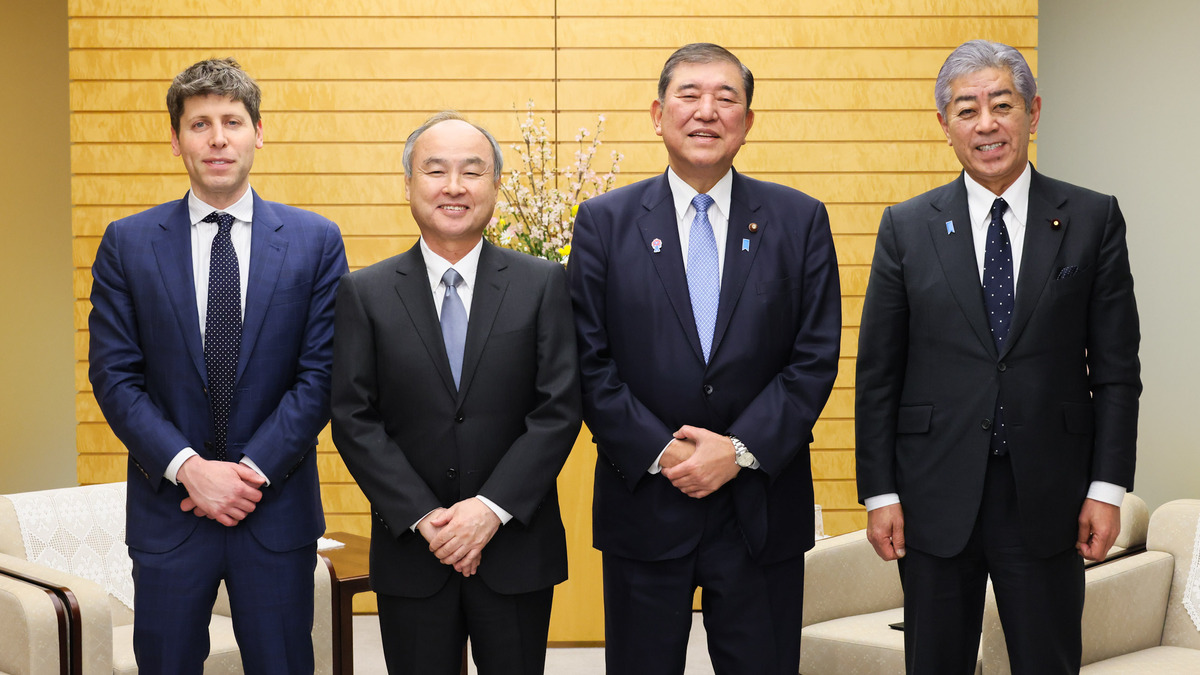 Masayoshi Son and Sam Altman met in Tokyo in February 2025. SoftBank's $30B commitment is now executing in quarterly tranches.
Source: commons.wikimedia.org
Masayoshi Son and Sam Altman met in Tokyo in February 2025. SoftBank's $30B commitment is now executing in quarterly tranches.
Source: commons.wikimedia.org
Who Pays
OpenAI, eventually
OpenAI isn't profitable. The company reports $2 billion in monthly revenue and 900 million weekly active users on ChatGPT, which sounds large until you account for what it costs to run inference at that scale, pay researchers competitive salaries in a war-for-talent market, and build new data centers at the rate needed for its stated $600 billion capex plan through 2030. The current burn rate isn't published, but the company has needed to raise more capital roughly every six months.
The IPO - now explicitly targeted for Q4 2026 per statements from both Altman and Friar - is the endgame for investors in this round. If it slips, Amazon's $35 billion conditional tranche goes unpaid, SoftBank's bridge loan becomes expensive to carry, and ARK's ETF inclusion loses its logic. Every investor in this round needs the IPO to happen this year.
Competitors
The broader AI investment surge has been major, but OpenAI is now in a different tier. With $122 billion in a single round, the company has the capital to outspend any competitor on compute, talent, and product development for the next two to three years. That's not a guarantee of technical success - AI research is notoriously unpredictable - but it does mean competitors face a resource gap that won't close through normal fundraising.
Anthropic, which doubled paid subscriptions and hit $19 billion ARR, is growing fast. But it's growing fast inside a sector where OpenAI just raised the equivalent of Anthropic's entire annual revenue roughly six times over in a single transaction.
The Super-App Question
Alongside the funding close, OpenAI disclosed plans to consolidate ChatGPT, Codex, browsing, and agentic capabilities into a single "super-app." The stated rationale: "Our consumer scale becomes the front door for enterprise usage, as familiarity in daily life drives adoption at work."
That's a reasonable strategy. It's also a significant execution challenge. OpenAI is simultaneously trying to run a frontier research lab, a consumer product with 900 million weekly users, an enterprise sales organization, and now a platform for third-party agentic integrations. Adding a super-app consolidation on top of an IPO preparation, inside a 12-month window, is a lot of operational surface area for a company that still has no CFO with full-cycle public company experience.
Sam Altman's line to CNBC captures the position accurately: "We are open to going public at the right time." The $122 billion close, the retail tranche, and the Q4 IPO target are all consistent signals that OpenAI has decided the right time is now - whether or not the super-app is finished.
Sources: TechCrunch · MarketScreener - Sarah Friar CNBC interview · Digital Journal

