
Ollama Banks $65M as Local AI Hits Enterprise Scale
Ollama raises $65M Series B led by Theory Ventures as 8.9 million monthly developers and 85% of Fortune 500 companies adopt local AI model deployment.
 6 min read
Three years after launch and with just 14 employees on the payroll, Ollama has closed a $65 million Series B led by Theory Ventures. The round brings total raised to $88 million. The figure that should grab anyone's attention isn't the check size - it's the market reach: Ollama says 8.9 million developers run it every month, and the tool sits inside 85% of Fortune 500 companies.
That kind of penetration, from a team this lean, is unusual. It's also exactly what Theory Ventures, which closed its own $450 million second fund in March 2026, is betting on.
TL;DR
- $65M Series B led by Theory Ventures; total raised now $88M
- 8.9 million monthly active developers; 176,000+ GitHub stars
- In use at 85% of Fortune 500 companies with 14 employees
- Subscription tiers charge by GPU usage, not tokens - a direct challenge to cloud pricing
The Deal in Numbers
Ollama was founded in 2023 by Jeff Morgan and Michael Chiang, who previously built Docker Desktop after their startup Kitematic was picked up by Docker. The playbook is roughly the same: take a painful infrastructure problem, wrap it in a clean developer interface, and let adoption do the distribution work.
The funding history reflects that growth:
| Round | Amount | Lead Investor | Year |
|---|---|---|---|
| Pre-seed | $125K | - | 2023 |
| Series A | $15M | Benchmark (Peter Fenton) | 2024 |
| Series B | $65M | Theory Ventures | Jul 2026 |
| Total | $88M |
The Series A investor, Benchmark's Peter Fenton, has argued publicly that open and closed models will coexist long-term, with enterprises increasingly wanting affordable alternatives to vendor APIs. The Series B lead, Theory Ventures - founded by Tomasz Tunguz, formerly of Redpoint Ventures - focuses on early-stage AI and SaaS infrastructure with check sizes typically between $1 million and $25 million. A $65 million lead is well above their stated range, which suggests Ollama represents a concentrated high-conviction bet.
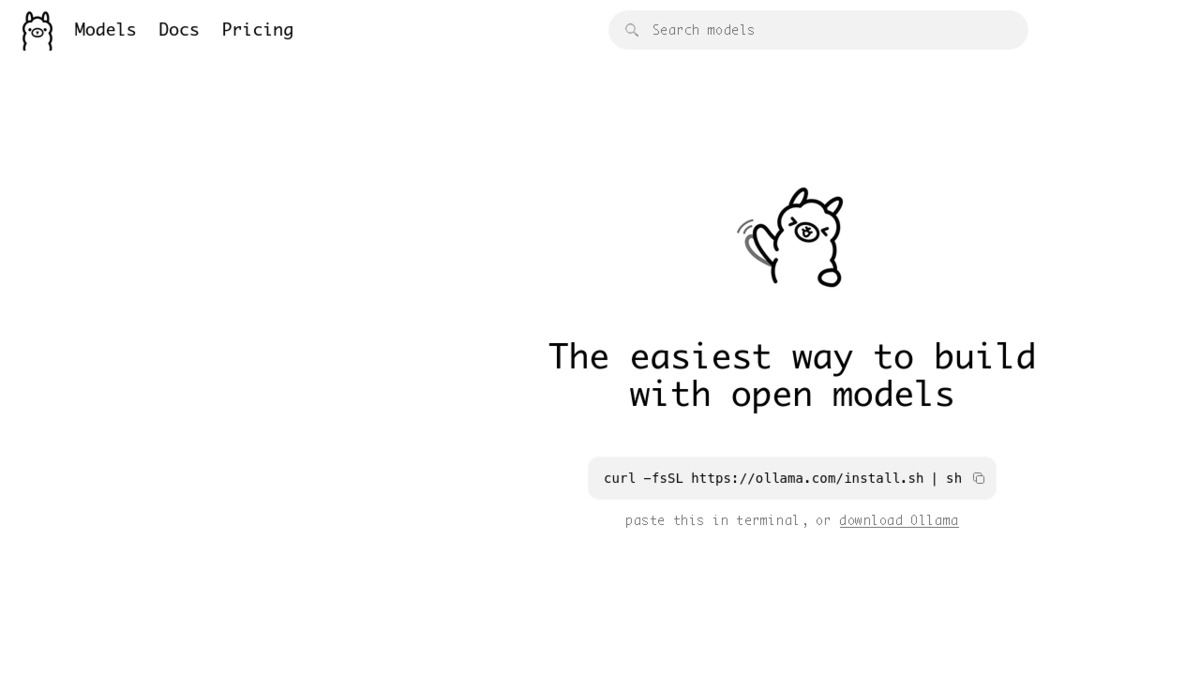 Ollama's website positions the tool as "the easiest way to build with open models," offering both local deployment and cloud burst options.
Source: ollama.com
Ollama's website positions the tool as "the easiest way to build with open models," offering both local deployment and cloud burst options.
Source: ollama.com
What Ollama Actually Does
In plain terms: Ollama lets developers download and run open-weight AI models on their own hardware, from a laptop to a datacenter server. You issue a single command, and a model is running locally within minutes. No API key, no vendor account, no per-token invoice.
The guide to running open-source LLMs locally covers the mechanics in detail. Ollama is the dominant tool for that workflow, supporting more than 100 models including Meta's Llama series, Mistral, Google's Gemma, Microsoft's Phi, Alibaba's Qwen, and DeepSeek. New models typically land in Ollama within days of a public release.
The business model layered on top of the free core is what makes the financials work. Subscribers can spin up larger models on Ollama's cloud infrastructure - what the company calls a "neocloud" - at three price points: free, Pro at $20 a month (three concurrent cloud models), or Max at $100 a month (ten concurrent models). Most importantly, the billing tracks GPU usage rather than token counts. That's a meaningful structural difference from how OpenAI, Anthropic, and Google Cloud charge, and it's a direct appeal to enterprises that have learned their token bills are hard to predict.
CEO Jeff Morgan told TechCrunch that the inflection point came in early 2023: "Open models started coming out in 2023 but they were really hard to use...not geared toward programmers." Ollama's bet was that a clean developer-first tool could unlock adoption faster than any closed-source competitor could.
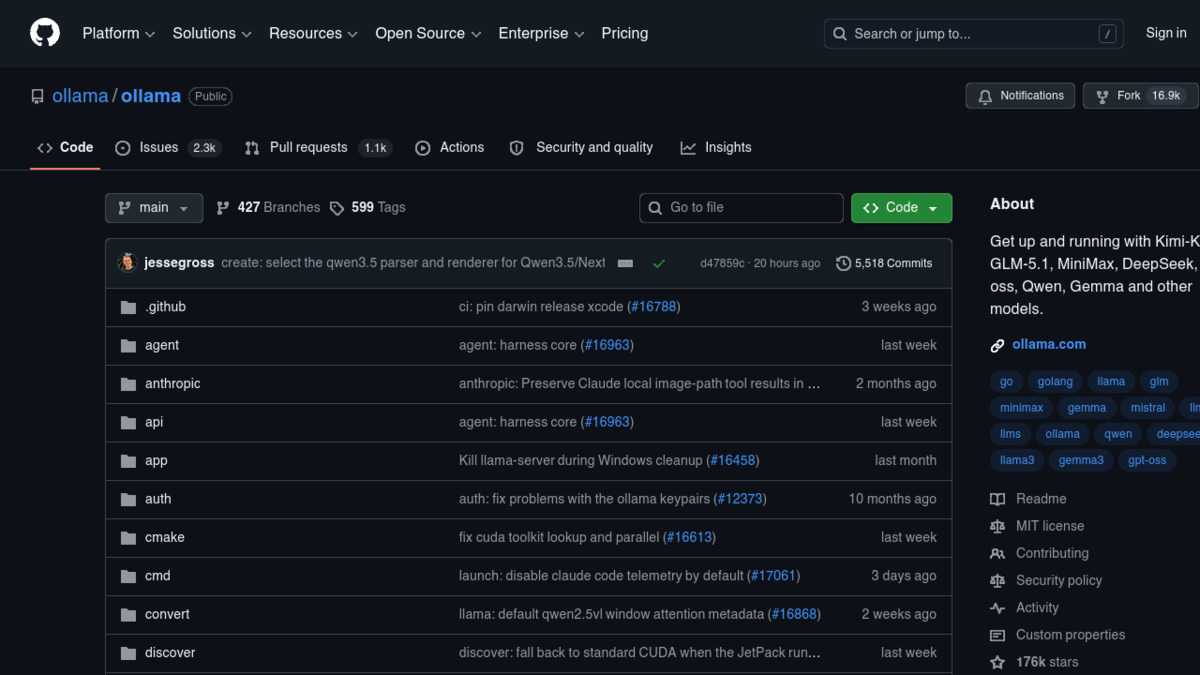 Ollama's GitHub repository has built up 176,000 stars and nearly 17,000 forks, ranking it among the most-used open-source AI projects.
Source: github.com/ollama/ollama
Ollama's GitHub repository has built up 176,000 stars and nearly 17,000 forks, ranking it among the most-used open-source AI projects.
Source: github.com/ollama/ollama
Who Benefits
Developers get the most direct value. Running a model locally removes latency added by network round-trips, removes the risk of rate limits, and costs nothing for the base tier. For scripting, prototyping, and offline applications, the economics are hard to beat. The 176,000 GitHub stars and nearly 17,000 forks reflect genuine adoption, not marketing spend.
Enterprises get something different: control. Data processed locally never leaves the building. For companies operating under GDPR, HIPAA, or sector-specific data-residency requirements, that's not a nice-to-have - it's often a compliance necessity. A 85% Fortune 500 adoption rate suggests legal and infosec teams have already signed off on Ollama in most large organizations. Getting $65 million behind that foothold means Ollama can now build enterprise support, audit logging, and access controls that make the compliance case even cleaner.
Open-source model creators benefit too, though indirectly. Ollama has become one of the primary distribution channels for publicly released models. A new model shipping with Ollama support reaches 8.9 million developers on day one. That's leverage that no individual lab could reproduce on its own. Related infrastructure plays, like the chip-agnostic inference server from ZML released earlier this year, are building out this same distribution layer from different angles.
Who Pays
Theory Ventures wrote the biggest check. At $450 million in fund two, a $65 million lead means roughly 14% of the new fund is concentrated in a single position. That's an unusually large allocation and signals they believe Ollama can become the default layer through which enterprises run open-weight models - a position worth many times the current stake if it holds.
Pro and Max subscribers are the actual revenue base. The model is freemium: free users create no revenue but build the install base and the GitHub credibility that makes enterprise pilots easier to close. Paying subscribers fund the company's neocloud infrastructure and its 14-person team. The math on 14 employees at an $88 million raise is aggressive; it implies very low burn and very high operational focus.
Cloud inference vendors face the structural pressure. AWS Bedrock, Azure AI, and Google Cloud's Vertex AI all charge per token for hosted model access. Ollama is training the developer community to expect zero marginal cost for inference, and offering a clear path to cloud burst when needed. That erodes the moat that hyperscalers have built on proprietary inference infrastructure. It doesn't replace them - but it caps the ceiling on what they can charge for commodity models.
The verdict: Theory Ventures is paying $65 million to own the distribution layer for open-weight AI inside the enterprise - a layer that 85% of Fortune 500 companies are already using, for free. That's a defensible position, and the GPU-based pricing model aims to extract value without repeating the mistakes of per-token billing. Whether a 14-person team can scale enterprise support to match that footprint is the open question the next round will have to answer.
Sources:

