
Odyssey Raises $310M as Amazon Bets on World Models
Amazon leads a $310M round into Odyssey, a startup building world models that simulate physics - not just language - with Trainium chip adoption baked in as the price of entry.
 6 min read
A London-based AI startup that builds systems capable of simulating the physical world has raised $310 million with Amazon as lead investor, according to reporting by the Financial Times published Tuesday.
Odyssey ML, co-founded by self-driving veterans Oliver Cameron and Jeff Hawke, is now valued at $1.45 billion including the new capital. The company has 55 employees spread across London, Zurich, and Palo Alto, and has spent two years building what it calls general-purpose world models - AI trained on physics and object relationships rather than text.
TL;DR
- Odyssey ML raises $310M at a $1.45B post-money valuation
- Amazon leads; NVIDIA, AMD, CIA-affiliated IQT, Google Ventures, Jeff Dean, and Elad Gil also participate
- Odyssey builds world models - AI that simulates physics, dynamics, and spatial relationships, not language
- As part of the deal, Odyssey will use AWS as its preferred cloud provider and deploy Amazon's Trainium chips
- Founders Oliver Cameron (ex-Cruise VP of Product) and Jeff Hawke (founding engineer at Wayve) started the company in late 2023
What Odyssey Actually Builds
Language models predict text. World models predict what happens next in physical space.
Odyssey's flagship product, Odyssey-2, generates interactive simulations from text or image prompts with streaming latency under 50 milliseconds. Its Starchild-1 model includes audio and spatial reasoning simultaneously. Agora-1 goes further: it lets multiple humans and AI agents interact inside the same simulated environment in real time.
The company's most cited demo has Agora-1 building a playable multiplayer version of GoldenEye using nothing but "pixels, actions and sounds" - no game physics training, no engine code. The model learned how the game world behaves from observation alone.
"World models will have a much more complete understanding of the world - physics, body language, dynamics - all these things that exist in the world that language doesn't really capture," CEO Oliver Cameron told the Financial Times.
The founders' background makes the bet less surprising. Cameron co-founded Voyage, a self-driving car startup picked up by Cruise in 2021, then served as Cruise's VP of Product overseeing its driverless launch in San Francisco. Jeff Hawke was a founding engineer at Wayve, the British autonomous vehicle company that pioneered end-to-end neural driving models. Both spent years building systems that have to understand physical space to function.
 Odyssey's world model technology creates continuous interactive video streams in real time, responding to user input with new frames every 40 milliseconds.
Source: artificialintelligence-news.com
Odyssey's world model technology creates continuous interactive video streams in real time, responding to user input with new frames every 40 milliseconds.
Source: artificialintelligence-news.com
The Funding Picture
| Round | Amount | Valuation | Key Investors | Year |
|---|---|---|---|---|
| Seed | $9M | undisclosed | Google Ventures, DCVC, Air Street Capital | 2024 |
| Strategic | undisclosed | undisclosed | NVentures (NVIDIA), Samsung Next | pre-2026 |
| Series B | $310M | $1.45B | Amazon, GV, IQT, NVIDIA, AMD, Jeff Dean, Elad Gil | 2026 |
The investor list for this round is worth unpacking. Amazon leads with cash and a cloud contract. Google Ventures returns from the seed round - and Google's own chief scientist, Jeff Dean, also invested personally. The fact that Dean participated outside the GV vehicle suggests he sees this as a bet on world models broadly, not just on Odyssey's commercial prospects. NVIDIA's investment arm and AMD's investment arm both participated, which puts two chip competitors on the same cap table, each hedging against the scenario where world model workloads shift their respective market positions.
Who Benefits
Amazon is the clearest winner. The deal builds Trainium chip adoption into Odyssey's cost structure from day one. As part of the agreement, Odyssey commits to AWS as its preferred cloud provider and rolls out Amazon's Trainium chips for training. This matters: Amazon has spent years trying to reduce the AI industry's dependence on NVIDIA hardware. Its Trainium chip strategy has secured commitments from Anthropic and OpenAI, but it needs frontier workloads running at scale to prove Trainium's performance claims to the broader market. Odyssey's training pipelines - intensive, continuous, physics-aware - are exactly the kind of workload that would make a compelling case.
Odyssey gets the runway to compete. World models are computation-heavy by design. Its current infrastructure runs at $1-2 per user-hour on NVIDIA H100 clusters. Two years of runway at this scale buys the company time to reach the efficiency threshold where a general-purpose world model becomes commercially viable. It also confirms the category: LeCun's AMI Labs raised $1B on a similar thesis, and NVIDIA's own world model research has attracted serious internal investment. Odyssey's round puts them among the best-funded independent bets in the space.
IQT - the CIA's venture arm - joining a round for a company that simulates physical environments, spatial dynamics, and body language isn't a coincidence. World models capable of realistic environment simulation have obvious applications in intelligence and national security contexts that don't require public disclosure.
 Odyssey collects real-world training data using custom camera rigs that can go anywhere a person can go, capturing the physics and dynamics that world models need to learn from.
Source: techcrunch.com
Odyssey collects real-world training data using custom camera rigs that can go anywhere a person can go, capturing the physics and dynamics that world models need to learn from.
Source: techcrunch.com
Who Pays
Amazon absorbs the most execution risk. World models could be the next phase of AI development, or they could stall at what researchers call the GPT-2 moment - impressive capabilities in narrow conditions, insufficient generalization for real applications. Amazon is betting $310M that Odyssey reaches the GPT-3 equivalent before the incumbents do it in-house. If Odyssey hits a technical wall, Amazon holds a large stake in a 55-person company without a clear path to revenue.
Odyssey trades strategic flexibility for scale. Committing to Trainium over NVIDIA hardware introduces platform risk most compute-intensive startups try to preserve optionality on. If Amazon's chips underperform in production for world model workloads, renegotiating the arrangement won't be easy. The Anthropic-Trainium partnership followed a similar structure and has had its share of friction.
NVIDIA is hedged but not well-served by this deal. Its investment arm participated - keeping NVIDIA informed about a company whose success could shift workloads away from its own accelerators. That's a defensive investment, not a growth one.
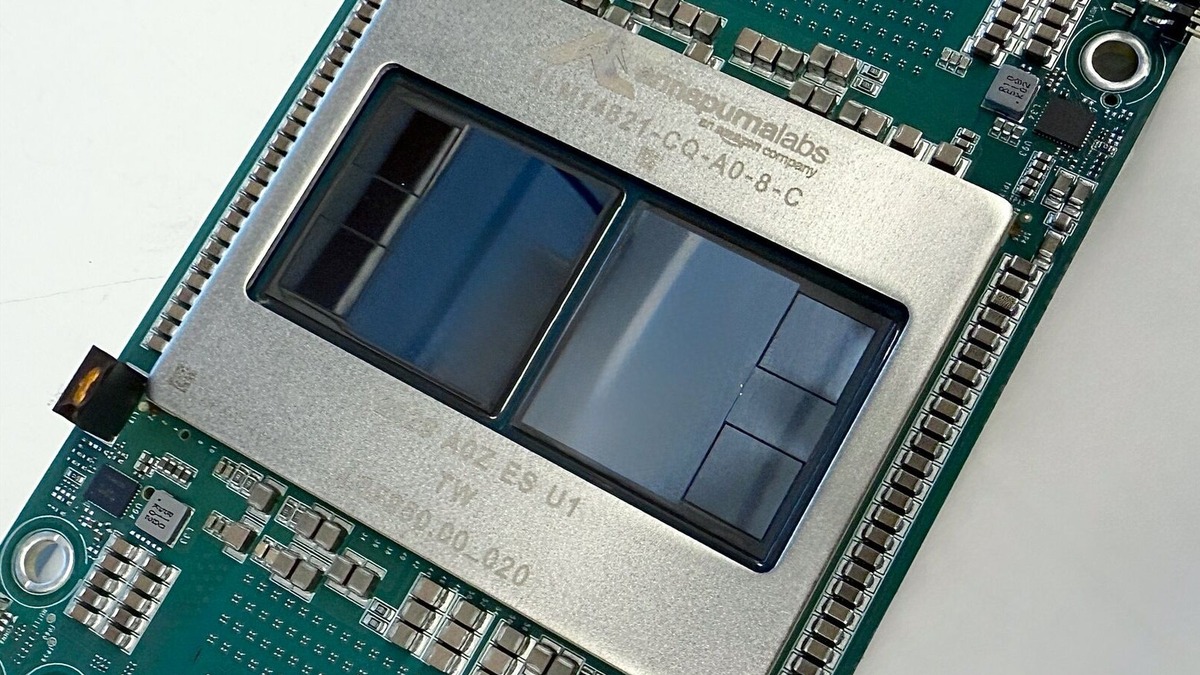 Amazon's Trainium3 delivers four times the compute of its predecessor at significantly lower energy cost - making it central to Amazon's pitch to replace NVIDIA as the preferred AI training chip.
Source: aboutamazon.com
Amazon's Trainium3 delivers four times the compute of its predecessor at significantly lower energy cost - making it central to Amazon's pitch to replace NVIDIA as the preferred AI training chip.
Source: aboutamazon.com
Where This Fits
The Odyssey round lands inside a broader world model funding wave. Q1 2026 broke venture records with AI capturing 80% of global venture capital. World models are emerging as one of the most capital-intensive sub-categories within that wave, because the applications that need them - robotics, autonomous systems, simulation-based training, spatial computing - all require AI that understands how objects behave in three dimensions over time.
Jay Zaveri of Natural Capital, one of the round's participants, described the investment as funding "a second wave of AI beyond current systems." That framing is doing a lot of work. A second wave implies the first wave - large language models - has reached some kind of plateau that world models will transcend. That claim is not yet proven.
What's proven is that $310 million of capital, including Amazon's cloud contract and the CIA's interest, has now been placed on the bet that it'll be.
World model funding rounds above $300 million used to be territory for frontier language model labs alone. Odyssey, at 55 people, just put itself in that category.
Sources:
- Amazon backs AI start-up developing models to simulate physical world - Irish Times
- Amazon backs Odyssey ML with $310M - Reuters via TradingView
- Odyssey's new AI model streams 3D interactive worlds - TechCrunch
- Odyssey AI model transforms video into interactive worlds - AI News
- Our investment in Odyssey - Air Street Press
- Odyssey ML

