
Nvidia May Guarantee $250B So OpenAI Can Pay Nvidia
Nvidia is negotiating to backstop $250 billion in financing for OpenAI's 10-gigawatt Ohio data center, plus another $350 billion for the chips going inside it, reviving the circular financing debate.
 6 min read
Nvidia is in talks to guarantee roughly $250 billion in financing so OpenAI can lease computing capacity from a 10-gigawatt data center hub SoftBank is building in southern Ohio, the Wall Street Journal reported Sunday. A second, separate discussion covers up to $350 billion more to finance OpenAI's purchase of the Nvidia chips that'll fill the building. Bloomberg matched the reporting Monday. Nothing is signed.
TL;DR
- Nvidia is negotiating a roughly $250 billion guarantee covering OpenAI's lease and construction debt on a 10-gigawatt Ohio data center, plus up to $350 billion more discussed separately for chip purchases
- The site is the former Portsmouth Gaseous Diffusion Plant in Piketon, Pike County - a decommissioned uranium enrichment complex now central to a $500 billion-plus buildout
- OpenAI lacks an investment-grade credit rating, so Nvidia's name is standing in for its balance sheet with lenders
- Investors Michael Burry, Jim Chanos, and commentator Ed Zitron all called the structure circular within hours of the report
- Jensen Huang told investors just four months ago that a $100 billion OpenAI equity pledge was "not in the cards"
What Nvidia Is Actually Guaranteeing
The two guarantees under discussion are structurally different, even though headlines have blurred them together. The first covers OpenAI's lease payments and the construction debt behind the Ohio campus itself - Nvidia effectively co-signs so that lenders treat SB Energy's project financing as bankable. The second, still separate and less advanced, would help fund OpenAI's actual chip orders, on top of that.
Both exist for the same reason. OpenAI doesn't carry an investment-grade rating, and professional lenders price its debt accordingly. A chipmaker with a market capitalization near $5 trillion can absorb that risk in a way a startup burning cash cannot. So Nvidia's signature substitutes for OpenAI's credit history, and the project gets built on a promise from the supplier rather than the buyer.
The Ohio Megasite
The location is the former Portsmouth Gaseous Diffusion Plant, a Cold War-era uranium enrichment complex in Piketon, Pike County, that the federal government began decommissioning decades ago. Commerce Secretary Howard Lutnick, Energy Secretary Chris Wright, and Interior Secretary Doug Burgum broke ground there in March, branding it the PORTS Technology Campus and calling it the largest construction project in the country.
The numbers have only grown since. The campus targets 10 gigawatts of capacity at full build, with an 800-megawatt first phase due in 2028. A dedicated 9.2-gigawatt natural gas plant, developed by SoftBank's SB Energy alongside utility AEP Ohio, will power it, backed by a $33.3 billion Japanese funding commitment under the US-Japan Strategic Trade and Investment Agreement - itself a down payment on a $550 billion bilateral pact. AEP Ohio has separately committed $4.2 billion to grid upgrades the companies say won't raise local ratepayer bills, a promise similar to what seven tech giants pledged the Trump administration in February.
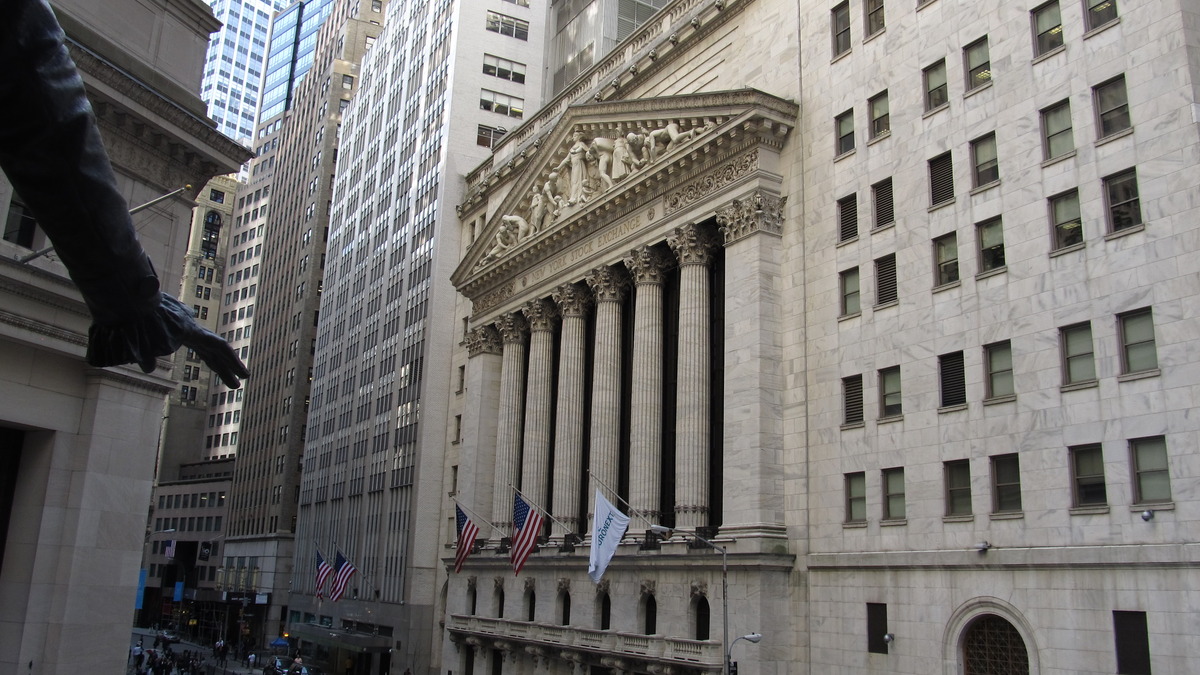 Wall Street's reaction to the guarantee talks was immediate and largely skeptical.
Source: commons.wikimedia.org
Wall Street's reaction to the guarantee talks was immediate and largely skeptical.
Source: commons.wikimedia.org
The Escalation, In Numbers
Nvidia's exposure to OpenAI has grown through three distinct mechanisms in under a year, and each one has been bigger and less direct than the last.
| Date | Mechanism | Amount | Status |
|---|---|---|---|
| Sept 2025 | Equity pledge tied to gigawatt milestones | Up to $100B | Superseded |
| Feb 2026 | Actual equity check, part of $110B round | $30B | Closed |
| Mar 2026 | Huang rules out the remaining $100B pledge | $0 | Confirmed dead |
| Jul 2026 | Lease and construction debt guarantee | ~$250B | In talks |
| Jul 2026 | Chip purchase financing | Up to $350B | In talks, less advanced |
Huang told the Morgan Stanley Technology, Media and Telecom Conference in March that further direct equity checks were "not in the cards" now that OpenAI was headed toward a public listing. That was true in the narrow sense: nobody is calling this new arrangement an equity stake. It's a financial guarantee instead, a mechanism that keeps the exposure off Nvidia's income statement while still putting its name behind OpenAI's ability to pay. Whether that distinction matters to a lender who has to be made whole either way is a separate question.
Who Benefits
OpenAI gets financing terms it could not get on its own, without having to explain to a rating agency why a company that has never posted an annual profit deserves them. SoftBank's SB Energy gets a bankable project instead of one stuck waiting on OpenAI's balance sheet, freeing it to break ground on schedule. Nvidia locks in demand for a customer that has already committed to some of the largest chip orders in its history, at a moment when rivals like Google's in-house TPUs and AMD are chipping at its market share. Ohio and Pike County get thousands of construction jobs and a tax base on land that has sat idle since the Cold War.
Who Pays
If OpenAI can't make its lease payments, Nvidia's guarantee is what stands behind the debt, not OpenAI's revenue. That is real exposure on the books of a nearly $5 trillion company, contingent but not hypothetical. Oracle offers a preview of what concentrated OpenAI exposure does to a credit profile: S&P Global downgraded Oracle's issuer rating to BBB-, one notch above junk, on July 9, citing OpenAI's roughly 50% share of Oracle's $638 billion in remaining performance obligations and projecting a free operating cash flow deficit of $42 billion for fiscal 2027. Oracle's five-year credit default swaps have quadrupled since mid-2025 to around 203 basis points, and the stock has fallen 54% from its 2026 high. Nvidia is proposing to take on a version of the same bet, on a bigger project, with less of its own money already committed to walk away from.
"Around and around we go. Nvidia to guarantee $200 billion of ChatGPT's spending on $NVDA chips," Michael Burry wrote, reacting to the report.
Jim Chanos, the short-seller who built his reputation calling Enron before its collapse, was blunter about the arithmetic: "So we are at the point in the cycle where $NVDA has to provide financing guarantees for roughly 2/3rds of the cost of the chips it is selling to the data center project...?! Lol, ok." Ed Zitron called the structure "insane on so many levels" and "about as bearish as it gets." Not every reaction was hostile. Gary Tan, a portfolio manager at Allspring Global Investments, offered a more measured read: Nvidia's continued investment "reinforces confidence in long-term AI buildouts," even as he acknowledged that "investors remain concerned about circular financing."
Circular financing describes a loop: a supplier backs its customer's ability to pay, the customer spends the backing on the supplier's own product, and the transaction gets counted as organic demand from the outside. Nvidia has run versions of this before, crossing $40 billion in equity commitments to its own customers earlier this year, but a debt guarantee on a single project is a different animal from a venture stake. Equity can go to zero without anyone else getting hurt. A guarantee gets called.
Sources:
- Nvidia in talks with OpenAI to guarantee $250 billion financing for data center, WSJ reports - Yahoo Finance / WSJ
- Nvidia Weighs $250 Billion Backstop For OpenAI's Gargantuan Ohio Data Center Campus - ZeroHedge
- Nvidia Reportedly Moves to Backstop $250 Billion in OpenAI Data Center Financing, Michael Burry Says, 'Around and Around We Go' - Yahoo Finance
- Jim Chanos Says Nvidia Is Effectively Financing Its Own AI Chip Sales in Reported OpenAI Deal - Benzinga
- ORCL Stock Jumps Overnight: Nvidia Reportedly Puts $250B On Table For OpenAI's Data Center Push - Yahoo Finance
- S&P Global sees OpenAI as a "key credit risk" for Oracle and cuts its credit rating - The Decoder
- Nvidia weighs US$250B backstop for OpenAI's Ohio data center - DigiTimes

