
Nvidia's Jetson Chips Are Headed to the Moon
Lunar Outpost and Firefly Aerospace will fly Nvidia Jetson modules on a lunar rover and orbiter this year, the first GPUs to run on and around the Moon.
 6 min read
Every GPU Nvidia has ever shipped has stayed on Earth. That changes later this year, when a rover built by Colorado startup Lunar Outpost carries an Nvidia Jetson module to the lunar surface, and a Firefly Aerospace spacecraft runs a second Jetson in orbit around the Moon. Neither chip is doing anything as flashy as training a model. They're driving a rover's laser scanner and triaging satellite imagery before it ever reaches Earth, which is exactly the point.
TL;DR
- Lunar Outpost's Lunar Voyage 2 (LV2) rover will carry an Nvidia Jetson module to control its lidar system, the first GPU to operate on the Moon's surface
- LV2 launches on a Falcon 9 later this year to study Reiner Gamma, a lunar magnetic anomaly
- Firefly Aerospace's Blue Ghost Mission 2 will run a Jetson aboard its Elytra orbiter for the Ocula imaging service, the first Jetson deployment in lunar orbit
- Future Lunar Outpost missions will carry Nvidia's Space-1 Vera Rubin module, a space-qualified chip Nvidia says delivers up to 25x the AI compute of an H100
A GPU Doing Rover Chores
Lunar Outpost's next rover is a scaled-up version of MAPP, the mobile platform that flew to the Moon's south pole on Intuitive Machines' IM-2 mission last year, only to end up stranded when the lander touched down on its side. This time the rover is booked on Lunar Voyage 2 (LV2), targeting Reiner Gamma, a bright swirl on the lunar surface tied to a localized magnetic field that has puzzled planetary scientists for decades.
The Jetson's job on that mission isn't glamorous. Lunar Outpost says the module will command and control the rover's lidar system, then handle post-processing and compression of sensor data before it's beamed home. On a mission where every kilobit crossing the quarter-million-mile link to Earth costs time and power, an onboard GPU that can compress a lidar point cloud before transmission is a genuine constraint-easing move, not a marketing bullet point.
Why Lidar Needs a GPU At All
Lidar systems on Earth-bound autonomous vehicles already lean on GPU-accelerated processing to turn raw point clouds into obstacle maps in real time. The lunar version of that problem is harder: no GPS, no cellular backhaul, and a round-trip communication delay that rules out having a human on Earth drive the rover turn by turn. Local compute is the only way the rover can build a usable picture of the terrain in front of it before it needs to move.
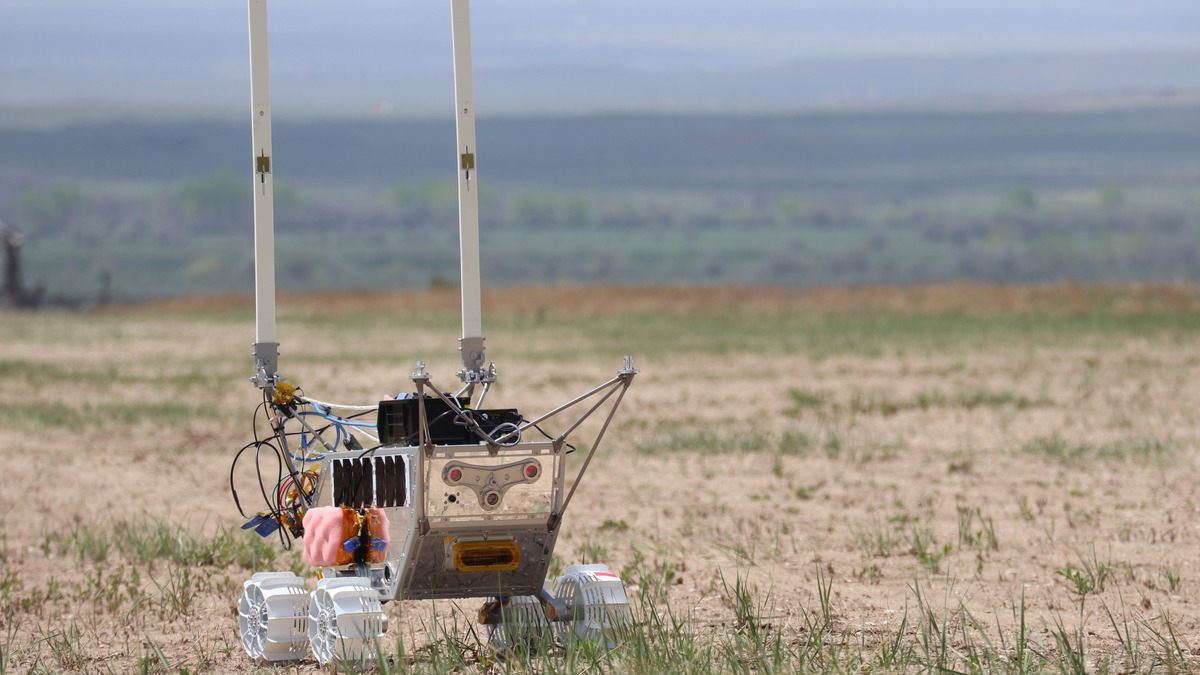 Lunar Outpost tests its rover platform at the Southern Colorado Autonomous Test Facility ahead of a prior lunar mission.
Source: nasa.gov
Lunar Outpost tests its rover platform at the Southern Colorado Autonomous Test Facility ahead of a prior lunar mission.
Source: nasa.gov
An Eye in Lunar Orbit
The surface deployment isn't the only lunar first. Firefly Aerospace will fly a Jetson module aboard Elytra, an orbiter built for its Blue Ghost Mission 2 and designed to operate around the Moon for five years. The chip powers Ocula, a moon-imaging service that processes ultraviolet and visible-range imagery on the spacecraft itself instead of downlinking raw frames for processing on the ground.
"We believe in a future where all AI processing and sensing will happen in space. We're going to be able to do that for the first time in history."
That's Firefly CEO Jason Kim, describing what on-orbit inference buys a mission like this: instead of streaming every image back to Earth and sorting through it later, Elytra can extract the frames worth keeping, whether that's a newly exposed crater or a competitor's rover, and send down only what matters. Blue Ghost Mission 2 is targeted for late 2026.
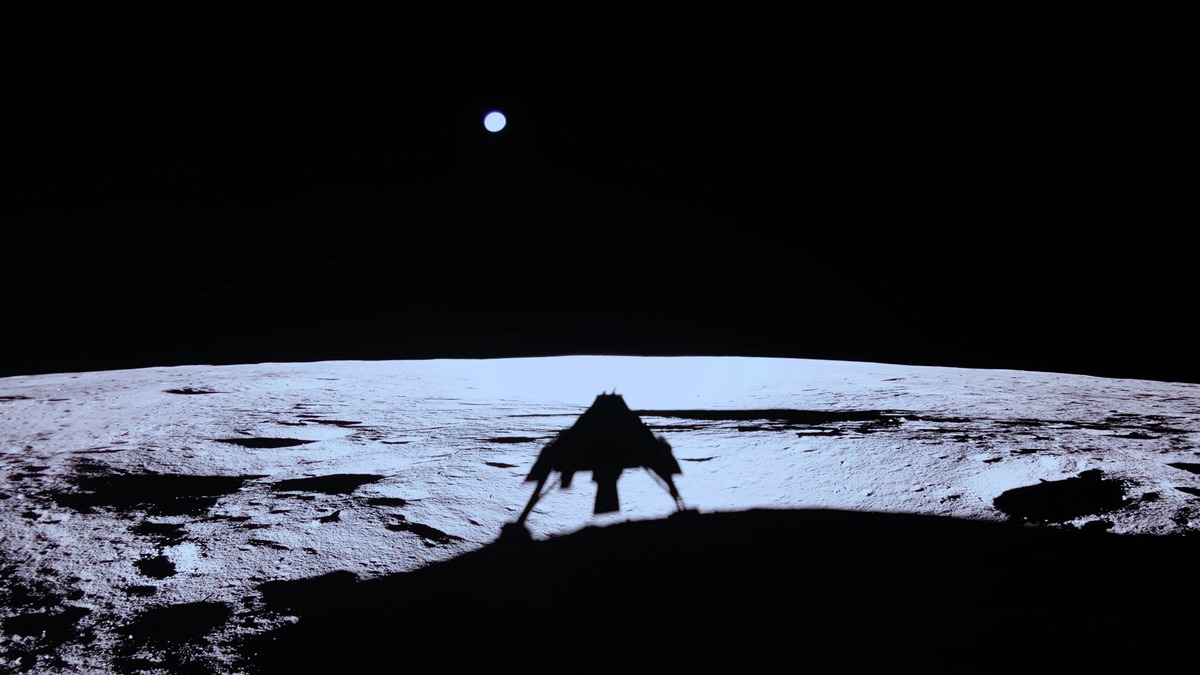 Firefly's first Blue Ghost lander on the lunar surface. Mission 2 will add an orbiting Jetson-powered spacecraft to the company's lunar program.
Source: nasa.gov
Firefly's first Blue Ghost lander on the lunar surface. Mission 2 will add an orbiting Jetson-powered spacecraft to the company's lunar program.
Source: nasa.gov
The Bigger Bet: Space-1 Vera Rubin
Both of these deployments run on Jetson Orin, hardware Nvidia originally built for terrestrial robotics and edge devices, repurposed for space because nothing built specifically for the job was available yet. That changes with Space-1 Vera Rubin, a space-qualified module Nvidia announced at GTC 2026 and built on the same Rubin architecture behind its next-generation data center chips. Nvidia claims up to 25x the AI compute of an H100 for orbital inference workloads, though the company's head of edge AI product marketing has said the module itself won't ship until 2027.
LV2 (2026)          Jetson Orin      lidar control, sensor compression
Blue Ghost 2 (2026) Jetson Orin      on-orbit imagery triage (Ocula)
LV3 / LV5 (pre-2030) Space-1 Vera Rubin  real-time terrain mapping, autonomous
                                          pathfinding, live video streaming
Lunar Outpost plans to put Space-1 modules on its later Lunar Voyage 3 and 5 missions, where the extra compute is meant to support real-time terrain mapping and autonomous path planning without a human in the loop, plus live video streaming from the surface. Nvidia isn't alone in courting that market. Planet Labs, Axiom Space, and Kepler Communications have signed on to deploy Space-1 or its Jetson/IGX Thor predecessors across their own satellite and Earth-observation missions, with smaller players like Aetherflux and Starcloud.
The NASA Contract Behind the Timeline
Lunar Outpost's push into flight hardware isn't a side project. In May, NASA awarded the company's Lunar Dawn team, which also includes Lockheed Martin, General Motors, Goodyear, and MDA Space, a $220 million contract to build Pegasus, a crewed lunar terrain vehicle due on the Moon's surface by 2028. Rival Astrolab won a competing $219 million award the same round. The LV2 rover flying this year is effectively a proving ground for the autonomy and edge-compute stack that Pegasus will eventually need to carry astronauts around the south pole without waiting on a ground controller.
| Mission | Chip | Role | Target |
|---|---|---|---|
| LV2 rover | Jetson Orin | Lidar control, sensor compression | Reiner Gamma, 2026 |
| Blue Ghost Mission 2 | Jetson Orin | Ocula on-orbit imagery | Lunar orbit, late 2026 |
| Lunar Voyage 3 / 5 | Space-1 Vera Rubin | Mapping, pathfinding, video | Before 2030 |
| Pegasus (crewed) | TBD | Astronaut surface mobility | South pole, 2028 |
Where It Falls Short
None of this hardware is radiation-hardened in the way flight computers built specifically for deep space typically are. TechCrunch reported that Lunar Outpost's own engineers describe the Jetson deployment as an experiment, benchmarking it directly against the rover's dedicated flight computer to weigh the tradeoffs before committing more silicon to future missions. That's a reasonable way to de-risk a first flight, but it means LV2 is also a test of whether commercial, non-hardened GPU silicon can survive the Moon's radiation exposure and extreme day-night temperature swings well enough to be useful, not a settled fact.
The bigger unknown is one Nvidia has already flagged for its Space-1 line rather than LV2 specifically: thermal cooling in the vacuum of space remains an unsolved problem for compute hardware generally, and rising launch costs still limit how much silicon anyone can justify sending up on a given mission. And Lunar Outpost's own track record includes the IM-2 mission, where its previous rover never got the chance to drive at all because the lander it rode in on tipped over. A GPU that compresses lidar data brilliantly is no use if the vehicle carrying it doesn't land upright.
Sources:
- Nvidia is sending GPUs to the moon - TechCrunch
- Firefly Aerospace Operates NVIDIA Jetson in Lunar Orbit for the First Time - Nvidia Blog
- Lunar Outpost Plans to Fly NVIDIA Chips to the Moon - Payload Space
- Lunar Outpost Collaborates with NVIDIA to Deploy Edge AI Across Upcoming Moon Missions - GlobeNewswire via The Manila Times
- Nvidia announces Vera Rubin Space-1 chip system for orbital AI data centers - CNBC
- NVIDIA Launches Space Computing, Rocketing AI Into Orbit - Nvidia Newsroom
- Lunar Outpost secures $220M NASA contract - BizWest

