
Nvidia Backs Voice AI's Two Biggest Rivals at Once
Nvidia has joined Gradium's seed round while holding a stake in rival ElevenLabs, tying its GPUs to both leaders in the race to own voice AI.
 5 min read
Gradium closed its seed round at $100 million this month, and the name on the new check is the same one already sitting on its biggest rival's cap table. Nvidia joined a roughly $30 million extension to the Paris-based voice AI startup's funding, first reported by TechCrunch on July 9. Nvidia has also backed ElevenLabs, the London company Gradium is trying to dethrone.
TL;DR
- Gradium's seed round hit $100M after Nvidia joined a ~$30M extension announced July 9
- Nvidia already holds a stake in ElevenLabs, now in talks for a $22B valuation, double its February mark
- Both companies plan to keep training and serving their models on Nvidia GPUs
- The bet extends a pattern: Nvidia had committed over $40B to equity deals in 2026 as of its last disclosure in May
- Neither company discloses whether Nvidia's capital carries any GPU purchase commitment
A Familiar Investor on Both Cap Tables
Gradium spun out of Kyutai, the nonprofit Paris AI lab backed by telecom billionaire Xavier Niel, and launched from stealth in December 2025 with $70 million from FirstMark Capital, Eurazeo, DST Global Partners, Eric Schmidt and Niel himself. Co-founder Neil Zeghidour, who previously worked at Google Brain, DeepMind and Meta, built the startup around ultra-low-latency audio models: speech-to-text, text-to-speech, voice cloning and real-time translation, aimed at developers building voice interfaces into consumer apps. Renault is a paying customer. The fresh capital funds a Bay Area office to compete for research talent, according to Sifted.
Zeghidour told Sifted that voice AI has become a crowded field with a narrow set of serious players.
"There is therefore intense competition when it comes to the models themselves, but concentrated between a limited number of players."
Gradium claims it ships new models roughly monthly, against six-to-twelve-month release cycles typical of larger competitors.
ElevenLabs sits at the top of that narrow list. The company raised $500 million in a Series D at an $11 billion valuation in February, backed by Sequoia Capital, Andreessen Horowitz and Iconiq, according to ElevenLabs' own announcement. Nvidia was already a backer by that point. Five months later, ElevenLabs is in early talks for a tender offer that would value it at $22 billion, The Next Web reported - a doubling driven by $500 million in annualized revenue and enterprise clients including Deutsche Telekom and Boston Consulting Group.
| Company | Latest Round | Reported Valuation | Nvidia Position | Other Backers |
|---|---|---|---|---|
| Gradium | $30M seed extension (Jul 2026) | Undisclosed | New investor | FirstMark, Eurazeo, DST Global, Niel |
| ElevenLabs | $500M Series D (Feb 2026) | $22B (tender talks) | Existing backer | Sequoia, a16z, Iconiq |
Neither company would confirm to reporters whether Nvidia's capital comes attached to compute purchase commitments. Both, however, plan to keep serving models on Nvidia hardware.
Who Benefits
Nvidia wins regardless of which company ends up defining the voice AI category. If ElevenLabs holds its lead into an IPO, Nvidia holds equity in the winner. If Gradium's faster release cadence or lower latency claims chip away at that lead, Nvidia still profits, both from the GPUs each company buys and from whatever the smaller stake in Gradium is worth once it prices its next round. It's the same logic behind Nvidia's $40 billion in equity commitments so far this year, most of it flowing into companies that turn around and spend heavily on Nvidia silicon.
Gradium gets more than cash. An investment from the world's most valuable chip company is also a signal to enterprise customers and future investors that the startup's infrastructure plans are credible, at a moment when it is trying to poach engineers from better-funded rivals for a Bay Area office. Kyutai, the nonprofit lab Gradium spun out of, gets a second proof point (after Mistral, another French lab-to-startup story) that Europe's open-science AI research culture can produce companies Silicon Valley wants to fund.
Who Pays
The clearest risk sits with whoever buys into these companies at their next valuation marks. ElevenLabs doubled its price tag in five months without a corresponding doubling in disclosed revenue, and strategic investors like Nvidia have every incentive to keep valuations climbing since it improves the marks on their own balance sheet. Wedbush Securities has already flagged Nvidia's broader pattern of investing in its own customers as a "circular investment theme" worth watching, a dynamic we've covered before for GPU cloud providers burning cash to keep up with demand commitments.
Rival voice AI startups without a Nvidia check face a subtler cost: compute access and investor attention increasingly flow toward companies with a strategic backer already on the board. And if OpenAI succeeds in making voice the primary interface for its own products, both Gradium and ElevenLabs are competing against a company that doesn't need anyone else's capital to buy Nvidia GPUs at scale.
Nvidia isn't picking a winner in voice AI. It's making sure that whichever company wins, the GPUs underneath it are still Nvidia's.
Sources:
- Paris-based AI voice startup Gradium raises $100M seed, backed by Nvidia - TechCrunch
- Nvidia backs voice AI startup Gradium, bringing seed round to over $100m - Sifted
- Nvidia-backed AI startup ElevenLabs hits $11 billion valuation in fresh fundraise - CNBC
- ElevenLabs raises $500M Series D at $11B valuation - ElevenLabs
- ElevenLabs in talks for tender offer at $22bn valuation - The Next Web
- Nvidia embraces AI investor, topping $40 billion in equity bets 2026 - CNBC
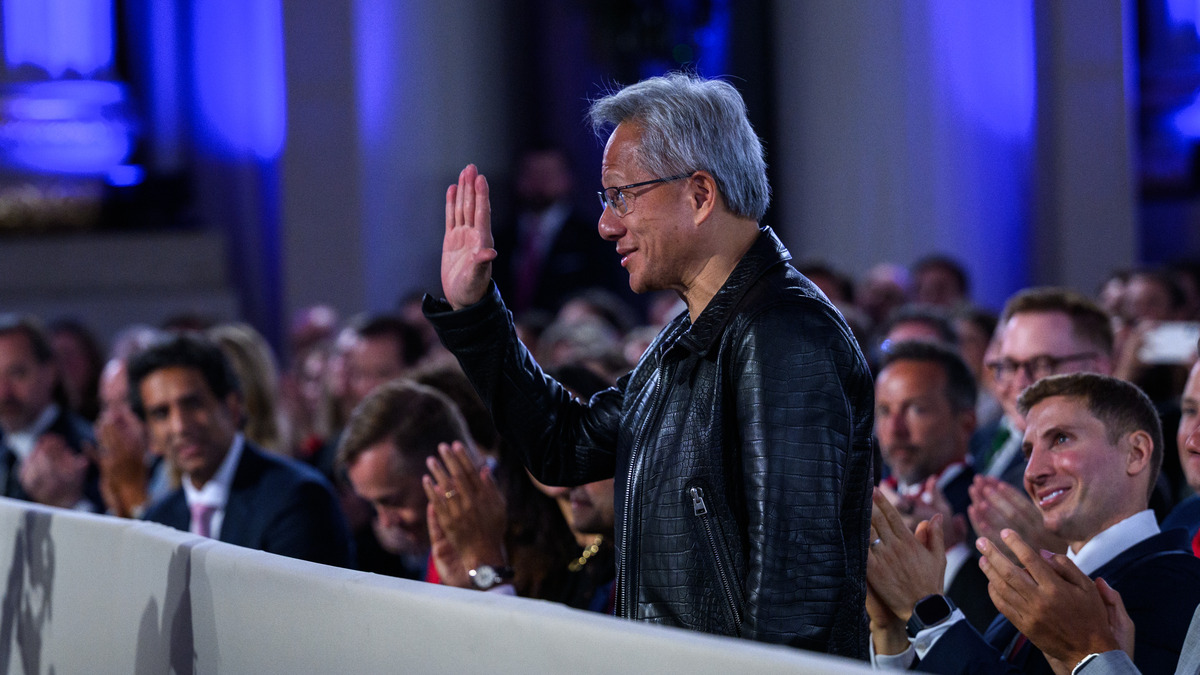 Nvidia CEO Jensen Huang has made equity investment a core part of the company's strategy, committing more than $40 billion to AI deals in 2026 alone.
Source: commons.wikimedia.org
Nvidia CEO Jensen Huang has made equity investment a core part of the company's strategy, committing more than $40 billion to AI deals in 2026 alone.
Source: commons.wikimedia.org
 Whichever voice AI startup ends up on top, its models are likely to keep running on Nvidia hardware.
Source: unsplash.com
Whichever voice AI startup ends up on top, its models are likely to keep running on Nvidia hardware.
Source: unsplash.com

