
NVIDIA and Emerald AI Turn Data Centers Into Grid Assets
NVIDIA's DSX Flex library and Emerald AI's Conductor platform let AI factories ramp GPU power up or down in seconds, unlocking faster grid connections and up to 100GW of new U.S. capacity.
 8 min read
AI data centers have a power problem that has nothing to do with how much electricity they consume. The bottleneck isn't supply - it's the interconnection queue. Getting a new data center onto the grid can take six to ten years in many U.S. regions. NVIDIA and Emerald AI announced at CERAWeek 2026 on March 23 that they've built a way around it: software that turns AI factories into dispatchable grid assets, allowing them to flex power draw on demand and qualify for faster, larger interconnections.
TL;DR
- NVIDIA's DSX Flex library and Emerald AI's Conductor platform let AI factories ramp GPU power up or down within seconds in response to real grid signals
- London trial with Nebius and National Grid hit 30%+ power reduction in under 40 seconds with 100% compliance across 200+ dispatch events
- Oregon trial showed 25%+ load reduction sustained over 6+ hours; 24-hour emergency response capability demonstrated
- First commercial-scale deployment: NVIDIA's 96 MW Aurora AI factory in Manassas, Virginia, with Digital Realty and PJM Interconnection, launching later in 2026
- Potential unlock: up to 100 GW of new U.S. grid capacity at scale
The Problem It Solves
AI factories are eating the grid, one interconnection at a time
A data center running NVIDIA Blackwell clusters at full draw doesn't vary its load - it pulls the same power continuously, hour after hour. That predictability sounds like a grid operator's dream, but it's actually the problem. Grid infrastructure is sized for peak demand. A facility that draws 96 MW constantly forces the utility to build or reserve 96 MW of dedicated capacity. That takes time and money that the current AI buildout timeline simply doesn't have.
Constellation CEO Joe Dominguez put it plainly at CERAWeek: "We don't have a supply problem - we have a peak problem." The actual generation exists. What's missing is the flexible capacity to handle simultaneous peak events without building dedicated infrastructure for every new data center.
Demand response programs have solved this for industrial facilities for decades - factories agree to cut load during grid stress events in exchange for faster connections and cheaper rates. Until now, AI data centers couldn't participate because reducing GPU compute mid-training run is expensive, and coordinating a 30% power cut across a cluster in seconds requires software that didn't exist.
DSX Flex and Emerald AI Conductor are that software.
 The NVIDIA and Emerald AI partnership coalition announced at CERAWeek 2026 includes AES, Constellation, Invenergy, NextEra Energy, Nscale, and Vistra.
Source: nvidianews.nvidia.com
The NVIDIA and Emerald AI partnership coalition announced at CERAWeek 2026 includes AES, Constellation, Invenergy, NextEra Energy, Nscale, and Vistra.
Source: nvidianews.nvidia.com
What's Inside the Stack
The technical infrastructure builds on NVIDIA's Vera Rubin DSX AI Factory reference design, released at GTC on March 16 - six days before the CERAWeek announcement. The DSX reference design ships with four software libraries. DSX Flex is the one handling grid integration.
DSX Flex
DSX Flex connects AI factories to power-grid services using NVIDIA SMI for GPU-level power telemetry at seconds granularity. The system reads real-time dispatch signals from utilities - CAISO market prices, PJM grid events - and coordinates compute load shedding with any onsite batteries or generation. High-priority AI workloads are protected while lower-priority inference tasks are paused or shifted.
The power management interface NVIDIA SMI exposes for this kind of work looks like this in practice:
# Set power limit on all GPUs to 70% for demand response event
nvidia-smi -pl $(nvidia-smi --query-gpu=power.max_limit --format=csv,noheader,nounits | awk '{printf "%d\n", $1*0.70}')

# Monitor real-time power draw per GPU
nvidia-smi dmon -s p -d 1

# Query current draw vs. limit
nvidia-smi --query-gpu=power.draw,power.limit --format=csv
The key metric Emerald AI and NVIDIA target is response speed. Grid frequency events can need megawatt-scale responses in under a minute. The London trial hit 30% power reduction in under 40 seconds.
Emerald AI Conductor
Conductor sits above DSX Flex as the orchestration layer. It manages the tradeoff between grid commitments and tenant quality of service - which jobs get cut, by how much, for how long. Emerald AI CEO Varun Sivaram described it as making AI factories "software-defined, measurable, and dispatchable assets" rather than static loads. The platform also handles two deployment models: hybrid facilities with co-located generation and batteries, and pure demand-response facilities that don't need any onsite energy resources.
The DSX ecosystem
DSX Flex integrates with thirteen industry partners including Schneider Electric, Siemens, Vertiv, Eaton, and Phaidra. Phaidra's AI contributes roughly 10% additional compute by reducing cooling-driven power spikes while staying within safety margins, using the DSX Max-Q library.
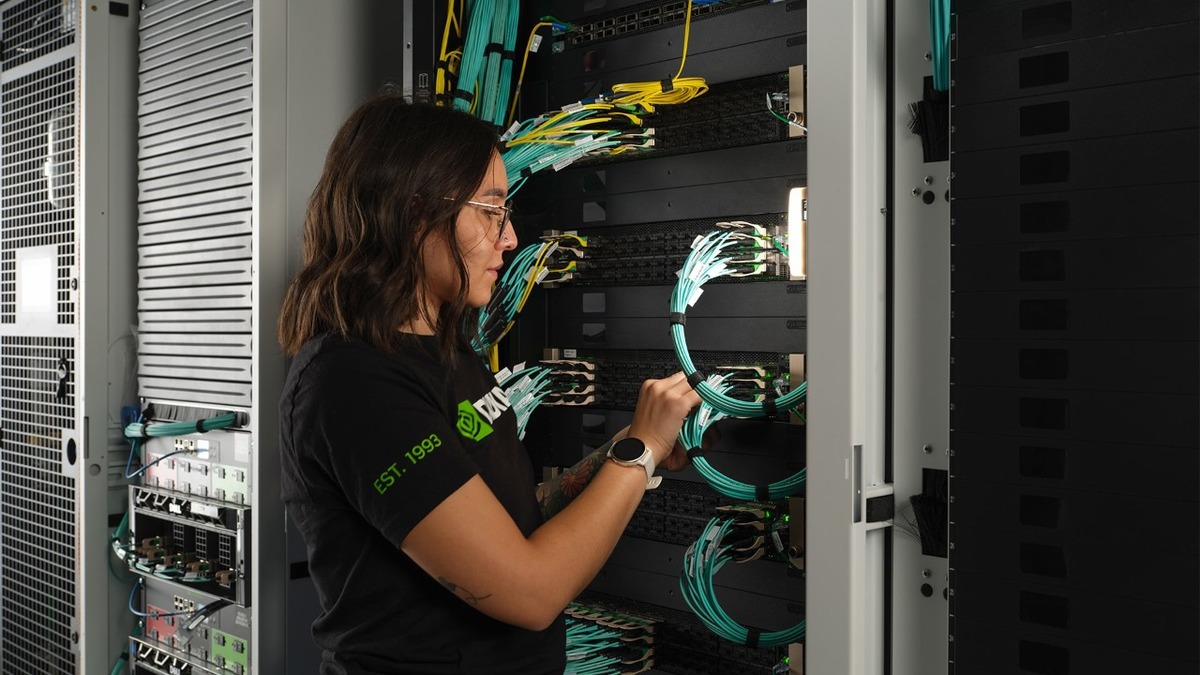 NVIDIA's AI Factory reference architecture now includes energy management as a first-class component with compute, networking, and storage.
Source: nvidia.com
NVIDIA's AI Factory reference architecture now includes energy management as a first-class component with compute, networking, and storage.
Source: nvidia.com
Trial Results So Far
NVIDIA and Emerald AI have completed five commercial data center trials over the past year. The public numbers come from two in detail.
London (December 2025): Nebius ran 96 Blackwell Ultra GPUs on NVIDIA Quantum-X800 InfiniBand. The trial modeled the UK's "TV Pickup" - the ~1 gigawatt demand surge that happens at major football match halftimes when millions of people simultaneously boil kettles. Results: 100% compliance across 200+ power targets; 22 distinct real-time dispatch events; 30%+ power reduction in under one minute.
Oregon (Portland General Electric, March 2026): Grace Blackwell Ultra clusters under real CAISO market signals. Results: 20% load curtailment during a freezing rain event; 25%+ reduction sustained over 6+ hours during a multi-day heat dome scenario; 24-hour sustained emergency response capability demonstrated.
A peer-reviewed paper from an earlier Phoenix trial with Oracle was published in Nature Energy, making this one of the few AI infrastructure claims with independent academic validation.
| Trial Location | Hardware | Peak Reduction | Response Time | Duration |
|---|---|---|---|---|
| London (Nebius) | 96x Blackwell Ultra | 33%+ | Under 60 seconds | Multiple events |
| Oregon (PGE) | Grace Blackwell Ultra | 25%+ | Not published | 6+ hours sustained |
| Virginia/Chicago | Hopper (Oracle) | Not published | Not published | Spatial inference shifting |
First Commercial Deployment
The first commercial-scale flexible AI factory is NVIDIA's own 96 MW Aurora data center in Manassas, Virginia. The deployment involves Digital Realty and PJM Interconnection - the grid operator for the mid-Atlantic region - and is expected to launch later in 2026. NVIDIA describes it as "one of the world's first power-flexible AI factories."
The energy company coalition backing the effort is major: AES, Constellation, Invenergy, NextEra Energy, Nscale Energy & Power, and Vistra all signed on at CERAWeek. Nscale is targeting 8 GW of onsite generation capacity, up from 2 GW currently.
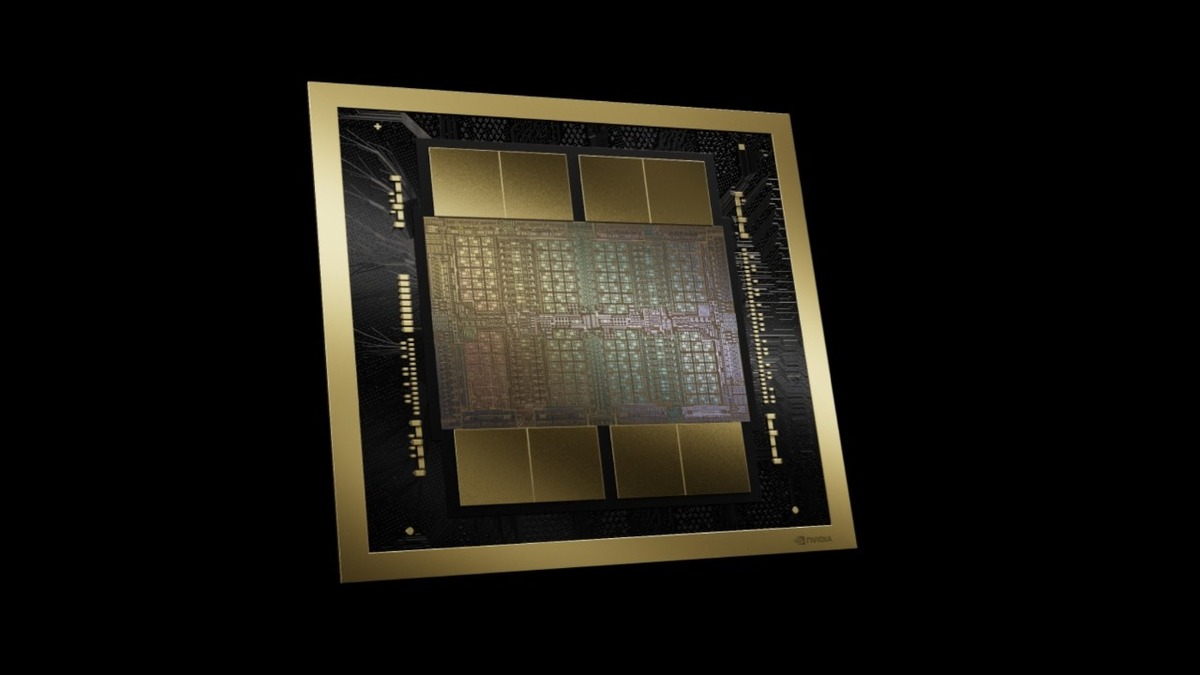 NVIDIA Blackwell GPU racks form the compute backbone of AI factories that DSX Flex can now dispatch as grid-responsive assets.
Source: nvidia.com
NVIDIA Blackwell GPU racks form the compute backbone of AI factories that DSX Flex can now dispatch as grid-responsive assets.
Source: nvidia.com
Where It Falls Short
The 100 GW number needs context
The 100 GW figure NVIDIA cites as potential U.S. grid capacity unlock is a theoretical ceiling, not a near-term target. It assumes wide adoption of flexible AI factories across the entire U.S. power system, optimized grid design, and full use of existing assets. The actual unlock from the first few deployments will be orders of magnitude smaller.
Demand response markets aren't homogenous
PJM and CAISO have mature demand response programs. Most U.S. utility territories don't. Scaling this model to the Southeast, the Mountain West, or international markets requires regulatory groundwork that NVIDIA and Emerald AI haven't addressed publicly.
GPU curtailment has real costs
A 30% power reduction on a Blackwell cluster is a 30% throughput reduction on whatever workload is running. For inference serving, that means slower responses or dropped requests. For training runs, it means paused jobs with potential checkpoint overhead. The trial results protect "high-priority workloads" by shedding lower-priority ones - but any operator with a fully loaded cluster is going to have opinions about which jobs get paused, especially under SLA.
Revenue targets are years out
NVIDIA noted that material revenue from the Arm AGI CPU - a separate but related infrastructure bet - starts in 2028. The grid flexibility story faces a similar timeline: the first commercial deployment launches later in 2026, but broad grid market participation requires regulatory approval, utility contracts, and operator adoption. Jensen Huang's framing of "NVIDIA Vera Rubin DSX as a complete AI factory platform" is accurate as a vision; as a revenue-generating product line, it's still early.
The underlying engineering is real. Five trials across three continents, a peer-reviewed paper, and grid operators like National Grid and PJM signing on as partners isn't marketing. But the distance between "we reduced power by 30% in a 96-GPU London cluster" and "AI data centers routinely participate in U.S. grid markets" is a long road - through utility regulators, interconnection queues, and operator workflows that move much slower than GPU generations.
Varun Sivaram's framing - that AI factories shouldn't have to choose between running at full capacity and being good grid citizens - is the right one. Getting there without that tradeoff is the actual engineering challenge, and DSX Flex is a credible first step toward it. The OpenAI Helion fusion energy deal and NVIDIA's grid flexibility push are converging on the same supply-side bottleneck from different directions. Whether either solution matures fast enough to keep pace with AI infrastructure demand over the next three years remains an open question.
Sources:

