
Nous Research Talks Put Open-Source Hermes at $1.5B
Nous Research is finalizing a round led by Robot Ventures and USV that would value the open-source Hermes agent maker at $1.5 billion, built on a training network that skips traditional data centers entirely.
 6 min read
Nous Research is finalizing a new funding round of at least $75 million led by Robot Ventures, with USV joining in, at a $1.5 billion valuation, according to TechCrunch. The company makes Hermes, an open-source AI agent with roughly 214,000 GitHub stars, and trains its models on a network that runs across the open internet instead of a single data center.
TL;DR
- Nous Research is in talks to raise $75M+ at a $1.5B valuation, led by Robot Ventures with USV participating
- Its flagship product, Hermes, is an open-source (MIT licensed) agent with 214,000 GitHub stars and 40,000 forks
- The company's latest model, Hermes 4.3, was trained on Psyche, a distributed network that coordinates GPUs over the internet using a Solana smart contract for consensus
- Hermes previously raised $50M from Paradigm in April 2025 at a $1B token valuation
- Nous Research declined to comment; neither USV nor Robot Ventures responded to requests for comment
What Hermes Actually Is
Hermes isn't a chatbot wrapper. It's a CLI agent that installs directly on a Linux, macOS, or Windows machine and runs continuously in the background:
curl -fsSL https://hermes-agent.nousresearch.com/install.sh | bash
source ~/.bashrc
hermes setup
Once configured, it reaches users through Telegram, Discord, Slack, WhatsApp, Signal, or email, and can be pointed at whichever LLM provider the user prefers. We covered its launch back in February, when Nous Research shipped it weeks after OpenClaw's own agent went viral.
The Memory and Skills Layer
What separates Hermes from a script that calls an API is persistence. It keeps full-text searchable session history via FTS5, builds a user profile across conversations through a system called Honcho, and creates new reusable "skills" automatically after it solves something difficult. Those skills are compatible with the open agentskills.io standard, so they aren't locked to Nous Research's own infrastructure.
The Numbers Behind the Hype
214,000 stars and 40,000 forks on GitHub is a real number, not a vanity metric picked by a marketing team. It puts Hermes in the same traffic tier as established developer tools, and it's the kind of adoption curve that VC term sheets get written around regardless of revenue. Nous Research sells a hosted version at $20 to $200 a month, but neither the company nor its investors would confirm how many people pay for it.
Under the Hood: The Psyche Network
The more interesting story sits underneath the funding headline. Nous Research just shipped Hermes 4.3, a 36-billion-parameter model built on Seed-OSS-36B-Base with a 512K token context window that the company says nearly matches its own 70B Hermes 4 at half the parameter count. What makes it remarkable isn't the benchmark, it's how it was trained.
Hermes 4.3 is the first Nous Research model post-trained entirely on Psyche, the company's distributed training network. Instead of renting a block of GPUs in one data center, Psyche coordinates 24 nodes scattered across the open internet.
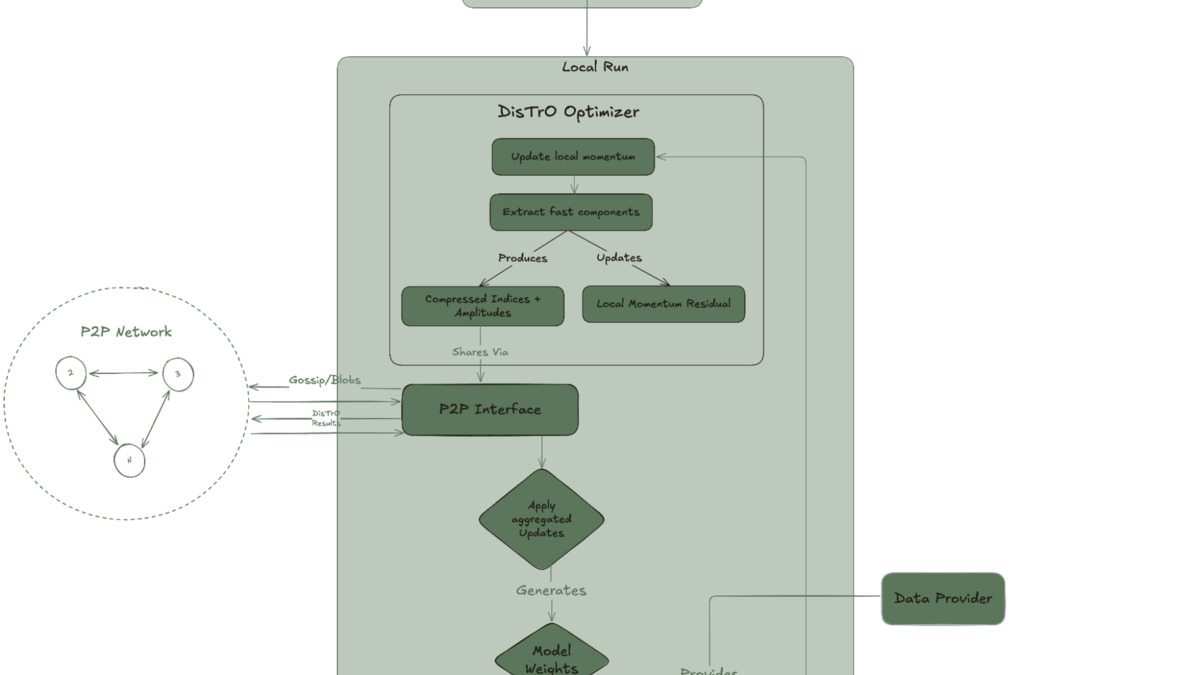 Psyche's architecture: each client runs a local forward/backward pass, compresses gradients with the DisTrO optimizer, and shares only the compressed update over a peer-to-peer mesh while a Solana smart contract manages coordination and consensus.
Source: nousresearch.com
Psyche's architecture: each client runs a local forward/backward pass, compresses gradients with the DisTrO optimizer, and shares only the compressed update over a peer-to-peer mesh while a Solana smart contract manages coordination and consensus.
Source: nousresearch.com
The DisTrO Optimizer
Ordinary distributed training needs near-constant, high-bandwidth communication between GPUs to sync gradients, which is why it happens inside a single data center over fast interconnects. Nous Research's DisTrO optimizer instead compresses each node's gradient update into a small set of indices and amplitudes before sharing it, cutting inter-node bandwidth needs from roughly 10Gbps down to about 1Gbps. That's slow enough to run over consumer-grade internet connections rather than a data center backbone.
Consensus Without a Central Operator
Coordination happens through a dual-layer setup: a Solana smart contract manages consensus state and assigns data batches to committees of nodes, while the actual gradient updates travel over a separate peer-to-peer mesh network, unrelated to the blockchain's own throughput. During the Hermes 4.3 run, the network averaged 144,000 tokens per second across the 24 nodes, and Nous Research says the Psyche-trained version of the model beat a centrally-trained control run on the same data.
Fault Tolerance as a Feature, Not an Afterthought
Because nodes can join or drop out mid-run without a central scheduler tracking them, Psyche was built to absorb individual node failures and accept new compute joining dynamically. That's a meaningfully different engineering problem than "add another node to the rack," and it's the part of Nous Research's pitch that has nothing to do with crypto speculation.
Running It Yourself
Hermes 4.3 ships as full-precision safetensors and as GGUF quantizations for local inference. The math is straightforward: 36 billion parameters at 16-bit precision is roughly 72GB, which needs multiple GPUs or a data-center-class card. Quantized to 4 bits, that drops to somewhere around 20GB, small enough for a single consumer GPU like an RTX 3090 or 4090.
| Deployment path | What it takes |
|---|---|
| Full precision (bf16 safetensors) | ~72GB VRAM, multi-GPU or a data center card |
| GGUF, 4-bit quantization | Roughly 20GB, fits a single RTX 3090/4090 |
| Hugging Face Inference | No local hardware, standard API billing |
| Nous-hosted Hermes agent | $20-$200/month, no GPU required |
Both the safetensors and GGUF builds are published on Hugging Face under the same permissive terms Nous Research uses across its model lineup, and third-party quantizers had community GGUF builds up within days of release.
 The Hermes 4.3 36B model card on Hugging Face, where Nous Research publishes both full-precision and GGUF builds.
Source: huggingface.co
The Hermes 4.3 36B model card on Hugging Face, where Nous Research publishes both full-precision and GGUF builds.
Source: huggingface.co
Where It Falls Short
None of this is proof that Psyche is ready to replace conventional training clusters at frontier scale. Twenty-four nodes training a 36B model is a real result, but it's still a small fraction of the thousands of GPUs labs like OpenAI or Anthropic use for models an order of magnitude larger. Nous Research hasn't published what it'd take to scale DisTrO's compression scheme to a run that size without losing the accuracy parity it claims at 36B.
The funding round itself is also thinner on detail than the valuation number suggests. Nous Research declined to comment on the raise, and neither Robot Ventures nor USV responded to requests for comment, according to TechCrunch's reporting. There's no confirmed revenue figure, no disclosed number of paying Hermes subscribers, and no breakdown of how much of the $1.5 billion valuation reflects the Hermes product versus speculative interest in the Psyche/Solana angle that made Nous Research's earlier $1 billion token valuation a crypto-press story as much as an AI one.
And the competitive picture hasn't gotten any easier. Hermes is chasing the same agent category as OpenClaw, plus every closed-source assistant with a Telegram integration, none of which have to justify a blockchain dependency to skeptical enterprise buyers. Open weights and a large GitHub following are real advantages. They aren't the same thing as a defensible business.
Sources:
- Hermes agent maker Nous Research in talks for new funding at $1.5B valuation - TechCrunch
- Introducing Hermes 4.3: Local Intelligence Globally Trained - Nous Research
- Democratizing AI: The Psyche Network Architecture - Nous Research
- Hermes-4.3-36B model card - Hugging Face
- Exclusive: Crypto VC giant Paradigm makes $50 million bet on decentralized AI startup Nous Research - Fortune

