
Niteshift Raises $7M to Be the Cloud for Coding Agents
Former Datadog engineers launch Niteshift, a $7M-backed cloud platform that runs AI coding agents in full-stack environments with model-agnostic routing.
 6 min read
Two ex-Datadog engineers just raised $7 million to solve a problem anyone running AI coding agents has hit: the development environment is the bottleneck, not the model.
Niteshift, which launched publicly today, describes itself as "the full-stack cloud for coding agents." The company gives coding agents - Claude Code, OpenAI Codex, open-source alternatives - a real environment to run in, verify against, and ship from: not a sandboxed file tree, but a full stack with databases, authentication, workers, and seeded data.
TL;DR
- Niteshift raised $7M seed led by Greylock with backing from Reid Hoffman and Datadog co-founders
- Platform runs full cloud development environments for AI coding agents, handling model routing across Claude, Codex, and open-source options
- Per-minute cloud pricing instead of token-based billing - sells infrastructure, not inference
- Agents produce merge-ready PRs with browser screenshots and test results attached as proof
- Targets large engineering teams and regulated-industry companies worried about vendor lock-in
What Niteshift Actually Does
Coding agents have a configuration problem. You point Claude Code or Codex at a repo, and the first 20 minutes are spent figuring out how to run the thing. Missing environment variables, unknown database seeds, CI/CD quirks that only the original author understands. Agents fail, hallucinate configs, and produce PRs that don't pass CI.
Niteshift solves this by front-loading environment setup. Point the platform at a repository, and an onboarding agent reads the documentation, Dockerfiles, and CI configuration to build a working environment. Later coding agents inherit that configured stack instead of starting from nothing.
Full-Stack Environments, Not File Sandboxes
The distinction Niteshift is drawing is between a code sandbox and a development environment. Most agent platforms give an agent access to a filesystem and maybe a shell. Niteshift provisions a full application stack: running databases, authenticated services, background workers, populated test data.
When an agent finishes a task, it runs the test suite and browser checks against that real environment. The resulting pull request includes screenshots and test output as verification artifacts - proof that the change worked before a human looks at it. Teams using the best agent sandbox tools today often bolt this verification layer on separately; Niteshift makes it built-in.
Model-Agnostic Routing
Niteshift doesn't lock you to one model. The platform currently supports Claude Opus 4.6 and Codex 5.3, with open-source options in the pipeline. Routing happens automatically based on task complexity and project requirements - a quick bug fix might go to a cheaper model, a complex architectural refactor to a more capable one.
This is the anti-lock-in pitch. If Anthropic raises prices or a better open-source model appears, teams can switch without re-architecting their workflow. The environment stays consistent; the model is just a parameter.
Work can be dispatched from GitHub, Linear, or Slack. The platform connects to external context sources - Notion, Figma, Linear - via remote MCP servers with OAuth.
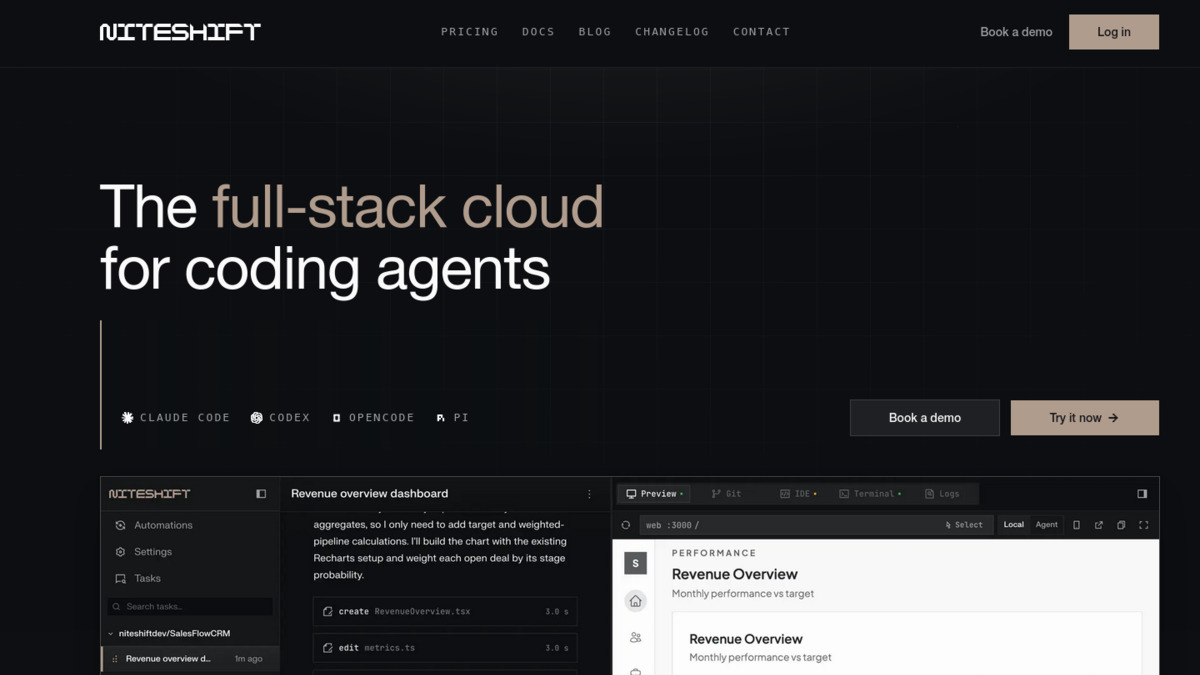 The Niteshift platform homepage. The company launched publicly today alongside its $7M seed announcement.
Source: niteshift.dev
The Niteshift platform homepage. The company launched publicly today alongside its $7M seed announcement.
Source: niteshift.dev
The Compatibility Matrix
| Feature | Niteshift | Typical Agent Sandbox |
|---|---|---|
| Full app stack (DB, auth, workers) | Yes | No |
| Model routing across providers | Yes | Rarely |
| Built-in PR verification artifacts | Yes | Manual setup |
| Parallel isolated environments | Yes | Limited |
| Dispatch from Slack / Linear | Yes | No |
| On-prem / self-hosted option | Not yet | Varies |
Who Is Backing It
The $7M seed round was led by Jerry Chen at Greylock, with Amplify Partners, BoxGroup, and SV Angel also participating.
Angel investors include Reid Hoffman, Datadog co-founders Olivier Pomel and Alexis Lê-Quôc, Ankur Goyal of Braintrust, and Misha Laskin of Reflection AI. The Datadog connection makes sense: founders Sajid Mehmood and Conor Branagan spent nearly a decade at Datadog building infrastructure and developer tooling before starting Niteshift.
Their background is visible in the product. The per-minute pricing model is borrowed directly from cloud compute - you pay for environment runtime, not token consumption. That's a different value proposition than most AI coding tools, which bill on model usage.
"Everybody's worried about getting stepped on by these giants." - Sajid Mehmood, Niteshift co-founder
How to Get Started
Niteshift is available now at niteshift.dev. Setup reportedly takes about an hour - the onboarding agent reads your repository and configures the environment automatically. The basic dispatch flow looks like this:
# Connect your repository
niteshift connect --repo github.com/your-org/your-repo

# Dispatch a task from the CLI
niteshift run "Fix the authentication timeout bug in the login flow"

# Or dispatch from GitHub via a label
# Add the label 'niteshift' to any issue and the agent picks it up
Tasks can also be triggered directly from Slack or Linear without touching the CLI. The resulting PR lands in GitHub with test output attached.
 Jerry Chen, Greylock partner, led Niteshift's seed round. Chen previously backed infrastructure companies including HashiCorp and Cockroach Labs.
Source: greylock.com
Jerry Chen, Greylock partner, led Niteshift's seed round. Chen previously backed infrastructure companies including HashiCorp and Cockroach Labs.
Source: greylock.com
Where It Falls Short
The market Niteshift is entering is crowded and well-funded. Cursor raised at a $50 billion valuation and has deep IDE integrations. Cognition raised $1 billion at a $26 billion valuation for its Devin product. Amazon Bedrock offers model routing as a managed service. OpenRouter, which handles cross-provider model routing, raised $113 million.
Niteshift's $7 million is seed-stage money against companies with hundreds of millions. That isn't necessarily fatal - Datadog started the same way - but it does define the near-term ceiling. Large enterprise deals, SOC 2 compliance, and on-prem options aren't mentioned yet.
The per-minute pricing model is appealing in theory but opaque in practice without published rates. "Infrastructure pricing" doesn't tell a team whether running 10 parallel agents costs $5 or $500 per day.
Model independence also isn't a novel idea. OpenRouter already routes across providers at the API level. What Niteshift adds is the environment layer - the contention is that routing is worthless without a properly configured environment to run in. That's a defensible position, but it needs proof at scale before it counters the head start competitors already have.
The comparison between Claude Code, Cursor, and Codex shows how fast this category is moving. Each of those products has iterated heavily in the past six months. Niteshift needs enterprise customers and usage data before the window closes.
Niteshift is available now with no waitlist. The founders are betting that infrastructure is the layer that survives even as models churn - that whoever owns the environment owns the workflow. It's a coherent thesis. Whether $7 million is enough to prove it before a well-funded competitor builds the same thing is the actual question.
Sources:

