
NEC Deploys Claude to 30,000 Engineers Across Japan
NEC becomes Anthropic's first Japan-based global partner, giving 30,000 employees Claude access to build what both companies call Japan's largest AI-native engineering organization.
 6 min read
NEC Corporation announced on April 23 that it's Anthropic's first Japan-based global partner, giving roughly 30,000 employees across the NEC Group access to Claude. The headline number makes it one of the largest enterprise Claude deployments anywhere. The more interesting detail is who NEC is: a company simultaneously building Japan's sovereign AI infrastructure and now all-in on a proprietary American model.
TL;DR
- NEC becomes Anthropic's first Japan-based global partner as of April 23, 2026
- 30,000 NEC Group employees worldwide get access to Claude, including Claude Opus 4.7 and Claude Code
- Target: build what both companies describe as Japan's largest AI-native engineering organization
- Sectors: finance, manufacturing, local government, cybersecurity
- NEC is also a founding member of Japan's $6.3B sovereign AI consortium - the dual bet tells you where Japan thinks this is actually going
Thirty Thousand Seats
Client Zero
NEC's approach has a name internally: Client Zero. The idea is that NEC becomes the first real-world test case for the tools it then sells to Japan Inc. Every consulting firm claims it eats its own cooking. Few do it at this scale.
The agreement sets up a Center of Excellence at NEC, staffed with engineers receiving direct technical training from Anthropic. Claude Code becomes the engineering workhorse - handling agentic, multi-step coding tasks that previous generations of AI tools could only gesture at. Claude Cowork, Anthropic's desktop AI agent for business operations, handles day-to-day knowledge work. Both feed into NEC's BluStellar Scenario, an existing platform that packages consulting, security, and digital infrastructure into a single offering for enterprise clients.
What Runs Where
The deployment spans several layers. At the individual level, 30,000 employees get Claude access for analysis, documentation, and knowledge work. At the engineering level, Claude Code drives software development workflows. At the product level, NEC will build industry-specific AI applications using Claude as the core intelligence, starting with tools for finance, manufacturing, local government, and cybersecurity.
NEC's Security Operations Centre is already running Anthropic's models to help clients defend against threats. That rollout predated this announcement. The April 23 agreement formalizes and expands it.
 NEC's headquarters in Minato, Tokyo. The company employs more than 100,000 people globally.
Source: commons.wikimedia.org
NEC's headquarters in Minato, Tokyo. The company employs more than 100,000 people globally.
Source: commons.wikimedia.org
Japan's Enterprise AI Gap
Japanese enterprises have been unusually slow to deploy AI relative to their US and Chinese counterparts. The reasons are structural: language barriers for English-centric models, strict data localization requirements, and procurement cultures that favor proven vendors over new entrants.
Finance, manufacturing, and local government are the three sectors NEC is targeting first - and they're the three most conservative in Japan's economy. Winning there requires models that pass rigorous compliance reviews, not just performance benchmarks.
NEC is the right vehicle for that kind of market penetration. It's Japan's largest IT system integrator, with deep relationships across every sector the agreement targets. When NEC rolls out something into a regional bank or prefectural government, the deal usually comes with integration services, ongoing support, and a multi-year contract. The pull-through effects on Anthropic's Japan presence are major.
The Double Bet
NEC is already a founding member of Japan AI Foundation Model Development - a joint venture launched in April 2026 by SoftBank, Sony, Honda, and NEC, backed by roughly ¥1 trillion ($6.3 billion) from Japan's government-linked NEDO agency. That consortium's explicit goal is a domestically trained trillion-parameter model that keeps Japan's AI infrastructure off American cloud providers.
And yet here is NEC, signing on as Anthropic's anchor partner in Japan.
This isn't contradictory - it's a hedge. Japan's approach to strategic industries has always been to bet on multiple horses. The sovereign model protects against worst-case geopolitical scenarios. The Anthropic deal gives NEC's clients access to the best working AI today, without waiting three to five years for a domestic alternative that may or may not match it.
"This long-term partnership enables NEC to maximize AI potential in the Japanese market," with solutions meeting "high safety, reliability, and quality standards."
- Toshifumi Yoshizaki, NEC COO
Paul Smith, Anthropic's Chief Commercial Officer, framed the partnership as "a meaningful step in our long-term commitment to shaping the future of AI in Japan." That's careful language - it says Anthropic is playing a long game here, not just picking up a revenue-producing contract.
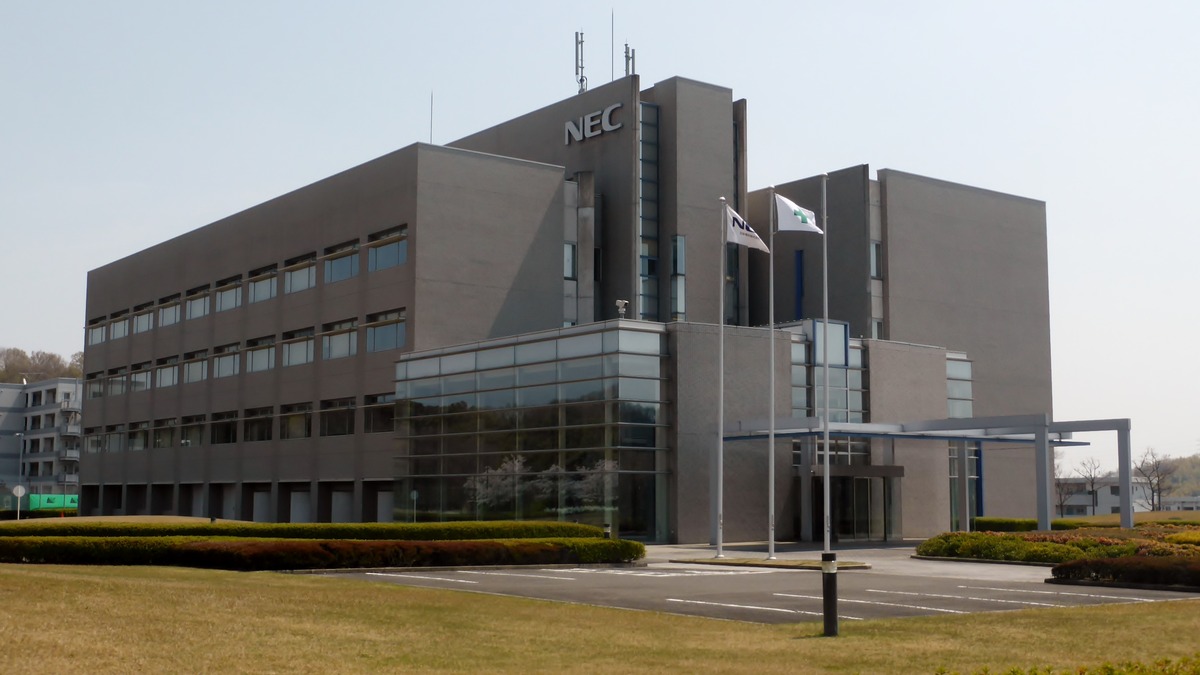 NEC's Kansai Research Laboratories. The Center of Excellence under the Anthropic agreement draws on NEC's existing research infrastructure.
Source: commons.wikimedia.org
NEC's Kansai Research Laboratories. The Center of Excellence under the Anthropic agreement draws on NEC's existing research infrastructure.
Source: commons.wikimedia.org
Timing and Context
The partnership was announced April 23 - one day after reports emerged that Anthropic had quietly removed Claude Code from its $20/month Pro subscription tier. The Register covered the change on April 22. Whether those two decisions were coordinated, the effect is the same: Claude Code is being repositioned as an enterprise product.
Anthropic's revenue is tracking toward roughly $19 billion in annualized run rate, with enterprise deals driving the growth. The NEC agreement discloses no financial terms, which is standard for partnerships at this stage. But an enterprise deployment covering 30,000 seats inside a corporation of NEC's size doesn't happen on trial pricing.
What It Does Not Tell You
"30,000 employees" is a headline number with no deployment timeline attached. Rolling out Claude to 30,000 people inside a Japanese corporation - with compliance reviews, data handling agreements, and user training - takes months, possibly longer. This is a commitment, not a done deal.
The agreement also doesn't address Japan's data localization requirements directly. Financial sector clients in particular face rules that restrict where certain data can be processed. How Anthropic's cloud infrastructure handles that for NEC's regulated customers will matter more than any partnership announcement.
Finally, integrating Claude into BluStellar Scenario sounds deep. Enterprise AI integrations often start as an API wrapper around an existing product. How embedded Anthropic becomes in NEC's core offerings - versus Claude as a layer sitting above existing systems - will be visible only as joint products start shipping.
The phrase "high safety, reliability, and quality standards" in Yoshizaki's statement isn't marketing. In Japan's regulated sectors, those words are procurement requirements. Banking regulators, prefectural IT departments, and manufacturing quality teams will hold them to account. That Anthropic agreed to a deal framed in those terms says as much about where Anthropic needs to go as it does about where NEC wants to take Claude.
Sources:

