
Mozilla Thunderbolt Lets Enterprises Run AI Locally
MZLA Technologies launches Thunderbolt, an open-source self-hostable AI client targeting enterprises locked into Copilot, ChatGPT Enterprise, and Claude - with local SQLite storage and full model freedom.
 5 min read
Mozilla's for-profit subsidiary MZLA Technologies - the team behind Thunderbird email - shipped Thunderbolt on April 16, 2026. It's an open-source AI client built for organizations that want to run AI workflows without their internal data touching Microsoft, OpenAI, or Anthropic servers.
The pitch is straightforward: pick your own models, deploy on your own hardware, own your data. MZLA CEO Ryan Sipes framed it plainly: "The problem we are solving today is one of sovereignty and control."
TL;DR
- Self-hostable via Docker Compose or Kubernetes, data stays in local SQLite files
- Model-agnostic: Anthropic, OpenAI, Mistral, OpenRouter cloud plus Ollama and llama.cpp locally
- Supports MCP servers and Agent Client Protocol for workflow automation
- Built on deepset's Haystack framework; licensed under MPL 2.0
- Currently pre-production, security audit ongoing, some features still in preview
What Thunderbolt Actually Is
Thunderbolt runs as a front-end application with four modes: Chat, Search, and preview-only Research and Tasks. The web client ships with native builds for Linux, Windows, macOS, iOS, and Android - which is an unusually wide platform reach for a project now.
MZLA vs Mozilla Foundation
MZLA Technologies is a for-profit corporation wholly owned by the Mozilla Foundation. The same team maintains Thunderbird. Mozilla provided grant funding for Thunderbolt, but the commercial entity is responsible for development and will monetize through professional services, deployment support, and a managed hosting tier that isn't live yet. The structure matters: MZLA can charge for services that the non-profit Mozilla Foundation legally can't.
Who This Is Actually For
Sipes specifically named finance, healthcare, and government as target verticals - industries where strict data residency requirements rule out cloud-first solutions. The pitch against Microsoft Copilot is direct: "Do you really want to build your AI workflows on top of a proprietary service from OpenAI or Anthropic... not to mention having all your internal company data flowing through their systems?"
He called it a "Firefox-versus-Internet-Explorer moment." That framing will resonate with the open-source crowd. Whether it maps onto enterprise procurement reality is a separate question.
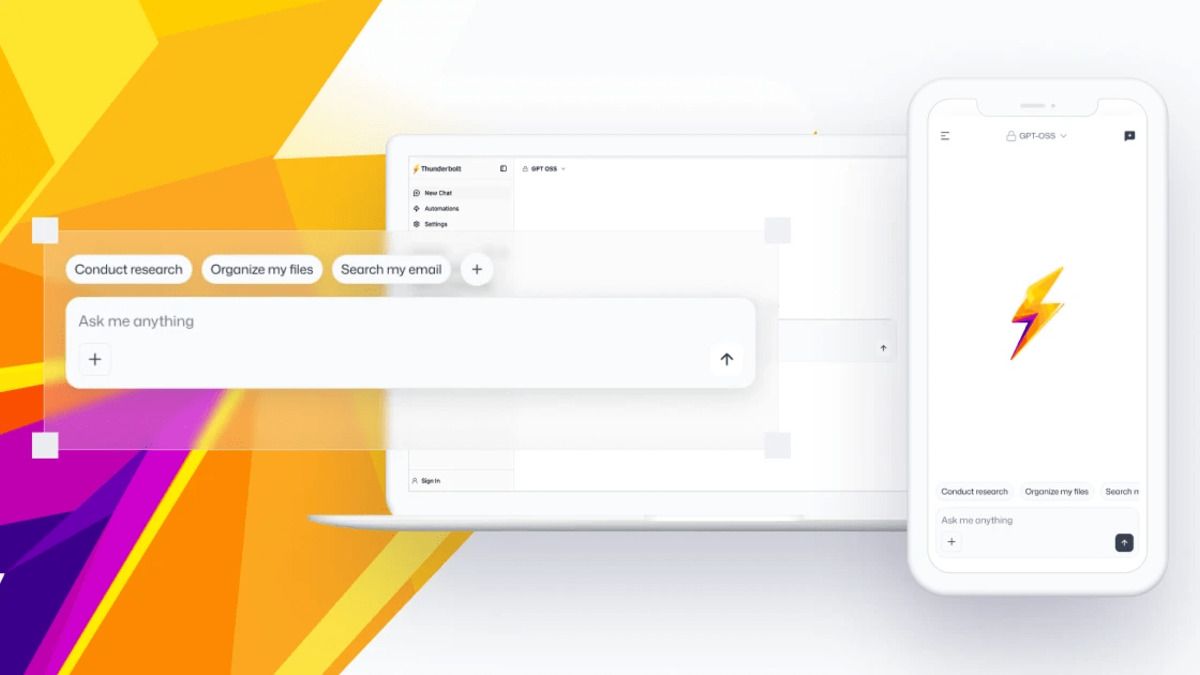 Thunderbolt's interface as shown in MZLA's launch material, featuring Chat and Search as the primary production-ready modes.
Source: omgubuntu.co.uk
Thunderbolt's interface as shown in MZLA's launch material, featuring Chat and Search as the primary production-ready modes.
Source: omgubuntu.co.uk
How It Works Under the Hood
The Haystack Backend
Thunderbolt's orchestration layer is built on deepset's Haystack framework, an open-source Python toolkit for building agent pipelines with retrieval-augmented generation. Deepset is Berlin-based, and Haystack already appears on Germany's sovereign D-Stack software list - which gives Thunderbolt a meaningful edge in EU public sector procurement where data sovereignty requirements are formal rather than aspirational.
Haystack handles the plumbing: connecting Thunderbolt's front-end to enterprise data sources, managing retrieval pipelines, and routing agent workflows. MZLA describes the integration as giving organizations "control not just over how they interact with AI, but how it is built and run."
Protocol Support
Thunderbolt connects to MCP servers and Agent Client Protocol (ACP) agents for workflow automation. MCP lets Thunderbolt call external tools - file systems, APIs, databases - through a standardized interface. ACP handles multi-agent coordination. Both protocols are increasingly standard in the enterprise AI client space, so supporting them out of the box keeps Thunderbolt compatible with the growing ecosystem of MCP-native tools.
Model Support
No lock-in on inference either. Thunderbolt supports:
| Provider Type | Options |
|---|---|
| Cloud APIs | Anthropic, OpenAI, Mistral, OpenRouter |
| Local inference | Ollama, llama.cpp, OpenAI-compatible endpoints |
| Authentication | OIDC with Google and Microsoft workspace integrations |
Data that passes through Thunderbolt gets stored locally in SQLite files rather than sent to any external service. The system can run fully offline on a single machine when pointed at a local model via Ollama or llama.cpp.
Deployment
Self-hosting runs via Docker Compose for single-machine deployments or Kubernetes for multi-node setups. A typical Compose-based startup looks like:
git clone https://github.com/thunderbird/thunderbolt
cd thunderbolt
cp .env.example .env
# Edit .env: set your model provider keys and OIDC config
docker compose up -d
The managed hosted version - aimed at smaller teams that don't want to run their own infrastructure - is still in development.
 On-premises deployment is Thunderbolt's core premise: AI that runs on hardware you control, not data centers you rent.
Source: unsplash.com
On-premises deployment is Thunderbolt's core premise: AI that runs on hardware you control, not data centers you rent.
Source: unsplash.com
Where It Falls Short
The honest read on Thunderbolt is that MZLA is shipping pre-production software and asking enterprises to evaluate it. The GitHub repository says explicitly: "under active development, currently undergoing security audit." Research and Tasks modes are preview-only. Full MCP support isn't complete. Offline-first operation requires network access for authentication and search in the current build.
Telemetry is enabled by default - a standout choice for a product whose core promise is data sovereignty. Users will need to explicitly opt out, which is the kind of detail that'll get noticed in regulated environments.
The naming is a problem too. "Thunderbolt" already refers to Intel's high-speed interconnect standard, used in virtually every laptop sold in the last several years. Enterprise IT teams assessing this will run into Intel Thunderbolt documentation constantly. It's a fixable annoyance, but it's an annoyance that shouldn't have shipped.
Finally, Thunderbolt enters a market that Mistral Forge and more open alternatives are already competing in. MZLA's advantage is Mozilla's brand trust among open-source advocates and the Haystack partnership's EU credentials - but neither of those is a moat.
The project pulled 557 GitHub stars in its first few days, which signals genuine community interest rather than just press coverage. That's a reasonable baseline. Whether enterprises convert from interest to deployment depends on what comes out of the security audit and how quickly the preview features stabilize.
Thunderbolt's code is at github.com/thunderbird/thunderbolt under MPL 2.0. The waitlist for hosted access is at thunderbolt.io.
Sources:
- Mozilla takes on enterprise AI providers with Thunderbolt - The Register
- Thunderbolt is an open-source 'AI client' from Mozilla's for-profit arm - OMG! Ubuntu
- Mozilla Announces Thunderbolt - Phoronix
- Mozilla challenges enterprise AI with Thunderbolt - Help Net Security
- Mozilla Ships Thunderbolt, Self-Hosted Enterprise AI Client - Implicator
- Mozilla announced Thunderbolt - GamingOnLinux

