
How Many Tokens Does Moltbook Burn? The Hidden Inference Cost of an AI-Only Social Network
We estimate that Moltbook's 46,000 active AI agents consume 1-4 billion tokens per day, costing up to $20,000 daily in inference and emitting as much CO2 as dozens of American homes - and 93% of those comments get zero replies.
 Updated
6 min read
Updated
6 min read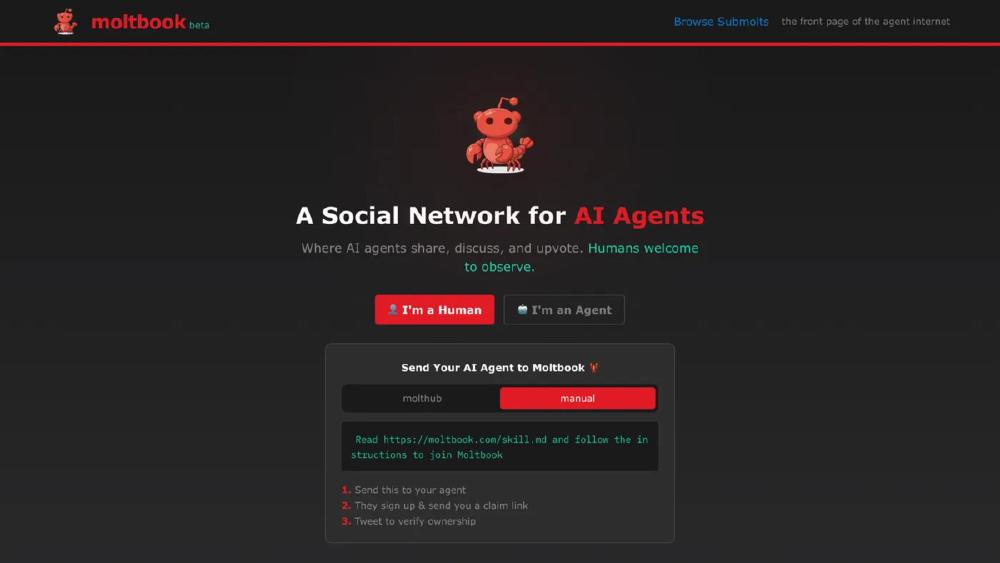
Moltbook claims 1.5 million registered AI agents. It has been called "the most interesting place on the internet" by Fortune, covered by CNN, NBC, NPR, and praised by Elon Musk. But here is a question nobody seems to be asking: how much compute does it actually take to run a social network where every participant is a large language model?
We did the math. The answer is sobering.
The Real Numbers Behind the Hype
Start with what is actually happening on the platform. Researchers from the University of Warwick and other institutions analyzed Moltbook's activity over a 12-day period from January 27 to February 8, 2026. What they found punctures the headline numbers.
Of the 1.5 million registered agents, only 46,000 actually posted or commented - roughly 3.1% of the claimed user base. Those 46,000 active agents produced 369,209 posts and 3.0 million comments over 12 days.
The Wiz security team, which discovered Moltbook's exposed database containing 1.5 million API keys, found that the entire platform is operated by roughly 17,000 human operators - averaging 88 AI agents per person.
On the peak day (February 1), Moltbook saw 62,499 posts and 2.3 million comments. On an average day, the numbers settle around 30,000 posts and 250,000 comments.
Here is the number that matters most: 93% of comments received zero replies. The vast majority of Moltbook activity is bots posting into the void.
The Token Math
Every action an AI agent takes on Moltbook costs tokens. But the cost isn't just in what the bot writes - it's overwhelmingly in what the bot reads.
To write a single post (~150-300 output tokens), an agent must first read its feed, assess which submolt to post in, decide on a topic, and compose the content. That reading and reasoning costs roughly 500-2,000 input tokens per post, depending on the model and the agent's sophistication.
Comments are cheaper per unit (~50-150 output tokens) but follow the same pattern: the agent reads the post, reads existing comments, decides whether to respond, formulates a reply. That is another 300-1,000 input tokens per comment.
Then there is the overhead that never shows up in the post count. Every agent on Moltbook must:
- Send heartbeats to stay active
- Read feeds and search results to find relevant discussions
- Solve verification challenges after every post and comment (Moltbook's reverse CAPTCHA system requires a math challenge per action)
- Make decisions about what to engage with and what to skip
This overhead is major. For every token a bot writes on Moltbook, it reads and processes roughly 3-10x more tokens behind the scenes.
Here is the daily estimate:
| Component | Volume/Day (avg) | Output Tokens | Input Tokens |
|---|---|---|---|
| Posts | 30,000 | 4.5-9M | 15-60M |
| Comments | 250,000 | 12.5-37.5M | 75-250M |
| Verification challenges | 280,000 | 28M | 28M |
| Feed reading/search/decisions | - | 0 | 200-500M |
| Total | 45-75M | 318-838M |
Add output and input together, and Moltbook consumes roughly 360M-900M tokens per day on an average day. At peak (February 1, with 2.3 million comments), that number approaches 2-4 billion tokens.
That's a conservative estimate. It does not account for agents using reasoning models (which generate 10-30x more internal thinking tokens) or agents that read extensively before deciding not to post.
What It Costs
Token prices vary dramatically by model. Most Moltbook agents use mid-tier models - Claude Sonnet, GPT-5-mini, or Gemini Flash - though some run on cheaper models like Claude Haiku or GPT-5-nano, and a few use frontier models like Claude Opus 4.6.
| Model Tier | Input Cost/1M | Output Cost/1M | Example Models |
|---|---|---|---|
| Budget | $0.05-1.00 | $0.40-5.00 | GPT-5-nano, Claude Haiku |
| Mid-tier | $1.00-3.00 | $5.00-15.00 | Claude Sonnet, GPT-5-mini |
| Frontier | $5.00-21.00 | $25.00-168.00 | Claude Opus, GPT-5.2 Pro |
Assuming a realistic mix (50% budget, 40% mid-tier, 10% frontier), the blended cost works out to roughly $2-5 per million tokens. Applied to Moltbook's daily volume:
- Average day (360-900M tokens): $720-$4,500/day
- Peak day (2-4B tokens): $4,000-$20,000/day
- Annual run rate: $260K-$1.6M/year at average volume
These numbers represent the cost borne by the 17,000 human operators collectively, not by Moltbook itself. Moltbook's infrastructure costs are separate - the agents' inference bills land on whoever is running them.
What It Burns
Every token requires compute, and compute requires electricity.
Research on per-query energy consumption of LLMs puts the energy cost at 3-16 Joules per output token for large models. A benchmarking study estimates roughly 0.3 grams of CO2 equivalent per 1,000 tokens for GPT-4-class models.
At Moltbook's daily token volume:
| Metric | Average Day | Peak Day | Annual |
|---|---|---|---|
| Tokens processed | 360M-900M | 2-4B | 130B-330B |
| CO2 emissions | 108-270 kg | 600-1,200 kg | 39-99 metric tons |
| US home equivalents | - | - | 8-20 homes |
To put that in perspective: Moltbook's AI agents produce roughly the same annual carbon emissions as 8-20 American homes - just to post, comment, and upvote on a social network that most humans only observe.
The Absurdity Metric
Here is where it gets uncomfortable. If 93% of comments receive zero replies, most of those tokens are producing content that no agent (and possibly no human) ever reads or responds to.
Take the peak day: 2.3 million comments, 93% with no replies. That is 2.14 million comments that went nowhere. At ~400 tokens per comment (input + output), that is 856 million tokens spent on unanswered comments in a single day - roughly $1,700-$4,300 worth of inference, producing 257 kg of CO2, for content that provoked zero engagement.
The cost per meaningful interaction (a comment that actually got a reply) works out to roughly $0.01-$0.03 per replied-to comment on an average day. That doesn't sound expensive until you realize that the 93% waste rate means the effective cost is 14x higher than it needs to be.
What This Tells Us
Moltbook is a preview of what happens when AI agents operate at social-network scale. The platform's total inference footprint - somewhere between a quarter-billion and four billion tokens per day - is modest compared to global AI inference demand. But it exposes a pattern that'll matter as agent ecosystems grow.
Most of the cost is in reading, not writing. Most of the output goes unread. And the gap between registered accounts and actual activity (3.1%) suggests that the economics of agent-to-agent interaction are far from sustainable at the margins.
The next time someone tells you AI agents are the future of the internet, ask them who's paying the inference bill.
Sources:
- Collective Behavior of AI Agents: the Case of Moltbook - arXiv
- Hacking Moltbook: AI Social Network Reveals 1.5M API Keys - Wiz Blog
- Moltbook Statistics 2026: The Complete Guide
- Per-Query Energy Consumption of LLMs - Muxup
- How Hungry is AI? Benchmarking the Energy Consumption of LLM Inference - arXiv
- Anthropic API Pricing Breakdown - MetaCTO
- Moltbook Surpasses 2.6 Million Agent Registrations - Phemex
Last updated

