
Mistral Vibe Adds Work Mode and a VS Code Extension
Mistral rebrands Le Chat as Vibe, ships Work Mode with enterprise integrations, a VS Code extension, and remote coding agents powered by Mistral Medium 3.5 at 77.6% SWE-Bench.
 7 min read
Le Chat is gone. Mistral renamed its consumer AI assistant to Vibe on May 28, consolidated work and coding into one subscription tier, and shipped a VS Code extension the same day. The backend powering both modes is Mistral Medium 3.5 - a 128B dense model that scored 77.6% on SWE-Bench Verified. This update makes Vibe a direct competitor to GitHub Copilot, Claude Code, and Cursor in a way the old Le Chat never was.
Mistral is pitching Vibe as "one agent and one licence across work and code." Practically, that means Work Mode handles scheduling, document synthesis, and enterprise integrations while Code Mode manages full coding sessions - from request to merged pull request - under the same Pro or Team subscription. No separate SKU for each surface.
TL;DR
- Le Chat rebranded to Vibe with two modes: Work (productivity/scheduling) and Code (coding agents)
- New VS Code extension runs the coding agent in a side panel with full project awareness
- Remote agents run in isolated cloud sandboxes - sessions persist even when your machine is off
- Powered by Mistral Medium 3.5: 128B dense, 256k context, 77.6% SWE-Bench Verified
- Pro plan: $14.99/mo; Team: $24.99/user/mo; model weights open on Hugging Face
From Le Chat to Vibe
Mistral launched Le Chat in early 2024 as a consumer chatbot. It grew into a coding product over time, but the name was a liability: consumers searched for the chatbot while developers needed the agent. The rebrand collapses both use cases under one brand.
All existing conversations, settings, and plans carry over automatically. Existing subscribers don't need to do anything. The pricing structure is unchanged: Free for basic tasks, Pro at $14.99/month, Team at $24.99/user/month, and Enterprise with custom deployments.
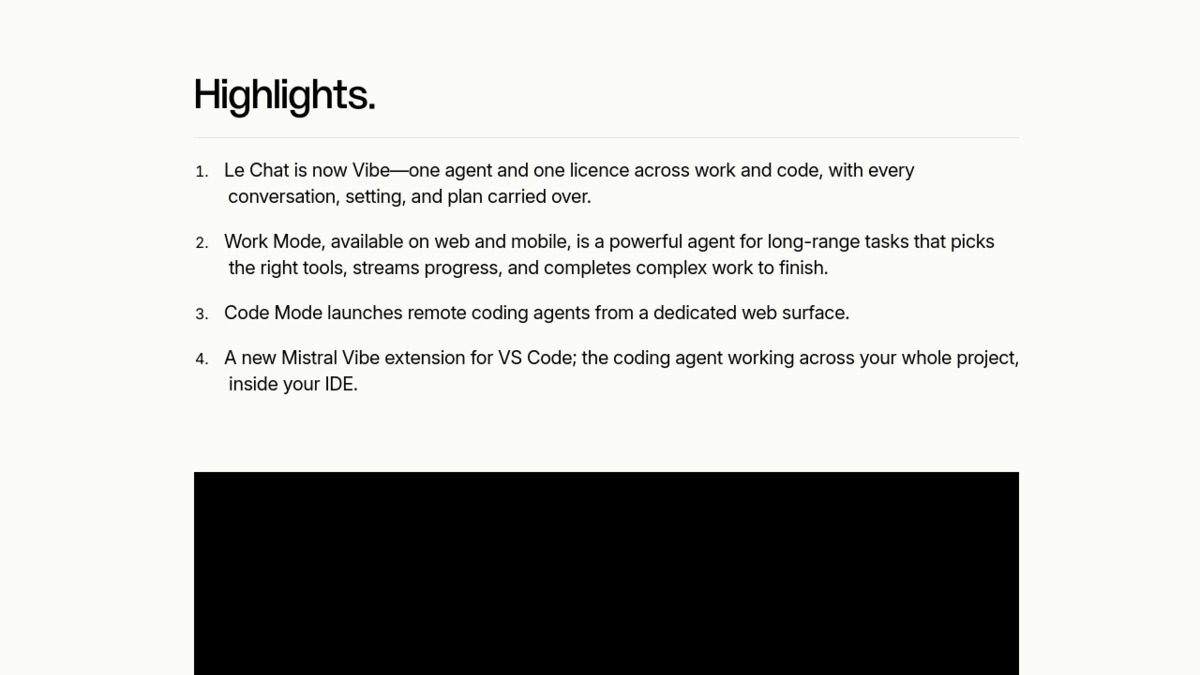 The official Vibe announcement lists four key changes: the rebrand, Work Mode, Code Mode with remote agents, and the VS Code extension.
Source: mistral.ai
The official Vibe announcement lists four key changes: the rebrand, Work Mode, Code Mode with remote agents, and the VS Code extension.
Source: mistral.ai
The platform surfaces have been reorganized. The web interface is now "Vibe," and Code Mode launched as a dedicated web surface. The CLI and the VS Code extension share the same infrastructure and feature parity - meaning a developer on the extension and a teammate on the web interface are using identical capabilities and the same model.
Pricing at a Glance
| Tier | Monthly price | Remote agents | Enterprise integrations |
|---|---|---|---|
| Free | $0 | No | No |
| Pro | $14.99 | Yes | Yes |
| Team | $24.99/user | Yes | Yes |
| Enterprise | Custom | Yes | Custom |
API access is priced separately at $1.50 per million input tokens and $7.50 per million output tokens - pay-per-use regardless of subscription tier.
Work Mode: The Long-Horizon Agent
Work Mode targets recurring, multi-step tasks that cross application boundaries. The agent connects to Google Workspace, Outlook, SharePoint, Slack, and GitHub natively, using OAuth per integration rather than API key juggling.
Enterprise Integrations
The enterprise knowledge search indexes across all connected sources simultaneously. A query that spans email threads, Slack channels, and shared documents comes back as a single synthesized response. Document outputs are produced via Mistral's Canvas tool - structured reports, summaries, and dashboards rather than raw text dumps.
Scheduled Tasks and Agent Approval
Work Mode supports scheduling at daily, weekly, or monthly cadences. Before executing any multi-step workflow, the agent presents a plan and requests user sign-off. That approval gate is the right design choice for anything touching email or calendar. Agents that fire autonomously without confirmation are a support ticket waiting to happen - Mistral built the pause in from the start.
Code Mode and the VS Code Extension
Code Mode handles software development from request to merged pull request. The headline feature is remote agents that run in isolated cloud sandboxes, separate from the local machine.
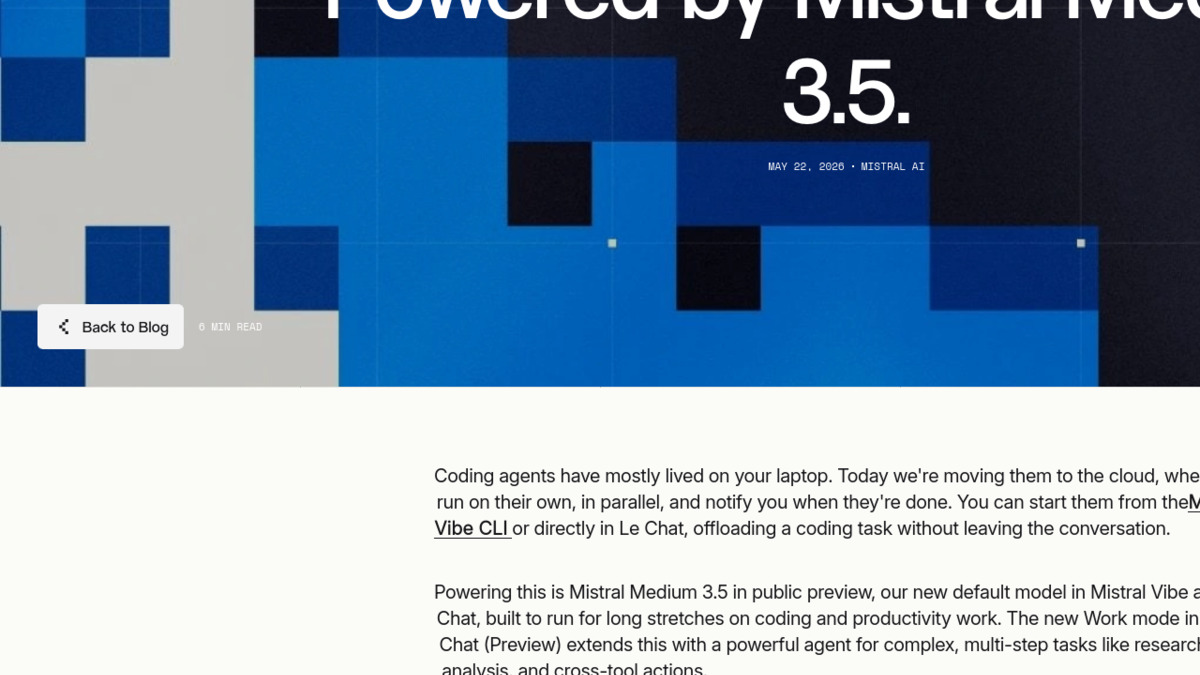 The Mistral Medium 3.5 announcement describes moving coding agents from the local machine to persistent cloud sandboxes.
Source: mistral.ai
The Mistral Medium 3.5 announcement describes moving coding agents from the local machine to persistent cloud sandboxes.
Source: mistral.ai
Remote Agents in the Cloud Sandbox
Remote agents run coding sessions in parallel and persist while your machine is off. That's a meaningful operational difference from local tools like Claude Code or Cursor - kick off a large refactor, close your laptop, and check back on completion. The GitHub integration covers the full lifecycle: create a branch, make changes, run tests, open a pull request.
Slack triggering is listed as "coming in June" without a specific date. Until it ships, kicking off a remote agent still requires going to the dedicated Code Mode web surface manually. For teams that already live in Slack, that gap reduces the async workflow appeal.
VS Code Integration Details
The VS Code extension runs in a side panel with full project access. Open files attach to the context automatically. Line-range selections work via highlight-then-click, and @ mentions pull context from other directories or files. The extension connects to GitHub, GitLab, Jira, and Linear for issue tracking and PR management.
# Install from the VS Code Marketplace
# Search: "Mistral Vibe" by mistralai
# Or via the dedicated page: https://mistral.ai/products/vibe/code/
The extension has feature parity with the CLI, which matters for teams using both. A developer working in VS Code gets the same context window, the same remote agent capabilities, and the same tool-call behavior as the CLI user next to them.
Mistral Medium 3.5 Under the Hood
Both Vibe modes run on Mistral Medium 3.5 as the default model. It's a 128B dense model with a 256k token context window - a significant jump from the 32k context of earlier Devstral models, which created real problems for large repository tasks.
Architecture
Mistral describes Medium 3.5 as their "first flagship merged model." A single set of weights handles instruction-following, reasoning, coding, and vision rather than routing between separate specialists. The vision encoder was trained from scratch rather than using CLIP, which Mistral says better handles variable image sizes and aspect ratios. Reasoning effort is configurable per API request - useful for tuning cost vs. quality on different task types.
Benchmarks
On SWE-Bench Verified - the benchmark testing real-world GitHub issue resolution - Medium 3.5 scores 77.6%. That's up from the 72.2% scored by Devstral 2, the model we tested in our Mistral Vibe 2.0 review. Five points may sound modest, but SWE-Bench gains at this score range are increasingly expensive to achieve. On the agentic τ³-Telecom benchmark, the model scores 91.4.
The model is open-weight and available on Hugging Face. Self-hosting runs on 4 GPUs - relevant for teams with data residency requirements who want Medium 3.5's capabilities without sending code to Mistral's infrastructure. API pricing is $1.50 per million input tokens and $7.50 per million output tokens for teams using the hosted version.
Where It Falls Short
Remote agents are cloud-only. Code Mode sandboxes run on Mistral's servers, which means private codebases cross their infrastructure during agent sessions. Teams operating under strict data residency rules or in air-gapped environments can't use Code Mode as-is.
The VS Code extension and CLI do have feature parity, but Cursor's integration goes deeper. Cursor builds active project graphs and understands codebase topology in ways a side panel doesn't reproduce. Vibe's advantage is connecting Work Mode and Code Mode on a single platform - a capability Cursor doesn't attempt - but pure IDE depth still favors the competition.
Slack triggering remains missing at launch, reducing the async angle Mistral is pushing. The use case where a colleague mentions a bug in Slack and a remote coding agent picks it up without manual intervention requires the June feature drop to arrive.
Finally, 256k context runs cost more than shorter contexts. Long-horizon Work Mode tasks pulling from multiple connected enterprise sources will consume token counts faster than users expect. The flat Pro subscription doesn't include unlimited token usage - API calls are pay-per-use on top of the subscription fee.
The Vibe rebrand gives Mistral a coherent enterprise pitch for the first time. One license, two surfaces, a model with open weights - and a clear statement that Mistral is competing for the developer stack, not just the consumer chat market. The remote agent sandbox is the technically interesting piece. Getting that right at scale, with the approval flows intact, is harder than it sounds.
Sources:

