
Microsoft Pledges $5.5B for Singapore AI and Cloud
Microsoft commits $5.5B to Singapore's cloud and AI infrastructure through 2029, one day after a separate $1B+ Thailand pledge, as Brad Smith tours Asia cementing Microsoft's position as the West's preferred AI infrastructure partner in the region.
 5 min read
Microsoft announced on April 1 that it will spend $5.5 billion on cloud and AI infrastructure in Singapore through 2029 - the company's largest single-country infrastructure commitment in Southeast Asia. The announcement came one day after Microsoft pledged more than $1 billion to Thailand, part of a coordinated regional push that Vice Chair and President Brad Smith is personally leading.
TL;DR
- $5.5B committed to Singapore cloud and AI infrastructure, 2025-2029
- Day after announcing $1B+ for Thailand (2026-2028)
- Free Microsoft 365 Copilot for 200,000+ Singapore tertiary students
- Singapore ranks #2 globally in AI adoption at ~62.8% generative AI penetration
- Brad Smith doing a direct government-to-CEO tour across Southeast Asia
The scale places Singapore in the same tier as the large European commitments Microsoft made in 2024 and 2025. Singapore's government has been openly courting Western hyperscalers as part of its National AI Strategy, and this announcement is the most significant response yet.
The APAC Tour
Brad Smith flew to Bangkok on March 31 for the Thailand signing, then moved to Singapore for the April 1 announcement. That sequencing was deliberate. By making both pledges in a 24-hour window, Microsoft is signaling a coherent regional strategy rather than a series of reactive decisions.
"Our ongoing investment in cloud and AI infrastructure reflects Microsoft's long-term confidence in Singapore as a global digital leader," Smith said in an official statement. "We're focused on helping people and organizations use AI by strengthening skills, increasing cybersecurity and resilience, and advancing trusted governance."
The tour follows similar moves by Google DeepMind and Anthropic in the region. Anthropic signed a safety MOU with Australia just 48 hours earlier, and Google has maintained a consistent regional expansion cadence through 2025. The AI labs and hyperscalers aren't waiting for formal US-ASEAN diplomatic frameworks - they're building bilateral relationships directly with governments.
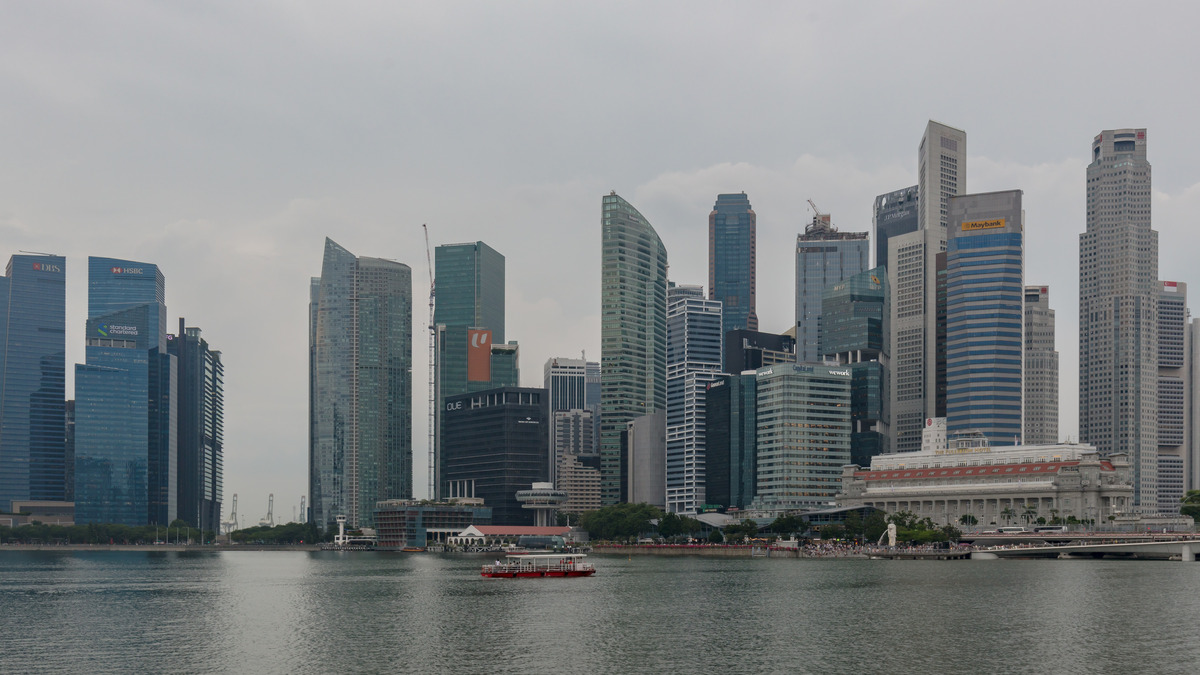 Singapore's Marina Bay district. The city-state ranks second globally in AI adoption, with generative AI reaching roughly 62.8% of the population as of Q1 2026.
Source: commons.wikimedia.org
Singapore's Marina Bay district. The city-state ranks second globally in AI adoption, with generative AI reaching roughly 62.8% of the population as of Q1 2026.
Source: commons.wikimedia.org
The Thailand deal is different in character from Singapore. Thailand's $1B commitment runs three years, relies heavily on local partners - Gulf Development, AIS, CP Group, True Corporation - and stresses green energy and "water positive" datacenter design. Singapore's $5.5B is a longer-cycle, larger-scale infrastructure bet with an explicit AI skilling program bundled in.
| Country | Commitment | Timeline | Key focus |
|---|---|---|---|
| Singapore | $5.5B | 2025-2029 | Cloud, AI infrastructure, education |
| Thailand | $1B+ | 2026-2028 | Datacenters, local partnerships, talent |
Who Benefits
Singapore
Singapore gets the obvious benefit: a hyperscaler anchor tenant for its growing datacenter ecosystem and a structural boost to local AI capability. The education side of the deal - 200,000+ tertiary students receiving free Microsoft 365 Premium with Copilot licenses for 12 months, plus the Elevate for Educators and Elevate for Changemakers programs - isn't window dressing. At 62.8% generative AI adoption, Singapore already has the user base. Skilling at the tertiary level converts that adoption into a trained workforce.
Dr. Janil Puthucheary, Singapore's Senior Minister of State for Education and Sustainability, framed it plainly: "Baseline AI skills are increasingly becoming as fundamental as digital literacy."
LinkedIn data cited in Microsoft's press release shows a 70% year-on-year growth in demand for AI literacy skills in the country. That number, if it holds, represents employers bidding wages up for workers with AI credentials - exactly the outcome Singapore's government has been engineering since the National AI Strategy relaunch.
Microsoft
Microsoft gets geography it cannot easily replicate. Singapore sits at the intersection of Southeast Asian internet traffic, operates as the financial and logistics hub for a region of 700 million people, and maintains strong relationships with both Washington and Beijing. That political ambiguity is an asset, not a liability.
The region is also growing fast. LinkedIn data from the same Microsoft report shows demand for AI literacy skills up 70% year-on-year in Singapore alone. The enterprise AI adoption curve across ASEAN is earlier-stage than the US or UK, which means Microsoft is buying into a market that has not yet consolidated around any single vendor.
At 62.8% generative AI adoption, Singapore already has the user base. Skilling at tertiary level converts that adoption into a trained workforce.
The investment also gives Microsoft political cover in a region where governments are increasingly forcing choices between US and Chinese tech stacks. Physical infrastructure - a datacenter that employs local workers and runs local government workloads - is a more durable relationship anchor than a cloud API contract.
 Brad Smith personally led the APAC tour, signing commitments in Thailand on March 31 before moving to Singapore on April 1.
Source: news.microsoft.com
Brad Smith personally led the APAC tour, signing commitments in Thailand on March 31 before moving to Singapore on April 1.
Source: news.microsoft.com
Southeast Asian enterprises and developers
Proximity matters for latency-sensitive workloads. More Singapore datacenter capacity from Microsoft means lower-latency Azure access for developers across Malaysia, Indonesia, the Philippines, and Vietnam - markets where AWS and Google Cloud have had longstanding advantages from earlier infrastructure investments. Developers who have been routing through older, more distant Microsoft nodes get a genuine performance win.
Who Pays
Microsoft's shareholders are funding a five-year, $5.5B commitment in a market where it faces established competition from AWS and Google Cloud. The capital cost is substantial and the payback period for hyperscale datacenter infrastructure normally runs eight to twelve years.
The pressure to deploy capital this aggressively is not coming from organic demand alone. It is coming from AI infrastructure competition. Meta signed a $27B deal with Nebius to secure European compute capacity it couldn't build fast enough internally. Oracle committed to a $156B AI data center buildout while simultaneously cutting 30,000 jobs to free cash flow. Mistral borrowed $830M to anchor a sovereign Paris GPU cluster. Every significant player in this market is making bets that the next phase of AI demand requires physical presence, not just cloud API access.
The $5.5B is not a discretionary bet on Singapore's potential. It's a forced move in a capital-intensive race where sitting out means ceding territory to a competitor who'll show up with infrastructure.
One-sentence verdict: Microsoft's Singapore pledge is the clearest evidence yet that the AI infrastructure arms race has moved from the data center halls of Virginia and Oregon into the government offices of Southeast Asia, and Brad Smith is playing ambassador as much as executive.
Sources:

