
Microsoft Bets on AMD's Helios to Crack Nvidia's Grip
Microsoft will deploy AMD's new Helios AI racks across Azure, joining Meta, Oracle and OpenAI as flagship customers in a direct challenge to Nvidia's 95% grip on the data center GPU market.
 6 min read
Microsoft is putting real money behind AMD's chips again, and this time it isn't a side bet. The company announced on July 20 that it'll deploy AMD's new Helios rack-scale AI system across Azure data centers, expanding what AMD and Microsoft describe as a "long-term strategic partnership" that now spans GPUs, CPUs, networking and software. AMD's stock jumped as much as 6% to 7.9% in the two trading sessions that followed, adding tens of billions of dollars to a market cap that has already more than doubled this year.
The headline number nobody said out loud: Microsoft didn't disclose contract value or GPU volume. What it disclosed instead is who else is already in line - Meta, OpenAI, Oracle and Tata Consultancy Services - which tells you more about where this is going than a dollar figure would.
TL;DR
- Microsoft will deploy AMD Helios racks - Instinct MI455X GPUs, EPYC "Venice" CPUs, Pensando networking, ROCm software - across Azure starting H2 2026
- Two new Azure VM families debut with it: HDv2 for agentic AI and data pipelines, HXv2 for chip design workloads
- AMD shares rose 6-7.9% on the news, extending a 2026 rally already north of 139%
- Microsoft joins Meta (up to 6 gigawatts committed), Oracle (a 50,000-GPU Helios supercomputer) and OpenAI as flagship Helios customers
- Nvidia still controls more than 95% of the data center GPU market; Futurum Group's Daniel Newman says AMD "can reach 20% to 25%"
What Microsoft Is Actually Buying
Helios isn't a chip, it's a rack. AMD's Instinct MI455X GPUs, sixth-generation EPYC "Venice" CPUs, Pensando data processing units and the ROCm software stack are bolted together into a single liquid-cooled, double-wide unit built to compete directly with Nvidia's GB300 NVL72. Microsoft says it will use Helios mainly for frontier-model inference - the compute-hungry work of actually serving trained models to users, as opposed to training them.
Two new Azure virtual machine families ride along with the hardware. Azure HDv2, built on the Venice CPUs, targets agentic AI and data pipeline workloads. Azure HXv2, same silicon, is aimed at semiconductor design work - the kind of chip-on-chip irony that only the AI infrastructure business produces. AMD is also expanding Pensando DPU deployment across Azure and integrating its silicon with Microsoft's Azure Boost networking layer.
 AMD and Microsoft's official partnership graphic accompanying the July 20 announcement.
Source: newsroom.amd.com
AMD and Microsoft's official partnership graphic accompanying the July 20 announcement.
Source: newsroom.amd.com
The Numbers Behind the Announcement
Key Specs
| Detail | Figure |
|---|---|
| AMD stock move (2 sessions) | +6% to +7.9% |
| AMD 2026 YTD stock gain | ~139% |
| AMD Q1 2026 revenue | $10.25B (+38% YoY) |
| AMD Q1 2026 data center revenue | $5.78B (+57% YoY) |
| AMD Q2 2026 revenue guidance | ~$11.2B (+46% YoY) |
| Nvidia data center GPU share | 95%+ |
| AMD data center GPU share | ~4.5% |
| Estimated Helios rack cost | $5M - $5.5M |
"AMD and Microsoft have spent years building high-performance infrastructure together, and today we're extending that partnership across the full stack of AMD AI solutions on Azure," said AMD CEO Dr. Lisa Su.
"Customers are looking for AI infrastructure optimized for a wide range of workloads, from training and inference to data preparation, search, and reinforcement learning," said Microsoft CEO Satya Nadella.
Who Benefits
AMD is the obvious winner. Landing Microsoft as a named Helios customer, alongside its earlier $100 billion deal with Meta, moves AMD from "GPU alternative" to "integrated AI infrastructure vendor" in the eyes of the market it actually needs to convince: hyperscalers weighing whether to keep every AI dollar flowing to Nvidia. Baptista Research analyst Ishan Majumdar put it plainly - the deal validates AMD as a full-stack provider, not just a chip-level challenger.
Microsoft benefits too, in a less flattering way for Nvidia. Every GPU that comes from AMD is a GPU Microsoft didn't have to negotiate for on Nvidia's terms, at Nvidia's allocation schedule. With Microsoft committed to roughly $80 billion in AI data center spending through 2028, a credible second supplier is worth real leverage even before a single Helios rack ships.
Who Pays
Nobody is writing a check they regret yet, but the risk sits with Microsoft's customers running production inference on Helios. AMD's ROCm software stack still trails Nvidia's CUDA ecosystem in maturity, and Counterpoint Research analyst Neil Shah was blunt about where the real competition lives: "the secret sauce is in the software and optimization... with CUDA, I think Nvidia has a bigger ecosystem, and it's quite ahead versus AMD." Enterprises that build on Helios inference now are betting AMD closes that gap before it costs them performance or migration headaches later.
Nvidia's Wall to Climb
Nvidia isn't standing still. The company has already unveiled its next-generation Kyber rack, doubling GPU density per rack to 144 from 72, and it still owns the software moat that keeps most AI workloads locked to CUDA. Futurum's Newman frames the upside for AMD in blunt dollar terms: "there is a significant case where AMD performs exceptionally well and can reach 20% to 25% market share... this is hundreds of billions of dollars of revenue." Getting from 4.5% to even half that requires more hyperscalers to do exactly what Microsoft just did.
AMD CEO Dr. Lisa Su has spent the past two years building toward this moment, chip launch by chip launch. At CES 2026, she held up the Instinct MI455X package that now sits central to every Helios rack Microsoft, Meta and Oracle are committing to.
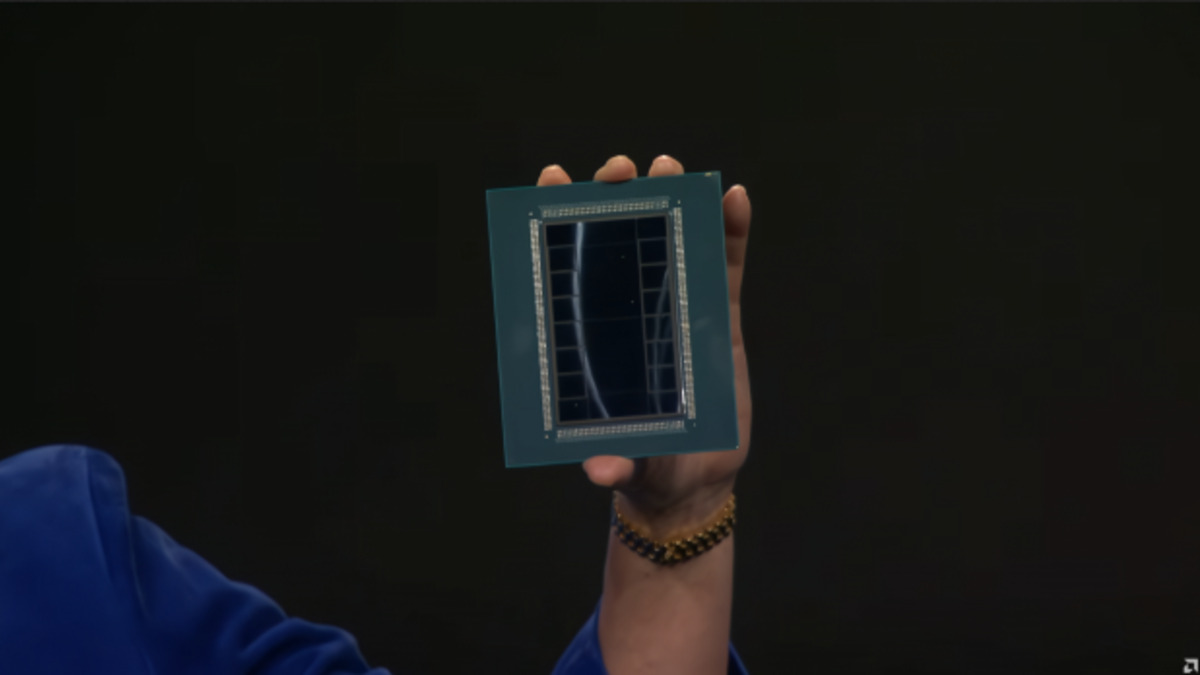 The AMD Instinct MI455X accelerator, the GPU that powers every Helios rack, shown at its CES 2026 unveiling.
Source: tweaktown.com
The AMD Instinct MI455X accelerator, the GPU that powers every Helios rack, shown at its CES 2026 unveiling.
Source: tweaktown.com
The deal doesn't dethrone Nvidia and nobody involved is claiming it does. What it does is give AMD a second flagship logo beyond Meta, real production volume commitments from Oracle and OpenAI already stacked behind it, and a stock market that is pricing in a future where "AI chips" stops being a synonym for "Nvidia." Whether that future arrives depends less on today's press release than on whether ROCm can do, in production, what AMD's slides say it can do on paper.
Sources:
- Microsoft to Deploy Next-Gen AMD Instinct and AMD EPYC Processors - AMD Newsroom
- Microsoft to Deploy Next-Gen AMD Instinct and AMD EPYC Processors as the Companies Expand Their Long-Term Strategic Partnership - GlobeNewswire
- Microsoft (MSFT) agrees to utilize AMD Helios AI infrastructure in its data centers - Shacknews
- AMD Rises After Microsoft's Helios Win: Is Nvidia Finally Facing Real Competition? - Benzinga
- AMD Lands Microsoft as Flagship Customer for New Helios AI System, Shares Jump 5% - BigGo Finance
- AMD Unveils Helios AI Rack System, Signs Microsoft In Direct Challenge To Nvidia - HNGN
- Microsoft adopts AMD Helios AI platform for Azure expansion - Digitimes

