
Microsoft Open-Sources Runtime Security for AI Agents
Microsoft released the Agent Governance Toolkit, a seven-package open-source system that enforces policies on autonomous AI agents at sub-millisecond latency and covers all 10 OWASP agentic risks.
 6 min read
The gap between shipping an AI agent and governing what it does in production has been growing for months. On April 2, Microsoft put out its answer: the Agent Governance Toolkit, a seven-package open-source system that drops a runtime policy layer between your agent framework and every action the agent takes.
TL;DR
- Seven independently installable packages for Python, TypeScript, Rust, Go, and .NET
- Policy enforcement at less than 0.1ms p99 - roughly 10,000x faster than an LLM API call
- Covers all 10 OWASP Agentic Top 10 risks through deterministic controls
- MIT license, public preview, framework-agnostic (LangChain, CrewAI, OpenAI Agents SDK, and more)
- Plans to donate the project to a foundation for community governance
The timing is deliberate. NIST published its AI agent standards framework in February, OWASP finalized its Agentic Top 10 in December 2025, and enterprises are now launching agents to book flights, execute trades, and write and ship code. Governance tooling hasn't kept pace.
What the Toolkit Actually Does
This isn't a content filter. It does not sit between your prompt and the model. The Agent Governance Toolkit intercepts actions - the things an agent tries to do after the LLM has responded - and assesses them against policies before they run. That distinction matters.
The core component is Agent OS, a stateless policy engine that runs every action through configured rules and returns allow or deny in under 0.1 milliseconds. You write policies in YAML, OPA Rego, or Cedar - whichever you already use. No new DSL to learn.
from agent_os.policies import PolicyEvaluator

evaluator = PolicyEvaluator()
evaluator.load_policies("policies/")

decision = evaluator.evaluate({
    "agent_id": "analyst-1",
    "action": "tool_call",
    "tool_name": "web_search",
})

if decision.allowed:
    # proceed
    pass
For more complex scenarios, you can use Rego directly:
evaluator.load_rego(rego_content="""
package agentos
default allow = false
allow { input.tool_name == "web_search" }
allow { input.role == "admin" }
""")
The Seven Packages
The toolkit ships as a monorepo with independently installable components. You don't have to use all seven.
Agent OS - the policy engine described above. This is the core. Everything else builds on top of it.
Agent Mesh - handles cryptographic identity for agent-to-agent communication using decentralized identifiers (DIDs) with Ed25519 signing, plus SPIFFE/SVID support. Each agent gets a trust score on a 0-1000 scale that decays over time and degrades when the agent's behavior drifts.
Agent Runtime - implements execution rings (inspired by CPU privilege levels) and saga orchestration for multi-step agent tasks. It also includes an emergency termination kill switch.
Agent SRE - brings standard reliability engineering to agents: SLOs, error budgets, circuit breakers, and chaos engineering mode for testing agent behavior under failure conditions.
Agent Compliance - maps your policies to specific regulatory frameworks and produces a compliance grade. Currently covers EU AI Act, HIPAA, and SOC2.
Agent Marketplace - manages plugin lifecycle with Ed25519-signed packages, addressing supply chain risk in agentic systems.
Agent Lightning - governs reinforcement learning training workflows by shaping rewards based on policy constraints. This is the most experimental of the seven.
 The toolkit intercepts agent actions before execution, not after, which means policy decisions happen before any external system is touched.
Source: socket.dev
The toolkit intercepts agent actions before execution, not after, which means policy decisions happen before any external system is touched.
Source: socket.dev
Installation and Framework Support
The quickest way to install the full Python package:
pip install agent-governance-toolkit[full]
For other languages:
| Language | Package | Install Command |
|---|---|---|
| Python 3.10+ | agent-governance-toolkit | pip install agent-governance-toolkit[full] |
| TypeScript/Node | @agentmesh/sdk | npm install @agentmesh/sdk |
| .NET | Microsoft.AgentGovernance | dotnet add package Microsoft.AgentGovernance |
| Rust | agentmesh | cargo add agentmesh |
| Go 1.21+ | agent-governance-toolkit | go get github.com/microsoft/agent-governance-toolkit/sdks/go |
The framework integrations hook into native extension points rather than requiring code rewrites. LangChain support uses callback handlers, CrewAI uses task decorators, Google ADK uses the plugin system, and Microsoft Agent Framework uses middleware. The OpenAI Agents SDK and LangGraph integrations are published to PyPI. Haystack and PydanticAI integrations are also shipped.
import { PolicyEngine } from "@agentmesh/sdk";

const engine = new PolicyEngine([
    { action: "web_search", effect: "allow" },
    { action: "shell_exec", effect: "deny" },
]);

const decision = engine.evaluate("web_search");
How It Maps to the OWASP Agentic Top 10
OWASP published the Agentic Top 10 for 2026 in December after more than 100 security researchers reviewed the framework. The toolkit claims to address all ten.
| OWASP Risk | Toolkit Mitigation |
|---|---|
| ASI01 - Goal Hijacking | Semantic intent classifier detecting DESTRUCTIVE_DATA, DATA_EXFILTRATION, PRIVILEGE_ESCALATION |
| ASI02 - Tool Misuse | Capability sandboxing and MCP security gateway |
| ASI03 - Identity Abuse | DID-based identity with behavioral trust scoring |
| ASI04 - Supply Chain | Plugin signing with Ed25519 |
| ASI05 - Code Execution | Execution rings with resource limits |
| ASI06 - Memory Poisoning | Cross-model verification kernel with majority voting |
| ASI07 - Insecure Communications | Inter-agent trust protocol encryption |
| ASI08 - Cascading Failures | Circuit breakers and SLO enforcement |
| ASI09 - Human-Agent Trust Exploitation | Approval workflows with quorum logic |
| ASI10 - Rogue Agents | Ring isolation, trust decay, and automated kill switch |
The decision to cover all ten rather than cherry-pick is a deliberate design choice - the threat surface of a launched agent isn't optional.
Imran Siddique, principal group engineering manager at Microsoft, described the toolkit as adding "a runtime security layer that enforces policies to mitigate" prompt injection and improve visibility into agent behavior.
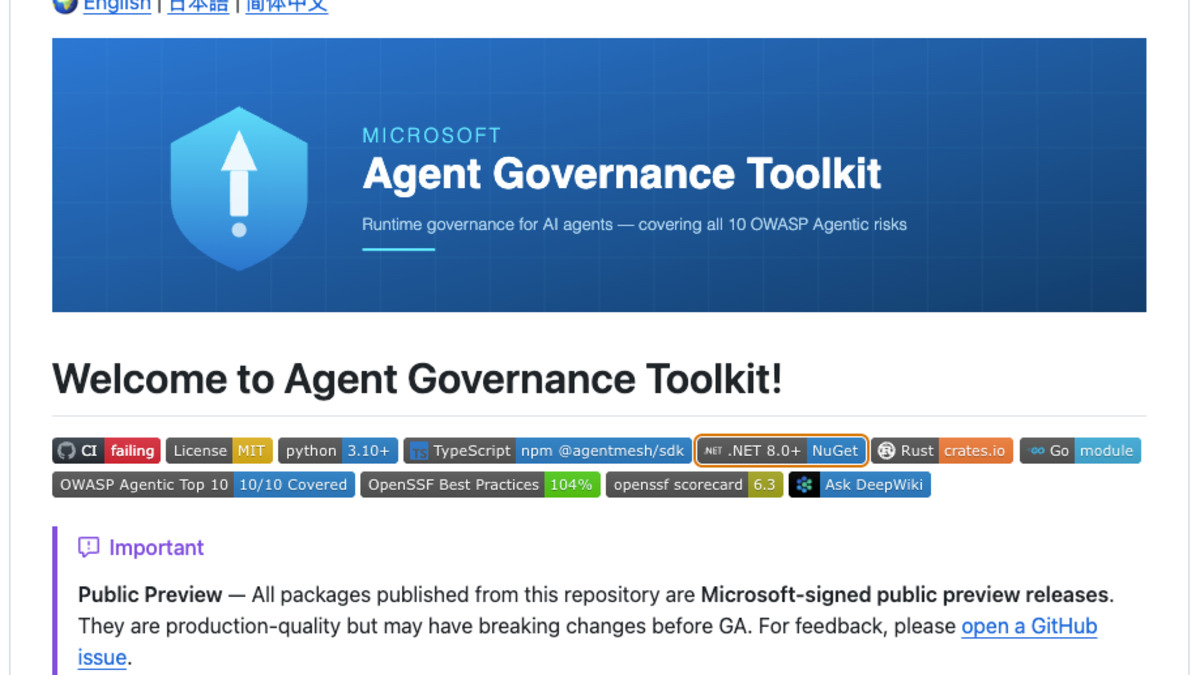 The seven packages can be installed independently - you do not need the full stack to get value from Agent OS alone.
Source: socket.dev
The seven packages can be installed independently - you do not need the full stack to get value from Agent OS alone.
Source: socket.dev
Where It Falls Short
The toolkit has real gaps worth flagging before you assess it for production.
No Independent Validation of the Intent Classifier
The semantic intent classifier is the mechanism Agent OS uses to catch goal hijacking. It classifies actions as DESTRUCTIVE_DATA, DATA_EXFILTRATION, or PRIVILEGE_ESCALATION. But the classifier's performance against actual adversarial inputs hasn't been independently confirmed. Microsoft ships benchmarks against internal test suites. That isn't the same as third-party red-team results.
Sample Configs Are Not Production-Ready
The documentation says it explicitly: "All policy rules, detection patterns, and sensitivity thresholds are externalized to YAML configuration files. Organizations must customize sample configurations before production." The toolkit ships with example configs, not hardened defaults. If you deploy it as-is, you'll have gaps.
Still Public Preview
Breaking changes are possible before general availability. For teams launching in regulated environments - healthcare, finance - this matters. The roadmap for a stable v1.0 isn't published.
No Track Record Yet
The 9,500 tests and continuous fuzzing in the repo are meaningful signals of engineering quality. Production deployments that have stress-tested the system at scale don't exist yet, at least not publicly. Cisco's DefenseClaw has a similar runtime interception approach and has at least some disclosed production deployments to reference. The Agent Governance Toolkit doesn't.
Despite those caveats, this is the most complete open-source attempt at the agentic governance problem to date. The OWASP alignment gives security teams a framework for requirements. The multi-language support removes the "Python-only" constraint that kills adoption in polyglot shops. And the framework-agnostic design means you can slot it in next to whatever agent orchestration you already run.
Anthropic's Managed Agents and similar production agent platforms are pushing the capability envelope. The governance layer to match them has been overdue. Microsoft's toolkit isn't a finished answer, but it's a credible starting point and it's open-source, which means the missing pieces can be built in public.
Sources:
- GitHub: microsoft/agent-governance-toolkit
- Microsoft Open Source Blog - Introducing the Agent Governance Toolkit
- Help Net Security - Microsoft releases open-source toolkit to govern autonomous AI agents
- InfoWorld - Microsoft's new Agent Governance Toolkit targets top OWASP risks for AI agents
- OWASP Top 10 for Agentic Applications 2026

