
Meta Opens Muse Spark 1.1 API for Agentic Coding
Muse Spark 1.1 launches via a public API preview with 1M token context and $1.25/M input pricing, scoring 68.3 on Meta's own coding benchmark against Opus 4.8's 69.0.
 6 min read
Three months after the original Muse Spark launched without a public API, Meta is opening the door. Muse Spark 1.1, announced July 9, ships via a new Meta Model API in public preview - and it brings a meaningfully changed model underneath: a 1 million token context window, restructured agentic architecture, and pricing at $1.25 per million input tokens.
Key Specs
| Spec | Value |
|---|---|
| Context Window | 1 million tokens (actively managed) |
| Input Pricing | $1.25 / million tokens |
| Output Pricing | $4.25 / million tokens |
| API Access | Meta Model API, public preview |
| Input Modalities | Text, image, video, PDF |
| Tool Use | MCP servers, custom skills, zero-shot |
| Parallel Tool Calling | Yes |
| Structured Output | Yes |
| API Compatibility | OpenAI-compatible |
Mark Zuckerberg announced the release on X - his first post in three years - calling Muse Spark 1.1 "a strong agentic and coding model at a very low price." The same day, Meta also launched Muse Image and Muse Video, separate products from Meta Superintelligence Labs targeting creative workflows. Muse Spark 1.1 is the developer-facing piece - the one the original Muse Spark launch deferred.
What Changed in 1.1
Context Window and Memory Management
The jump from 262K to 1 million tokens comes with an active management layer. The model summarizes earlier steps, retrieves relevant information from much earlier in a session, and compacts context to preserve the intermediate state needed for later work. For long agentic runs involving multi-step code migrations or extended debugging sessions, this matters more than the raw token count. Passive 1M windows exist elsewhere; what Meta describes here is closer to session memory with selective retention.
Agentic Architecture
Muse Spark 1.1 is trained to operate as both an orchestrator and a subagent within multi-agent systems. As the main agent, it gathers context, builds a plan, and delegates execution to parallel subagents to cut end-to-end latency. As a subagent, it tracks its scope, understands the available tools, and escalates when it hits a constraint.
The model zero-shot generalizes to new tools without any fine-tuning for new integrations - including MCP servers and custom skills. Parallel tool calling and structured output are built in.
Coding Gains
Coding was the original Muse Spark's weakest area - its Terminal-Bench 2.0 score trailed GPT-5.4 by a wide margin, as detailed in the model card. Meta says 1.1 improved substantially on real-world tasks involving "large, complex codebases." The company's Meta Internal Coding Bench shows Muse Spark 1.1 at 68.3, just behind Opus 4.8 at 69.0 and ahead of GPT 5.5 at 67.1, with the original Muse Spark scoring 58.8 on the same bench.
The model supports common agentic coding setups including planning mode, goal conditioning, subagent delegation, and context compaction. Meta's blog shows it running in OpenCode, fixing a web app by taking automated screenshots, tracing failures back to specific code, and confirming the fix before handing back to the user.
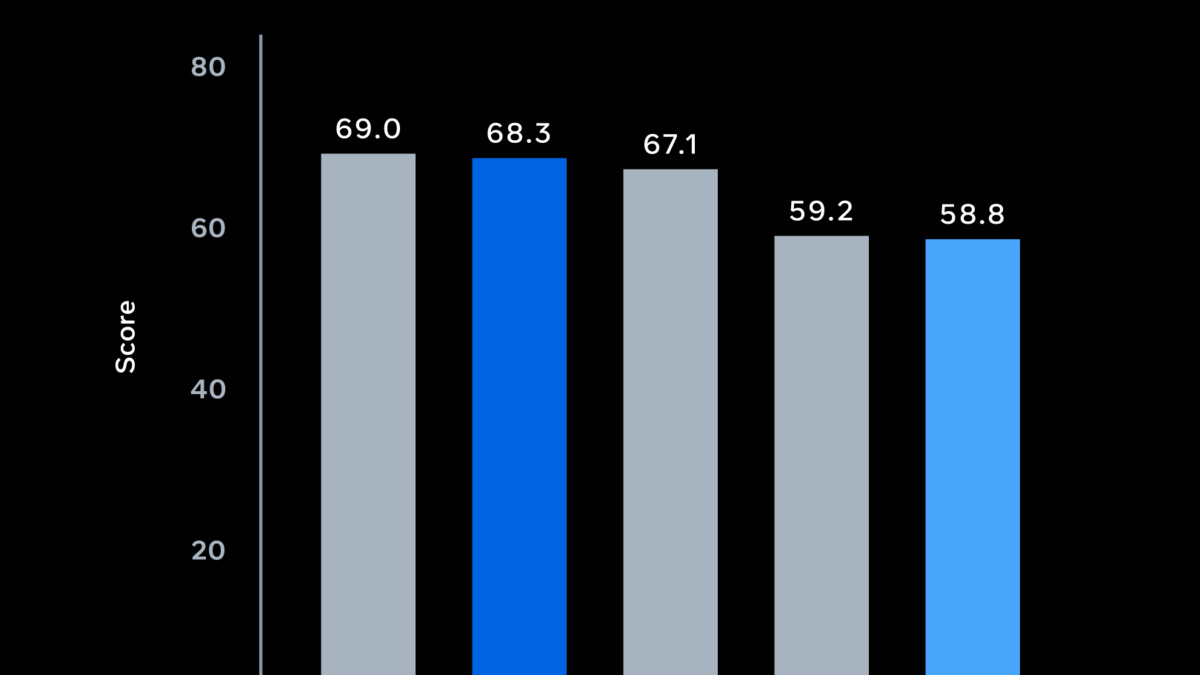 Meta Internal Coding Bench scores: Muse Spark 1.1 at 68.3 sits between Opus 4.8 max and GPT 5.5 xhigh. Original Muse Spark scored 58.8 on the same benchmark.
Source: ai.meta.com
Meta Internal Coding Bench scores: Muse Spark 1.1 at 68.3 sits between Opus 4.8 max and GPT 5.5 xhigh. Original Muse Spark scored 58.8 on the same benchmark.
Source: ai.meta.com
Computer Use
Computer use got a similar architecture update. The model chooses between writing automation scripts and direct interface interaction based on what's faster for the task at hand. Meta's example: the model places a dinner order across multiple apps, then adapts mid-task when new context arrives that changes the order - without user intervention.
This isn't a passive screenshot-and-click loop. The model produces "batches of actions at each step," deciding when scripting is faster and when direct interface navigation is simpler. The approach is similar in spirit to how agentic coding tools like ZCode handle multi-step workflows, though integrated directly into the model rather than as a wrapper layer.
Who's Already Building With It
The partner list Meta assembled for the public preview covers several major agentic coding platforms.
"Massive million-token context, full multimodal support (images, video, PDFs), built-in search with citations, strong reasoning, top-tier coding abilities - particularly frontend and design - structured output, and parallel tool calling - all in a clean OpenAI-compatible package. A complete agentic foundation."
- Amjad Masad, CEO of Replit
"Meta is clearly building for serious agentic coding - strong tool use at a price point that makes it viable to run real coding workloads at scale. That combination is rare, and it's exactly why we wanted Cline developers to have access early."
- Saoud Rizwan, CEO of Cline
Box tested it against their enterprise work evaluation set and called it "competitive with today's leading frontier models." OpenClaw's Dave Morin confirmed 1.1 is available to OpenClaw users.
The spread of early partners - consumer coding tools, enterprise platforms, open agentic frameworks - suggests Meta targeted representation across segments rather than a single use case to anchor the preview.
 Meta's official Muse Spark 1.1 announcement page, featuring coding and computer-use demos with partner quotes from Replit, Cline, and Box.
Source: ai.meta.com
Meta's official Muse Spark 1.1 announcement page, featuring coding and computer-use demos with partner quotes from Replit, Cline, and Box.
Source: ai.meta.com
Pricing in Context
At $1.25 per million input tokens and $4.25 per million output tokens, Muse Spark 1.1 lands in the same tier as Claude Haiku 4.5 rather than competing directly with Opus or GPT-5.4. The 1M context at this price point is what changes the comparison - running a sustained agentic coding session within a single context instead of chunking and re-prompting affects actual per-task cost even when per-token prices look similar.
The coding benchmarks leaderboard will update as independent evaluations come in. External SWE-bench or similar scores aren't published yet.
What To Watch
The main gap in the announcement is external validation. Meta's own Internal Coding Bench shows a strong jump from 58.8 to 68.3, but it's a proprietary evaluation and the company chose which models to include in the comparison. Terminal-Bench 2.0, SWE-bench Verified, and other independent benchmarks will provide a clearer read.
Two other things worth tracking:
Context management in practice. Active 1M context management is harder to build reliably than passive storage. How the model compacts - what it forgets, when it triggers compaction, whether relevant state survives long runs - will determine whether the million-token figure is a real capability or a ceiling that's rarely reached cleanly.
Open source timeline. Meta committed to open-sourcing future Muse series models at the original Spark launch. Muse Spark 1.1 is still fully proprietary. The gap between the commercial API and any open-weight release hasn't narrowed visibly.
Sources:

