
Meta's Applied AI Unit Called a Gulag by Its Staff
Meta's 6,500-person Applied AI team, created in March with a join-or-quit mandate, is in revolt: 1,600+ employees signed a petition against keystroke surveillance, bathroom-stall flyers appeared across US campuses, and UK workers began organizing with UTAW.
 6 min read
Meta built a 6,500-person Applied AI team in three months. The engineers inside it have started calling it "the gulag."
TL;DR
- Meta formed its Applied AI Engineering unit in March 2026; joining was effectively mandatory or face termination
- Work involves generating coding puzzles and click-sequence demonstrations for AI model training
- The Model Capability Initiative captures keystrokes, mouse movements, and screenshots on work laptops with no opt-out
- More than 1,600 employees signed an internal petition; flyers appeared in bathrooms; UK staff joined UTAW
- Leaked Zuckerberg audio: the program feeds AI "a very large amount of content" on how "smart people use computers"
Drafted Into the Data Factory
The Applied AI Engineering team formed in March 2026 under Maher Saba, a 12-year Meta veteran who previously ran Reality Labs. Its purpose: produce high volumes of training examples for Meta's AI models. Engineers generate coding puzzles, step-by-step task demonstrations, and click-sequence records - the kind of labeled data that shows a model what human-computer interaction looks like from the inside.
On May 20, Meta sent termination notices to 8,000 employees and simultaneously transferred 7,000 others into new AI-focused groups: Applied AI Engineering, the Agent Transformation Accelerator, and Central Analytics. Engineers who didn't want to join left. That framing from the company is important: it was a choice. The practical meaning of that choice wasn't.
"It's literally the gulag," one engineer told TechCrunch. Another said most people in the unit find the work "soul-crushing."
The complaints carry specific weight at Meta. The engineers being reassigned built the company's advertising auction system, its messaging infrastructure, and its content ranking algorithms. Producing puzzle data for model training isn't work of comparable technical depth or autonomy.
The Scale AI Irony
The financial context makes this stranger. In 2026, Meta invested $14.3 billion for a 49% stake in Scale AI - a company that built its entire business on paying global contractors to label data for AI training. Alexandr Wang, Scale's former CEO, now leads Meta Superintelligence Labs.
Meta's Applied AI unit is doing what Scale's contractor network does. The primary difference is that Meta's engineers earn senior software salaries rather than task-based rates.
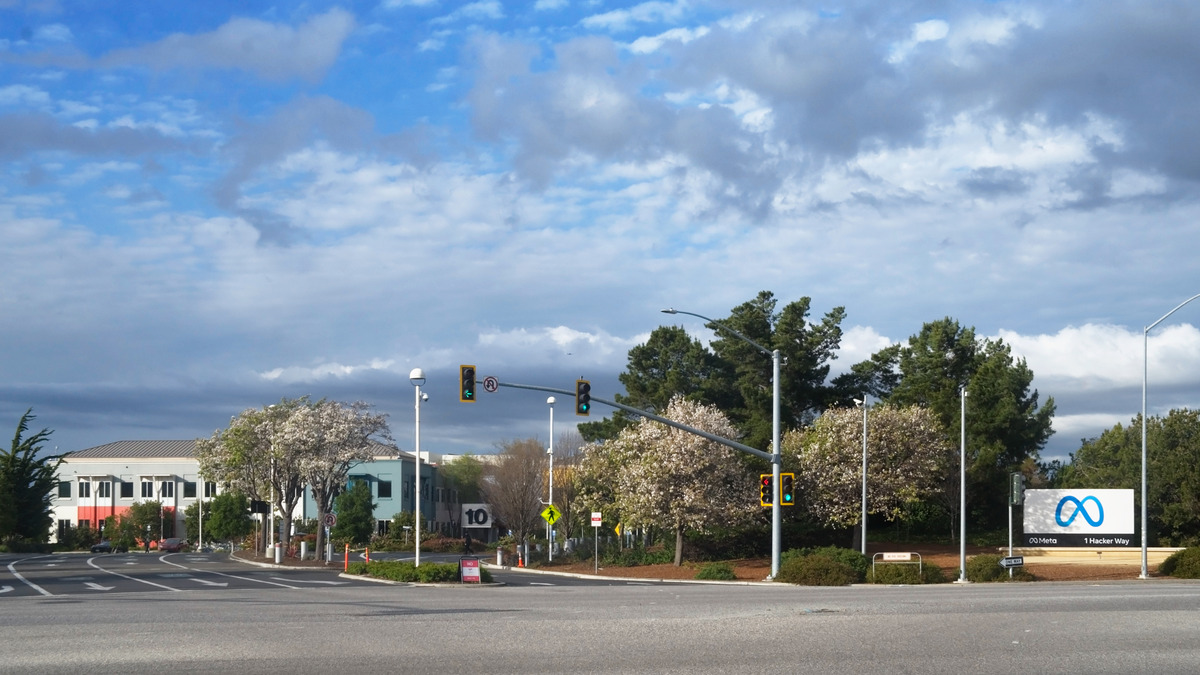 Meta's campus in Menlo Park, where thousands of engineers received surprise reassignment emails in May 2026.
Source: commons.wikimedia.org
Meta's campus in Menlo Park, where thousands of engineers received surprise reassignment emails in May 2026.
Source: commons.wikimedia.org
The Surveillance Layer
Behind the Applied AI team's data work sits the Model Capability Initiative. Installed on US employee work laptops, MCI captures mouse movements, keystrokes, clicks, and screenshots across hundreds of applications. There's no opt-out on company-issued devices. CTO Andrew Bosworth confirmed this directly to employees who pushed back.
Meta's internal memo to Superintelligence Labs staff, seen by Reuters, explained the logic: AI agents need to learn how humans actually use computers. Dropdown navigation, keyboard shortcuts, error recovery - behaviors obvious to any experienced engineer but difficult for models to learn without direct observation.
Meta spokesperson Andy Stone offered the public framing: "If we're building agents to help people complete everyday tasks using computers, our models need real examples of how people actually use them."
The Leaked Audio
 Zuckerberg at F8, where he has regularly made public commitments on AI capabilities and Meta's long-term strategy.
Source: commons.wikimedia.org
Zuckerberg at F8, where he has regularly made public commitments on AI capabilities and Meta's long-term strategy.
Source: commons.wikimedia.org
In audio from an April 30 all-hands meeting - leaked but not authenticated by Meta, whose public statements are consistent with its contents - a speaker identified as Zuckerberg described the program's purpose:
"Using this to feed a very large amount of content into the AI model, so that way it can learn how smart people use computers."
The same recording included a more candid note about communications strategy: "It is not strategically in your interest for us to communicate everything in all the detail that we normally would."
In a confirmed public statement, Zuckerberg said MCI data isn't used for performance monitoring or surveillance of individual employees. The gap between the all-hands description and the public position remains unaddressed.
The Petition and the Flyers
An online petition at mcipetition.com opposing the initiative gathered more than 1,600 signatures across the company. One engineer post calling MCI "an invasion of my privacy" circulated to nearly 20,000 colleagues before it was removed from internal forums.
Then came the physical protest. Flyers began appearing in bathroom stalls, on vending machines, and in meeting rooms at US Meta offices. They asked: "Don't want to work at the Employee Data Extraction Factory?" The pamphlets cited the US National Labor Relations Act and encouraged staff to organize.
In the UK, workers did exactly that. United Tech and Allied Workers began a formal unionization campaign with Meta employees there, targeting MCI specifically. Meta isn't a company with a history of organized labor action, which makes this particular.
Zuckerberg addressed the situation in an internal memo. He acknowledged the changes had "caused distress" and that the company had "made mistakes that it plans to address." His stated north star: "Meta's north star is to be the best place for the most talented people in the world to make an impact."
The Strategic Logic
Zuckerberg committed up to $135 billion in 2026 capital expenditure for AI. The Applied AI effort aims to produce models capable of operating computers without human supervision - handling enterprise workflows, writing and executing code, managing customer service, and reducing dependence on human knowledge workers for repetitive tasks.
To train those systems, Meta needs data that external contractors and synthetic generation can't fully supply on their own. Senior engineers working in real software environments, on real internal tools, using professional judgment across hundreds of applications - that's a dataset with unusual density. Meta closed its open-source door at the frontier this year even as it draws on internal expertise to push proprietary model performance. The company has faced earlier criticism over how it handles human contributors to its AI pipeline, but those controversies involved external workers in lower-income markets. This one is in Menlo Park.
On June 12 - the same week the Applied AI revolt became public - Zuckerberg told the "No Priors" podcast that substantial AI advances don't require "many, many hundreds" of researchers, and that real progress comes from "a very strong group of a dozen or a couple dozen people." He didn't mention the 6,500 engineers creating the training data that lets those dozen researchers' models actually work at production scale.
Sources:
- Meta's months-old AI unit is a soul-crushing gulag - TechCrunch
- Meta will start tracking employees' screens and keystrokes to train AI tools - Fortune
- Meta Employee Surveillance for AI Training Draws Protest - TechTimes
- Meta employees are protesting the company's mouse tracking program - Engadget
- Meta workers are posting flyers in bathroom stalls - HCA Magazine
- Those spared latest Meta job cuts forcibly reassigned to AI roles - The Register

