
Ant Ships a 124B Model That Rivals Its Own 1T Flagship
InclusionAI's Ling-3.0-flash quietly went live with 124B parameters and 5.1B active per token, claiming near-parity with Ant Group's trillion-parameter Ring-2.6-1T flagship.
 5 min read
Ling-3.0-flash showed up on inference platforms before anyone at InclusionAI had said a word about it. No model card, no blog post, just a 256K-context endpoint that appeared on ZenMux and a free Novita tier sometime on July 23. AI tracker David Hendrickson flagged it on X as "a mysterious new model" hours before Ant Group's own Ling account confirmed what it was.
When the confirmation came, it came with a specific claim: 124B total parameters, 5.1B active per token, and performance that matches or beats the company's own trillion-parameter flagship on most of the benchmarks it published.
Key Specs
| Spec | Value |
|---|---|
| Total parameters | 124B |
| Active parameters | 5.1B per token |
| Context window | 256K native, extendable to 1M |
| Attention | Hybrid KDA + Gated MLA, 5:1 stacking |
| MoE routing | 512 experts, 8 active + 1 shared |
| License | MIT expected, not yet published for this release |
| Price | Free through August 3, 2026 |
A Trillion-Parameter Model, Beaten by a Twelfth of Its Compute
The comparison target matters here. Ant's tweet calls it "our 1T flagship," and the benchmark chart it posted names that flagship as Ring-2.6-1T-expert, InclusionAI's reasoning-tuned trillion-parameter model released in May with 63B active parameters per token. Ling-3.0-flash uses 1/8 of its total parameter count and roughly 1/12 of its active compute per token, according to the numbers in the chart.
The gap for the smaller model is not subtle in places. On SkillsBench, the flash model scores 44.83 against Ring-2.6-1T-expert's 11.88. On SWE-Bench Multilingual it posts 72.44 versus 56.67. Terminal-Bench, Tau3-banking, MCP-Atlas, WideSearch, and BrowseComp all show similar double-digit swings in the smaller model's favor. It isn't a universal sweep: on Multi-IF, the flagship still edges it out, 89.25 to 87.65.
Set against outside competitors, the picture gets more mixed. Ling-3.0-flash trails Claude Sonnet 4.6's "maxthink" configuration on SWE-Bench Multilingual (75.9 vs 72.44), Terminal-Bench (71.2 vs 57), and SkillsBench (54.41 vs 44.83), but beats it on IFBench (74.49 vs 57) and edges ahead on Multi-IF (87.65 vs 84.8). Against GPT-5.4-mini high-effort mode, results split roughly the same way, task by task rather than clean sweep by clean sweep.
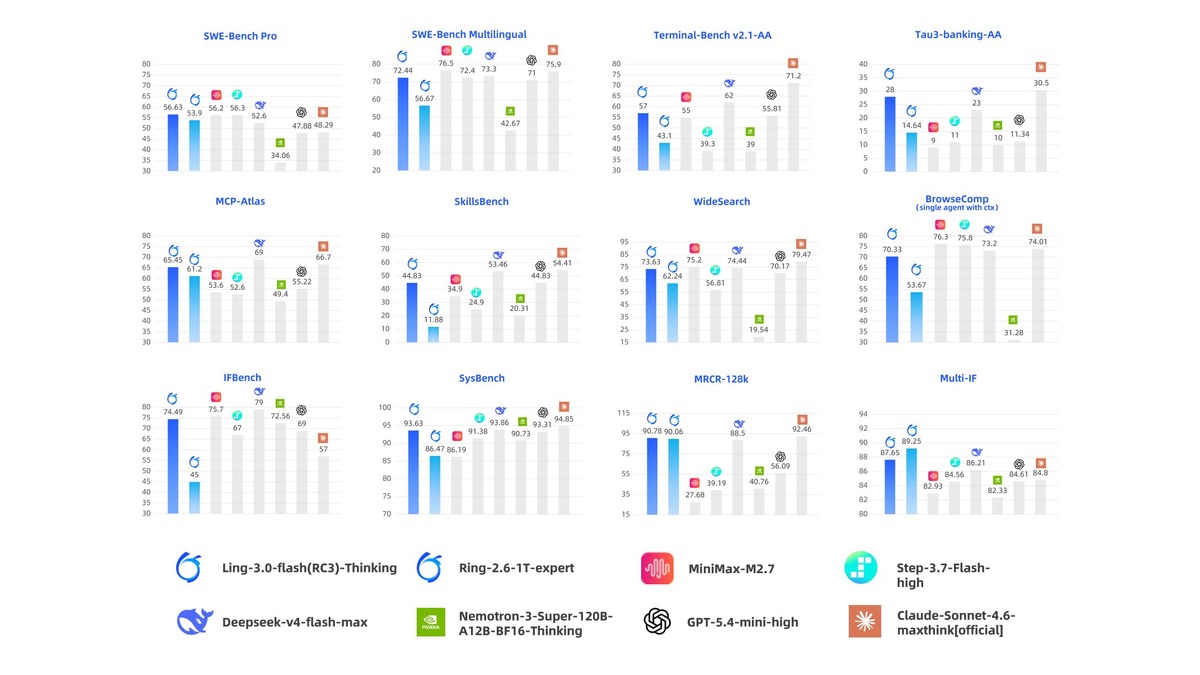 InclusionAI's own benchmark chart, posted with the release, spanning coding, tool-use, search, and instruction-following evaluations.
Source: x.com
InclusionAI's own benchmark chart, posted with the release, spanning coding, tool-use, search, and instruction-following evaluations.
Source: x.com
The Architecture Behind the Efficiency Claim
InclusionAI's follow-up posts, published as replies to the same thread, laid out what changed under the hood.
Hybrid Linear Attention, Stacked 5:1
Ling-3.0 groups its transformer blocks into seven repeating units, each containing five KDA (Kimi Delta Attention) layers followed by one Gated Multi-head Latent Attention layer. The KDA mechanism, named after and built on the delta-rule attention used in Moonshot AI's Kimi linear-attention models, runs at linear time complexity and handles most of the model's token mixing. The Gated MLA layer, appearing once per group, handles the harder long-range dependencies a purely linear mechanism tends to lose. The first two blocks in the stack skip the mixture-of-experts layer completely and use a dense feed-forward network instead, a detail InclusionAI's diagram attributes to training stability at the embedding layer.
Sparse Enough to Matter
The MoE layer itself routes to 512 experts, activating 8 per token plus one shared expert that's always on, a configuration the diagram labels E512A8. Combined with an auxiliary-loss-free load-balancing scheme, that routing scheme is what compresses 124B total parameters down to 5.1B active ones. The embedding dimension is 2,560, the vocabulary is 157,000 tokens, and the architecture supports up to 1M tokens of context through RoPE-based extension beyond its native 256K window.
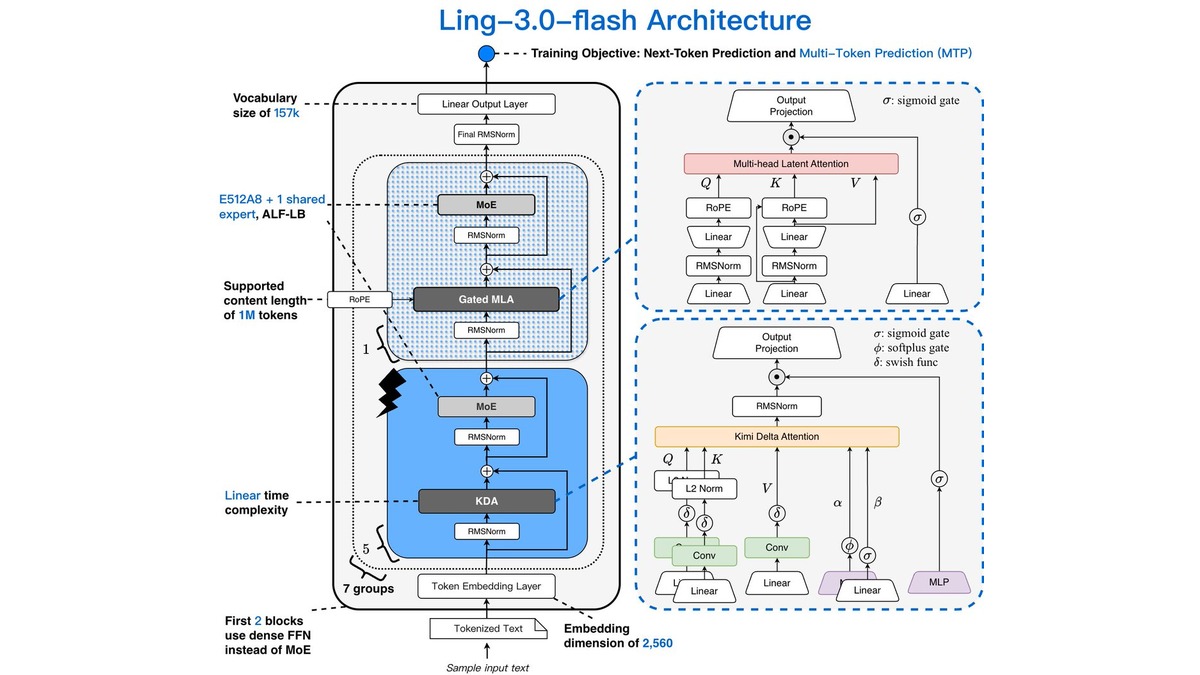 InclusionAI's architecture diagram for Ling-3.0-flash, showing the 5:1 KDA-to-Gated-MLA block ratio and the E512A8 mixture-of-experts configuration.
Source: x.com
InclusionAI's architecture diagram for Ling-3.0-flash, showing the 5:1 KDA-to-Gated-MLA block ratio and the E512A8 mixture-of-experts configuration.
Source: x.com
Already Live, Already Being Used
Whatever InclusionAI's publishing process looked like internally, the model wasn't vaporware by the time the tweet went out. A look at OpenRouter's usage dashboard for InclusionAI's models shows Ling-3.0-flash already processing traffic within hours of going public, on a page that also lists Ring-2.6-1T and Ling-2.6-1T as available through the same unified API.
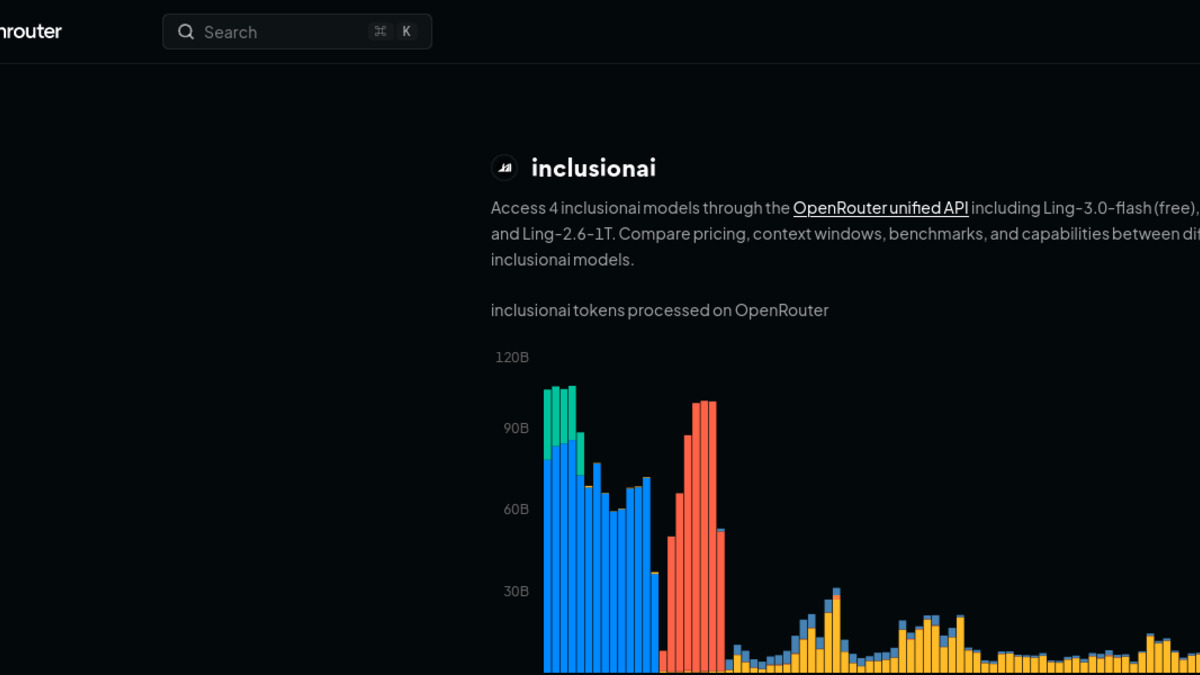 OpenRouter's inclusionAI model page, showing Ling-3.0-flash listed as a free model with token usage history for the broader Ling family.
Source: openrouter.ai
OpenRouter's inclusionAI model page, showing Ling-3.0-flash listed as a free model with token usage history for the broader Ling family.
Source: openrouter.ai
Vercel's AI Gateway added the model the same day, offering it with no markup and no platform fee through its standard pass-through pricing, on top of the free access InclusionAI is running through August 3. ZenMux and Novita were serving it even earlier, through OpenAI-compatible endpoints that required no special integration work.
What To Watch
A few caveats are worth keeping in mind before treating this as a settled result.
The benchmark chart labels the assessed checkpoint "Ling-3.0-flash(RC3)-Thinking," meaning the numbers InclusionAI published apply to a release-candidate thinking-mode configuration, not necessarily the exact weights sitting on ZenMux and Novita right now. No independent lab has reproduced any of the chart's numbers yet. And while every prior model in the Ling and Ring family, including Ring-2.6-1T, shipped under an MIT license, InclusionAI has not yet published a license file for Ling-3.0-flash itself. Until that happens, teams assessing it for production use are working from a precedent, not a guarantee, on top of an already crowded open-source leaderboard.
The free pricing window closes August 3. What Ling-3.0-flash costs after that, and whether InclusionAI backs its own SWE-Bench and Terminal-Bench numbers with a published technical report, are the two questions that'll determine whether this becomes a model people actually build on or another chart that looked good for a week.
Sources:
- Ant Ling on X: Ling-3.0-flash announcement
- David Hendrickson on X: Ling-3.0-flash spotted live
- Ling 3.0 Flash is now available on AI Gateway - Vercel
- inclusionAI/Ling-2.6-flash - Hugging Face
- inclusionAI/Ling-1T - Hugging Face
- Ring-2.6-1T by InclusionAI - Crafiq model specs
- inclusionai API and Models - OpenRouter
- ZenMux: inclusionAI Ling-3.0-flash pricing and providers

