
LetinAR Scores $18M for the Optics Behind AI Glasses
South Korean startup LetinAR raises $18.5M to scale its PinTILT optical modules, which already power AI glasses and AR helmets as shipments hit 8.7 million units globally in 2025.
 7 min read
Most people buying AI glasses don't think about the optics. South Korean startup LetinAR is betting that the companies building those glasses think of little else.
The company announced $18.5 million in new funding from Korea Development Bank and Lotte Ventures, bringing its total raised to $41.7 million. The round comes as AI glasses shipments hit 8.7 million units globally in 2025 - a 300% year-over-year increase according to Omdia - with the research firm forecasting 15 million units in 2026. LetinAR doesn't sell glasses. It sells the optical modules inside them, and that position is starting to look strategically very smart.
TL;DR
- LetinAR raised $18.5M (total: $41.7M) from Korea Development Bank and Lotte Ventures
- Its PinTILT optical modules combine waveguide and birdbath architectures to cut weight by up to 66%
- Modules ship in NTT QONOQ's MiRZA XR glasses and Aegis Rider's EU-market AR motorcycle helmet
- Global AI glasses shipments hit 8.7M units in 2025 (up 300%) and Omdia projects 15M+ in 2026
- IPO planned on the South Korean exchange in 2027
Inside PinTILT: The Hybrid Approach
AI glasses have an optics problem. The three dominant architectures each solve some of the problem while creating new ones.
Waveguide: Thin but Leaky
Waveguide optics are the approach companies like Microsoft and Meta explored early on. Light enters the lens and bounces through a thin slab of glass toward the eye. The advantage is form factor - waveguide lenses can be as thin as standard prescription glass. The disadvantage is efficiency. Only 5-15% of input light actually reaches the eye, which means you need a bright, power-hungry projector to compensate, and even then brightness falls short in daylight conditions.
Birdbath: Bright but Bulky
Birdbath optics work differently - light is reflected off a curved half-mirror toward the eye. Light efficiency jumps to around 50%, which means much better brightness with lower power draw. The problem is physical. The curved mirror geometry requires an housing that protrudes from the frame, making glasses look like what they are: small computers attached to your face. That's fine for an industrial headset. It's fatal for consumer products where Meta Ray-Ban's design language has set the expectation of normal-looking frames.
PinTILT: The Middle Path
LetinAR's PinTILT technology is a hybrid. Arrays of tiny tilted pin mirrors direct light efficiently toward the eye - closer to the light efficiency of birdbath, but in a form factor thin enough to pass for ordinary glasses. The company's latest module, shown at Display Korea 2026, reaches 40 degrees diagonal field of view at 1,000 nits brightness. Its FrontiAR lens module extends that to 45 degrees. For context, human central vision covers roughly 60 degrees - so these modules don't fill your entire field of view, but they cover enough for navigation, notifications, and contextual AI overlays without requiring you to peer through a porthole.
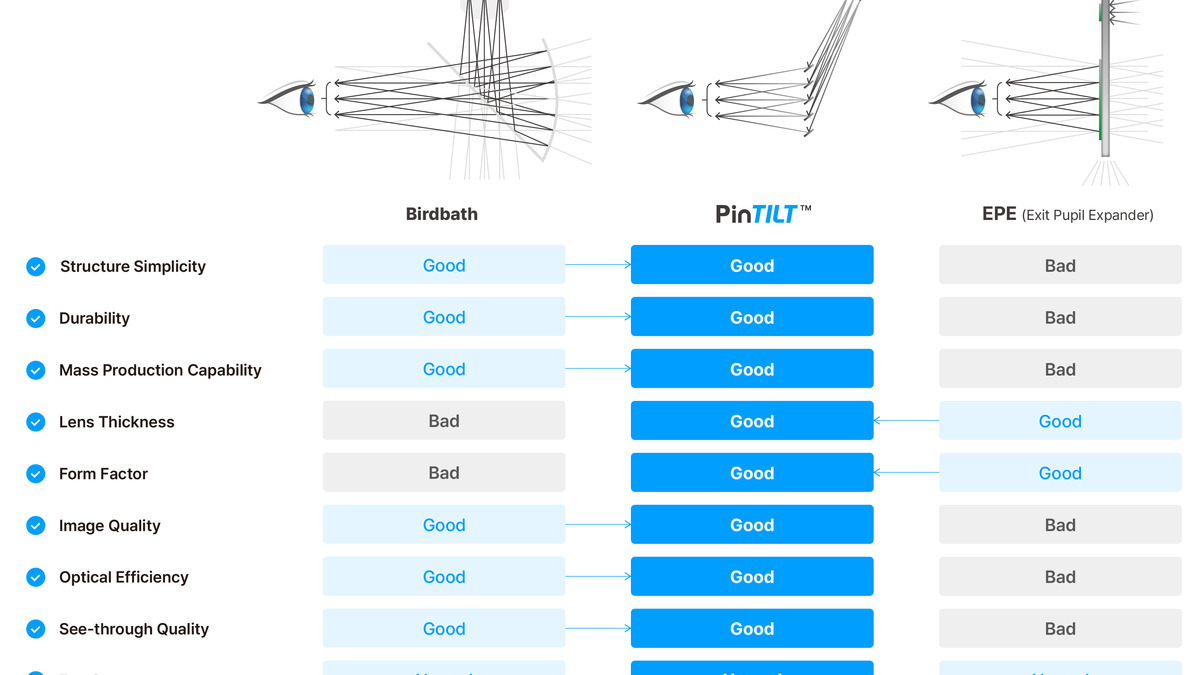 LetinAR's PinTILT modules combine the brightness of birdbath architectures with the thin profile of waveguides.
Source: letinar.com
LetinAR's PinTILT modules combine the brightness of birdbath architectures with the thin profile of waveguides.
Source: letinar.com
| Technology | Light Efficiency | Form Factor | Daylight Usability | Cost |
|---|---|---|---|---|
| Waveguide | Low (~5-15%) | Ultra-thin | Poor | High (complex fab) |
| Birdbath | Moderate (~50%) | Bulky housing | Good | Moderate |
| PinTILT (LetinAR) | High | Thin, fashionable | Good | Moderate |
The PinTILT comparison above is honest about the tradeoff: "high" light efficiency here is relative to waveguide, not absolute. LetinAR doesn't publish an efficiency percentage in its public materials. What it does publish - the 66% weight reduction in the MiRZA XR versus comparable glasses modules - suggests the form-factor advantage is real.
A Market That Changed Shape Fast
Two years ago, AR glasses were mostly a niche product for warehouse workers and surgeons. Something shifted in 2024, and it wasn't the technology - it was Meta's Ray-Ban partnership proving that AI glasses could look like glasses and still sell in volume.
Meta now holds 73% of the smart glasses market by shipment according to Counterpoint Research, with an internal goal of 10 million units sold by end of 2026. That success has pulled in competitors who were previously reluctant to enter: Apple confirmed AI wearables including smart glasses (covered in our earlier piece on Apple's AI wearables strategy), Alibaba launched Qwen AI smart glasses at MWC, and Samsung is preparing its own entry. Chinese brands including Huawei and Xiaomi are moving aggressively in their home market, where Omdia says China will account for roughly 12% of global 2026 shipments.
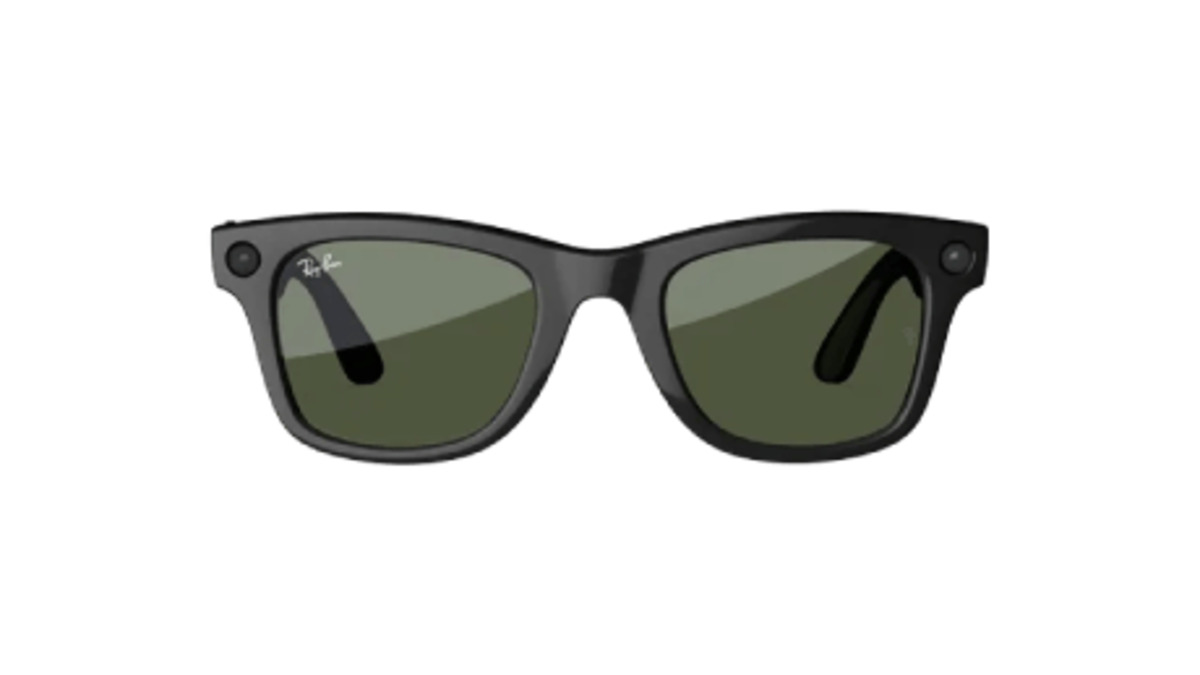 Meta's Ray-Ban Wayfarer (Gen 2) set the commercial template that competitors are now scrambling to match.
Source: meta.com
Meta's Ray-Ban Wayfarer (Gen 2) set the commercial template that competitors are now scrambling to match.
Source: meta.com
Each of these companies needs optical modules. And unlike the AI chips or inference software stack, optical manufacturing doesn't scale through software - it requires specialized fabrication expertise that takes years to build. LetinAR has been building since 2016.
Who's Buying the Modules
LetinAR's customer list is small but concrete. Japan's NTT QONOQ Devices, a joint venture between NTT QONOQ and Sharp Corporation, built the MiRZA XR smartglasses around PinTILT modules. The partnership was significant as LetinAR's first mass-production deployment - the MiRZA XR launched in Japan and demonstrated that the modules could survive real supply chain requirements, not just lab conditions. Dynabook, also Japanese, uses LetinAR optics in its AI glasses line.
The more unusual customer is Aegis Rider, a Swiss ETH Zurich spin-off building AI-enabled motorcycle helmets. Its Vision helmet ships with LetinAR's AR optics integrated into magnetic binocular glasses mounted inside the carbon-fibre shell. The helmet launched at CES 2026 with pre-orders at €1,599, targeting EU and Swiss markets with first consumer units shipping out of Portugal. Navigation data, speed, and ride information appear spatially anchored to the real world rather than floating in front of the rider's face - a meaningful safety distinction when you're doing 100 km/h on a motorway.
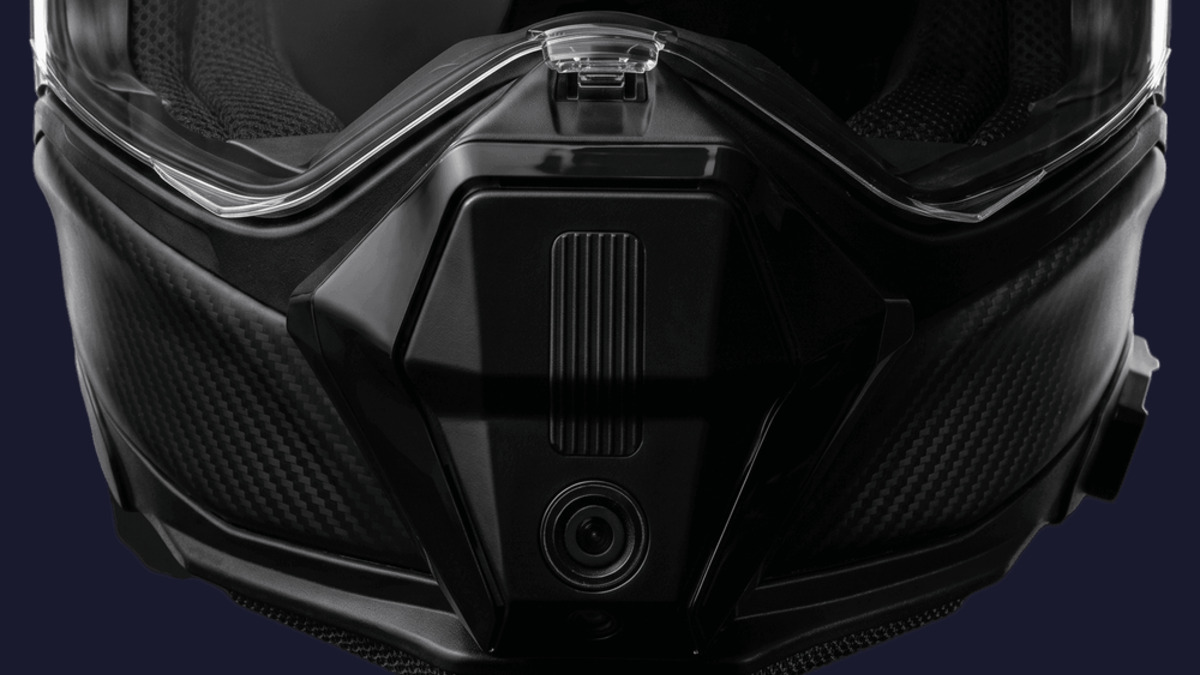 The Aegis Rider Vision helmet integrates LetinAR optical modules to deliver spatially anchored AR navigation for motorcyclists.
Source: aegisrider.ch
The Aegis Rider Vision helmet integrates LetinAR optical modules to deliver spatially anchored AR navigation for motorcyclists.
Source: aegisrider.ch
Where It Falls Short
The funding round doesn't resolve LetinAR's core manufacturing challenge. The company is still building toward scale, and the AI glasses market is about to get notably more demanding.
Apple's entry - expected to intensify competitive pressure through 2026 and 2027 - will likely set a new standard for optical quality and integration tolerances that component suppliers will need to match. LetinAR is a subcontractor in that dynamic, which means it has limited pricing power and can be displaced if a larger optical manufacturer offers comparable technology with better yields or lower costs.
The field of view is also the honest limitation. At 40-45 degrees diagonal, PinTILT falls short of what video pass-through headsets like Apple Vision Pro offer. For AI glasses - where the use case is overlaid information rather than immersive video - that's probably acceptable today. But as user expectations evolve toward richer AR experiences, the FOV ceiling becomes a constraint.
Competitors include WaveOptics, DigiLens, and Lumus, all of whom are also chasing the same market with different optical approaches. Waveguide technology continues to improve, and if light efficiency climbs meaningfully, LetinAR's efficiency advantage narrows. The company's best defense is the relationships it's already built with manufacturers willing to bet on the technology before the market existed - those reference deployments in Japan and Switzerland matter more than the FOV numbers on a spec sheet.
LetinAR plans a South Korean IPO in 2027. Whether it gets there as a component supplier or something larger depends on how fast it can scale manufacturing to meet orders from customers who are now measuring demand in tens of millions of units.
Sources:
- TechCrunch: South Korea's LetinAR is building the optics behind AI glasses
- Counterpoint Research: Meta Dominates Smart Glasses Market with 73% Share
- LetinAR: PinTILT Technology
- PR Newswire: LetinAR Unveils First Mass-Produced AR Product with NTT QONOQ
- Aegis Rider: About
- Motorcycle News: Aegis Rider AR Head-Up Display

