
A Memory Shortage Triggered $950B in AI Deals
Nvidia, SK Group, Samsung and Broadcom signed close to a trillion dollars in AI chip and memory deals in San Francisco, and the memory shortage behind them means someone outside the room ends up paying.
 7 min read
Over two days in San Francisco, Nvidia, SK Group, Samsung and Broadcom signed close to a trillion dollars in AI chip and memory agreements, and every one of them is calling it a win. That arithmetic only holds up if someone who wasn't in the room ends up covering the difference.
South Korean President Lee Jae Myung hosted the summit on July 24 and 25, bringing together the chairmen of SK Group and Samsung with Nvidia CEO Jensen Huang, Broadcom leadership, and executives from Microsoft and Anthropic. By the time it ended, Reuters reported $950 billion in new commitments: $750 billion from SK Group, headlined by a partnership with Nvidia worth more than $500 billion, plus additional memory agreements with Microsoft and supply deals with Anthropic. Samsung answered with its own $200 billion memorandum of understanding with Broadcom.
TL;DR
- Nvidia locks in HBM4 memory for its Vera Rubin platform years before SK Telecom's planned AI Cloud data center goes online in 2027.
- SK Group's $750 billion haul, spanning deals with Nvidia, Microsoft and Anthropic, extends SK hynix's lead in the HBM market ahead of Samsung.
- Samsung answered within a day with a $200 billion, five-year Broadcom agreement covering memory, 2nm foundry work and packaging.
- President Lee called it a vision for "global cooperation," while the fine print reads like a US chip supply plan with Seoul's signature on it.
Who Wants What
Four parties walked away from the summit with something to announce, and a fifth group got stuck holding the bill without ever being invited to the table.
| Stakeholder | What they're chasing | What's actually at stake | The catch |
|---|---|---|---|
| Nvidia | Guaranteed HBM4 supply for Vera Rubin | A GPU roadmap that survives a memory shortage it doesn't control | Multi-year commitments hand SK hynix and Samsung pricing leverage over Nvidia's own margins |
| SK Group / SK hynix | A "sovereign AI" role for Korea | More than half of the global HBM market, before Samsung and Micron close the gap | The 2027 target for SK Telecom's AI Cloud draws on the same wafer capacity SK hynix has also promised Nvidia and Microsoft |
| Samsung Electronics | Parity with SK hynix | Its 2nm foundry line's largest customer win to date | Broadcom picked Samsung partly because TSMC's advanced nodes are booked out, not because Samsung's HBM4 yields have caught up |
| South Korean government | An AI power seat and "global cooperation" optics | A locked-in place inside the US chip supply chain | Almost all of the $950 billion serves American cloud and chip buyers, not Korean AI developers |
| Everyone else buying memory | Nothing - they weren't at the summit | Server, laptop and phone prices that already track DRAM cost | Capacity booked into HBM4 through 2030 doesn't come back to consumer memory |
Who Benefits
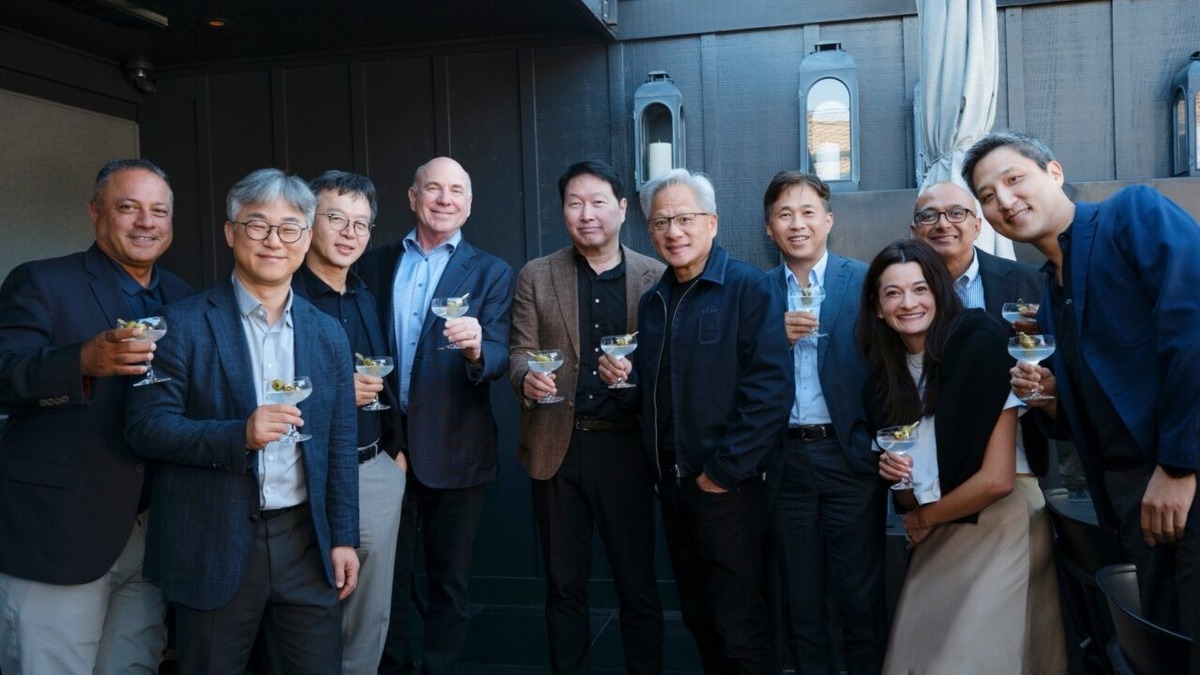 SK Group Chairman Chey Tae-won, Nvidia CEO Jensen Huang, SK hynix CEO Kwak Noh-jung and other executives at a dinner the night before the summit's deals were signed.
Source: sedaily.com
SK Group Chairman Chey Tae-won, Nvidia CEO Jensen Huang, SK hynix CEO Kwak Noh-jung and other executives at a dinner the night before the summit's deals were signed.
Source: sedaily.com
Nvidia's stake is the simplest to follow. Vera Rubin is the platform SK Telecom's new AI Cloud will run on, and Nvidia needs the memory to ship with it. Industry reporting out of Korea via TrendForce already put SK hynix's share of Nvidia's HBM4 orders at roughly 70 percent before this week, up from earlier estimates closer to 50 percent. This deal extends that relationship years further out, with SK Telecom's 2-gigawatt facility slated to come online in 2027.
"South Korea has all the ingredients to become a global AI powerhouse - world-class networks and data centers, leadership in chip technology and vast industrial scale."
- Jensen Huang, CEO, Nvidia
SK Group gets the bigger prize. Combined with Samsung, the two companies control 79 percent of global HBM revenue as of the first quarter of 2026, and SK hynix holds the larger half of that split. Chairman Chey Tae-won described the demand curve bluntly at the summit.
"I wouldn't be surprised if, the next time I see [Huang], he'll tell me those figures were too low and say, 'I want more.'"
- Chey Tae-won, Chairman, SK Group
Samsung didn't get left out. Its $200 billion memorandum with Broadcom, signed July 24, runs through 2030 and covers five years of HBM supply plus 2-nanometer chip production at its Pyeongtaek campus. Vice Chairman Jun Young-hyun framed it as validation of Samsung's integrated strategy.
"In the AI era, semiconductor solutions that tightly integrate memory, logic and advanced packaging are the core competitiveness."
- Jun Young-hyun, Vice Chairman, Samsung Electronics
And Seoul benefits politically. President Lee opened the summit with language built for headlines rather than balance sheets: "I'd like to present a vision for the future of AI and propose global cooperation to make it happen." It's a good line for a president trying to position Korea as more than a components supplier to Silicon Valley.
Who Pays
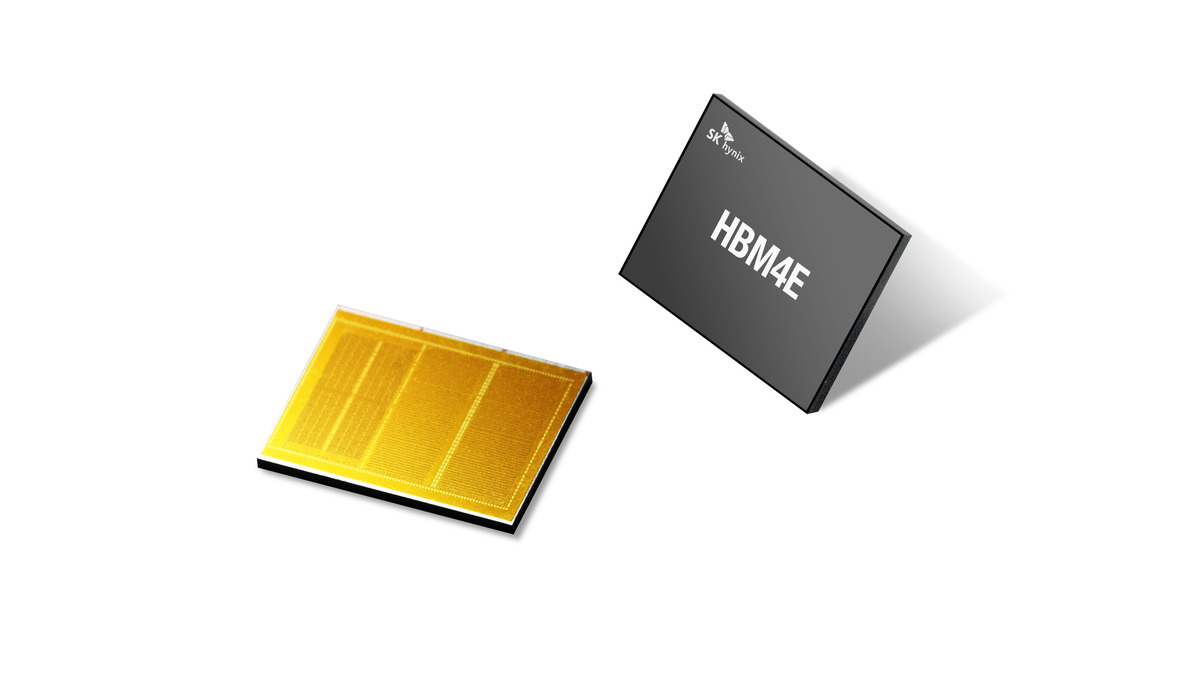 A single HBM4E package like this one is the unit everyone at the summit was really fighting over.
Source: skhynix.com
A single HBM4E package like this one is the unit everyone at the summit was really fighting over.
Source: skhynix.com
The party missing from every stage photo is the one actually funding the shortage. Memory that gets locked into HBM4 contracts with Nvidia, Microsoft and SK Telecom doesn't circulate back to the DRAM and NAND markets that laptops, phones and ordinary servers depend on. We've covered that squeeze before: consumer and enterprise memory prices have been climbing for months as fab capacity shifts toward AI accelerators. Industry pricing trackers already expect 12-layer HBM4 modules, the kind central to this week's deals, to sell for more than $600 each. Every wafer that becomes one of those modules is a wafer that isn't becoming ordinary system memory.
Even Anthropic, one of the summit's named beneficiaries, isn't fully insulated. A company spokesperson told reporters the firm was "always exploring options and drawing on a range of chips as part of a diversified approach to computing," a hedge that reads less like confidence and more like a company aware it's competing with Microsoft and Nvidia for the same finite HBM4 allocation it just helped announce.
Where the Deals Contradict Each Other
SK hynix has now promised HBM4 capacity to three different destinations from the same production lines: Nvidia's Vera Rubin orders, a new supply arrangement with Microsoft, and its own sister company's SK Telecom AI Cloud. Each commitment assumes the others won't crowd it out. SK hynix says it's expanding capacity to match, but the 2027 online date for the AI Cloud is the same year that expansion has to prove itself against Nvidia's own delivery schedule.
There's a second tension in the "Team Korea" framing the summit encouraged. Samsung and SK hynix are direct rivals for the same pool of HBM4 sockets, yet both were presented as national champions in the same announcement. Samsung's win came specifically because Broadcom's usual foundry partner, TSMC, had no room left at its advanced nodes - which means Samsung's $200 billion victory is itself a symptom of the shortage, not evidence Samsung has closed the technology gap with SK hynix.
And President Lee's "global cooperation" language sits awkwardly next to who actually cashes the checks. Nvidia, Microsoft, Broadcom and Anthropic are all US-headquartered. Korea's own domestic chip investment plan, announced weeks earlier, runs alongside this deal rather than through it. The summit strengthened Korea's position as the supplier of record for American AI infrastructure. It didn't hand Seoul a comparable stake in the AI systems that infrastructure will run.
The first real test lands in 2027, when SK Telecom's AI Cloud is due online and SK hynix has to prove it can supply Nvidia, Microsoft and its own data center at once, at the exact moment Samsung's Broadcom capacity starts ramping at Pyeongtaek. Whichever commitment slips first will show who was actually first in line for a chip that was just promised, on paper, to everyone.
Sources:
- SK Group and NVIDIA Expand Strategic Partnership Across AI Factories and Next-Generation Memory - NVIDIA Newsroom
- Samsung Elec, SK Group Seal $950 Billion Deals as South Korea Hosts AI Powers - Reuters, via The Express Tribune
- Nearly $1 Trillion in Deals: Big Tech, Korean Chipmakers Align to Steer Future of AI - Korea JoongAng Daily
- Samsung Strikes $200 Billion AI Chip Deal, SK Extends HBM4 Supply to Microsoft - Seoul Economic Daily
- Chey Tae-won Dines With Jensen Huang in US, Cementing AI Infrastructure Alliance - Seoul Economic Daily
- SK Hynix Reportedly to Supply About Two-Thirds of NVIDIA HBM4; Samsung Targets Early Delivery - TrendForce

