
Kimi K3 Tops Frontend Arena Just as Its Price Triples
Moonshot AI's Kimi K3 jumped 17 spots to #1 on LMArena's Frontend Code Arena, but the win comes with a tripled price tag and a weaker showing on broader intelligence benchmarks.
 6 min read
TL;DR
- Kimi K3 jumped from #18 to #1 on LMArena's Frontend Code Arena on July 16, scoring 1,679 points and beating Claude Fable 5, GPT-5.6 Sol, and five other frontier models
- The win is domain-specific: on Artificial Analysis's broader Intelligence Index, K3 scores 57.1, still behind Fable 5 (60) and GPT-5.6 Sol (59)
- API pricing roughly tripled versus Kimi K2.6 - $3/M input and $15/M output, landing near Claude Sonnet 5 rates instead of Kimi's old discount-bin pricing
- Open weights are promised by July 27, 2026, but as of publication they haven't landed
Moonshot AI just did something no open-weight lab has managed before: put a model at #1 on one of LMArena's flagship leaderboards, ahead of every closed frontier system tracked there. On July 16, the official Arena.ai account announced that Kimi K3 had taken the top spot on the Frontend Code Arena with 1,679 points, a 17-place jump from Kimi K2.6's #18 finish. It is, by a real margin, the best headline number Chinese open-weight AI has produced against Western closed models in a public evaluation.
It's also, on closer inspection, a narrower story than the headline suggests - and one with a price tag Moonshot has never asked its users to pay before.
The Leaderboard Kimi K3 Just Took Over
The Frontend Code Arena scores models on how well they produce working, aesthetically coherent front-end code across seven task domains, judged by blind human pairwise comparison rather than a fixed test set. Kimi K3 didn't just edge out the field - it won a 76% pairwise rate and topped six of the seven domains outright.
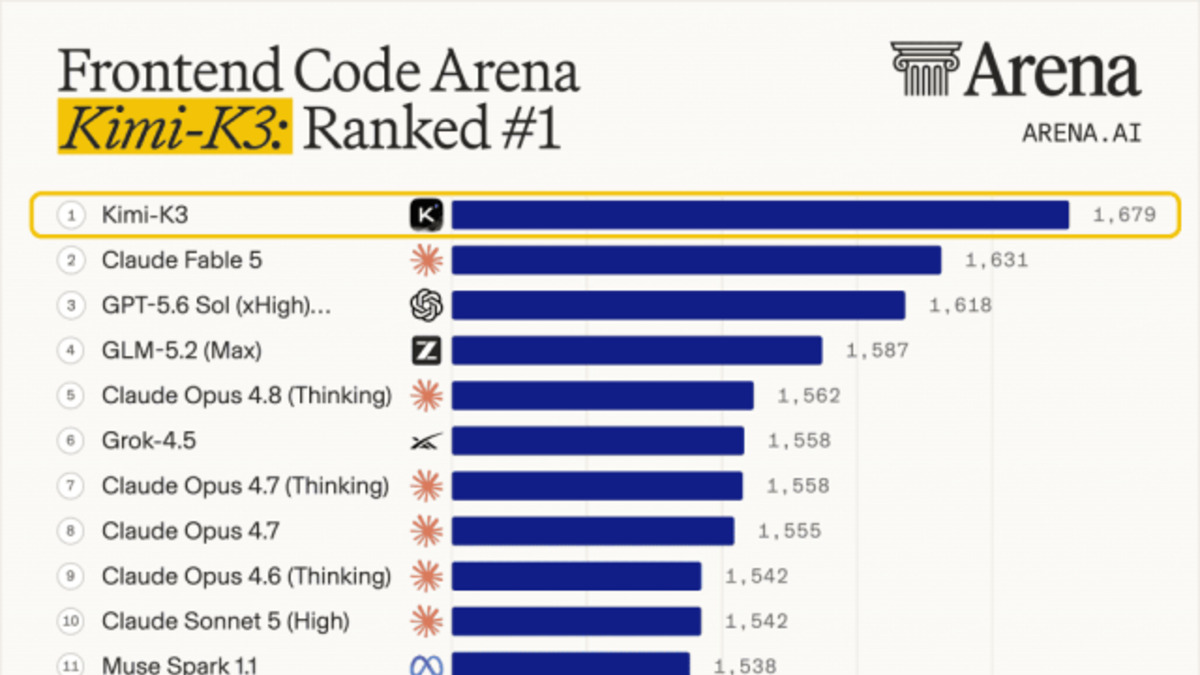 Arena.ai's official leaderboard chart, published July 16, 2026, showing Kimi-K3's jump to #1 ahead of Claude Fable 5, GPT-5.6 Sol, and GLM-5.2.
Source: officechai.com
Arena.ai's official leaderboard chart, published July 16, 2026, showing Kimi-K3's jump to #1 ahead of Claude Fable 5, GPT-5.6 Sol, and GLM-5.2.
Source: officechai.com
| Rank | Model | Frontend Code Arena Score |
|---|---|---|
| 1 | Kimi K3 | 1,679 |
| 2 | Claude Fable 5 | 1,631 |
| 3 | GPT-5.6 Sol | 1,618 |
| 4 | GLM-5.2 | 1,587 |
| 5 | Claude Opus 4.8 | 1,562 |
| 6 | Grok-4.5 | 1,558 |
K3 swept Brand & Marketing, Reference-Based Design, Data & Analytics, Consumer Product, Simulations, and Content Creation Tools. Its only loss was Gaming, where Claude Fable 5 held on to first place. That's a broad win across categories that actually matter to teams building product UI, not a fluke confined to one narrow prompt style - and it's a sharper result than GLM-5.2 or Grok-4.5 managed against the same closed-model field.
Gennaro Cuofano, founder of the business analysis outlet FourWeekMBA, summed up why the result matters beyond bragging rights:
"The Chinese open-weight model story now has a capability argument, not only a cost one."
That line is the real headline. For three years, Chinese labs including Moonshot, DeepSeek, and Alibaba have competed on price - matching or beating Western models at a fraction of the API cost. K3's Arena win is the first time one of them has taken an outright #1 on a marquee leaderboard on merit, judged by humans, against every closed frontier lab simultaneously.
The Price Tag Nobody Priced In
Here's the part the celebratory coverage tends to skip: winning that leaderboard got a lot more expensive. K3's API pricing is not a modest bump over K2.6 - it's close to triple across the board.
| Metric | Kimi K2.6 | Kimi K3 | Change |
|---|---|---|---|
| Input (cache miss) | $0.95/M | $3.00/M | +216% |
| Input (cache hit) | $0.16/M | $0.30/M | +88% |
| Output | $4.00/M | $15.00/M | +275% |
That $3/$15 rate card lands almost exactly on Claude Sonnet 5 pricing - not the budget tier where Kimi has built its reputation. The Decoder's analysis frames this correctly as a structural shift: Chinese frontier labs are no longer undercutting the West by an order of magnitude on price. They're matching a mid-tier Western rate card and betting that capability, not cost, wins the next round of enterprise contracts.
 Kimi K3's pricing move away from rock-bottom rates marks a shift for open-weight Chinese AI, which has competed almost entirely on cost since 2023.
Source: unsplash.com
Kimi K3's pricing move away from rock-bottom rates marks a shift for open-weight Chinese AI, which has competed almost entirely on cost since 2023.
Source: unsplash.com
The tripling isn't the whole story, though. Artificial Analysis measured K3's real-world cost per Intelligence Index task at $0.94 - cheaper than GPT-5.6 Sol's $1.04 and well under Claude Opus 4.8's $1.80, because K3 needs fewer output tokens to reach a correct answer despite its higher per-token rate. So the sticker price tripled, but the effective cost of getting work done didn't rise nearly as much, and K3 still undercuts Opus 4.8 on a per-task basis by close to half.
Counter-Argument
The case against treating this as a crowning moment is straightforward: the Frontend Code Arena measures one thing, and Kimi K3 isn't the best model in the world at everything else.
On Artificial Analysis's broader Intelligence Index, which aggregates reasoning, knowledge, and agentic performance across a wider benchmark suite, K3 scores 57.1 - fourth among the models in this comparison, behind Fable 5 (60) and GPT-5.6 Sol (59), and only narrowly ahead of Opus 4.8 (56). On GDPval-AA v2, an Elo-style measure of real-world professional task quality, K3 sits at 1,668 against Fable 5 and GPT-5.6 Sol both above 1,745. A model can be truly excellent at creating front-end UI code and still trail the field on the kind of general reasoning enterprises actually deploy models for.
There's a second caveat worth flagging: nobody outside Moonshot has been able to independently verify K3's weights yet. The July 27 open-weight release date is a promise, not a shipped artifact, and Moonshot's own K2.6 launch showed the company generally keeps that kind of commitment - but "generally" isn't "confirmed." Until the weights land, every claim about K3's architecture and training is running on Moonshot's account plus API-side benchmarking, not independent inspection.
What the Market Is Missing
The mistake would be treating this as either a total vindication of open-weight Chinese AI or a discount to be dismissed on a technicality. Both readings miss what actually happened: a lab that built its identity on being cheap just won a major leaderboard by being good, and then charged accordingly. That's not a contradiction - it's Moonshot testing whether the market will pay Western prices for a Chinese model with a genuine, judge-verified edge in one high-value domain. If enterprise buyers start routing front-end code generation to K3 at Sonnet-tier pricing instead of treating "made in China" as synonymous with "the cheap option," that's the real story here, and it says more about where this market is heading than any single leaderboard number does.
Sources:
- Arena.ai on X: Kimi-K3 now #1 in the Frontend Code Arena - Official ranking announcement with per-domain breakdown
- Kimi-K3 Takes the Top Spot on Arena.ai's Frontend Code Leaderboard - FourWeekMBA - Analyst commentary on the capability-vs-cost narrative shift
- Kimi's open model K3 nears GPT-5.6 Sol and Fable 5 while signaling the end of super cheap Chinese AI - The Decoder - Pricing analysis
- Moonshot AI launches Kimi K3 - Constellation Research - Independent industry analysis
- Kimi K3 Beats Fable 5, GPT 5.6 Sol On Frontend Code Arena - OfficeChai - Leaderboard chart and domain breakdown
- Kimi K3 - Intelligence, Performance & Price Analysis - Artificial Analysis - Independent Intelligence Index and cost-per-task data
- Kimi K3 by Moonshot AI ranks No. 1 in Frontend Code Arena - Cryptobriefing - Additional coverage of the leaderboard result
- Kimi K3 is now #1 in the Frontend Code Arena - Hacker News discussion - Community reaction and technical context on how Arena scoring works

