
Karpathy Joins Anthropic to Lead Pre-Training Push
Andrej Karpathy, OpenAI co-founder and former Tesla AI director, joins Anthropic's pre-training team to build a research program that uses Claude to accelerate its own training.
 Updated
5 min read
Updated
5 min read
Andrej Karpathy, one of the most recognizable names in AI research, starts at Anthropic this week. He'll work on pre-training under Nick Joseph, the team lead responsible for the large-scale training runs that give Claude its core capabilities. Anthropic confirmed that Karpathy will build a new team focused on using Claude to accelerate that research.
TL;DR
- Karpathy announced on X, May 19, 2026, he's joining Anthropic's pre-training team
- Reports to Nick Joseph, Anthropic's pre-training lead
- Will build a team using Claude to speed up pre-training research
- Eureka Labs, his AI education startup, is on pause - not shut down
- Second high-profile OpenAI researcher to join Anthropic this year
OpenAI's talent pipeline has leaked before. Max Schwarzer moved from OpenAI to lead Anthropic's VP of Research role earlier this year. Karpathy is a different profile - not an executive hire but a researcher with a decade of work spanning the theoretical foundations of deep learning and the operational realities of rolling out AI in physical vehicles at volume.
What Karpathy Brings
His career reads as a series of adjacent-but-hard problems. At OpenAI in 2015, when the lab was small enough that individuals shaped research direction, he worked on deep learning and computer vision. At Tesla from 2017 to 2022, he ran a team building Autopilot and Full Self-Driving - a domain that punishes academic assumptions. Pre-training a language model is about compute, architecture, and data quality. Building FSD is about all of that, plus sensor fusion, safety-critical software, and hardware constraints in cars built by the millions.
| Chapter | Period | Role | What He Built |
|---|---|---|---|
| OpenAI (founding) | 2015-2017 | Researcher | Deep learning foundations, ImageNet-scale work |
| Tesla | 2017-2022 | Director of AI | Autopilot and Full Self-Driving at vehicle production scale |
| OpenAI (return) | 2023-2024 | Staff Researcher | GPT-4 era research, language model work |
| Eureka Labs | 2024-2026 | Founder | LLM101n course, AI-assisted teaching platform |
| Anthropic | 2026- | Pre-training researcher | AI-assisted pre-training research via Claude |
That range - theoretical depth, production-scale engineering, and a genuine ability to explain hard concepts publicly - is rare in the field. Pre-training is usually opaque even inside labs. Karpathy's writing and courses have made more of it legible to the outside world than almost anyone else's.
The Pre-Training Bet
Pre-training is where the biggest decisions in model development happen. It's the phase where a model acquires its core knowledge, reasoning capacity, and the intuitions it carries through fine-tuning and RLHF. It's also the most expensive phase - compute bills for frontier pre-training runs are measured in hundreds of millions of dollars.
Anthropic's specific move here is to use Claude to accelerate that research cycle. It isn't just a researcher hire - it's a research direction. The idea that AI models can help design and assess their own pre-training decisions is a bet that the leverage is in research process quality, not raw compute volume. OpenAI and Google have more capital and more chips. If Anthropic's thesis is right, that gap matters less than it appears.
"I think the next few years at the frontier of LLMs will be especially formative. I am very excited to join the team here and get back to R&D. I remain deeply passionate about education and plan to resume my work on it in time."
- Andrej Karpathy, via X, May 19, 2026
The phrase "get back to R&D" matters. Eureka Labs was a founder role - product decisions, hiring, fundraising, customer calls. This is a return to research proper.
What Happens to Eureka Labs
Karpathy launched Eureka Labs in July 2024 with a course called LLM101n - an undergraduate-level curriculum for training AI models from scratch, built around AI teaching assistants that guide students through technical material. The model was AI-native from the start: a human instructor designs the content, and an AI TA handles the pacing and student questions.
 Karpathy at an OpenAI event in 2016. He co-founded the lab at 29 and built some of the field's most widely used educational resources.
Source: commons.wikimedia.org
Karpathy at an OpenAI event in 2016. He co-founded the lab at 29 and built some of the field's most widely used educational resources.
Source: commons.wikimedia.org
He says Eureka Labs isn't closing - just paused while he works at Anthropic. His stated intention to return to education eventually is credible given his track record, but the timeline is open-ended. Startups that are built around a founder's personal attention are hard to sustain in their founder's absence.
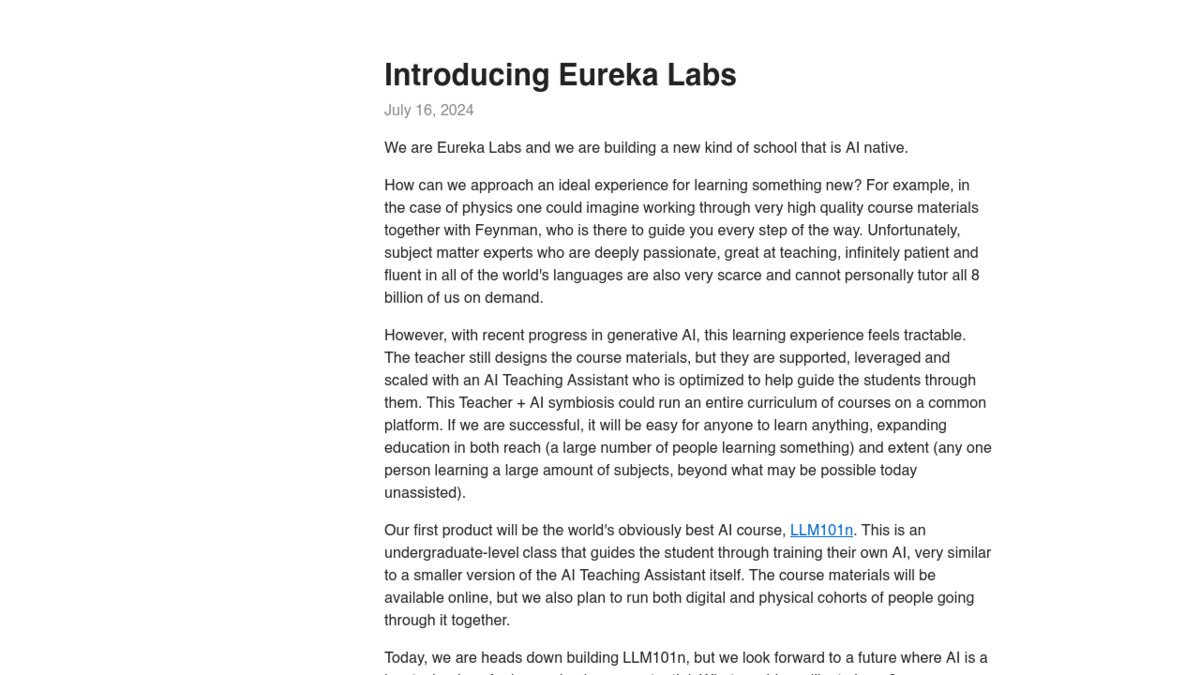 Eureka Labs launched LLM101n in 2024 - one of the most widely used free courses for training language models from scratch. The startup is now on hold.
Source: eurekalabs.ai
Eureka Labs launched LLM101n in 2024 - one of the most widely used free courses for training language models from scratch. The startup is now on hold.
Source: eurekalabs.ai
Counter-Argument
This hire is significant, but the effect isn't immediate and won't be easy to trace in benchmark results. Anthropic already has strong pre-training capabilities - the Claude 4 series has been competitive at the frontier. OpenAI built GPT-4 after Karpathy left that lab the first time, and the lab didn't noticeably slow. Frontier model performance is driven by org-wide execution - training runs, data pipelines, RLHF teams - not by individual researchers, however prominent.
The risk is that Karpathy's real value at Anthropic ends up being communicative rather than technical: making research legible to the outside world, attracting other researchers, building Anthropic's public research identity. None of that's bad, but it's different from the version where this hire reshapes what Claude can do by 2027.
What the Market Is Missing
The more interesting signal isn't Karpathy's specific contributions. It's what Anthropic's recent moves add up to. The lab acquired Stainless SDK to build out developer tooling. It committed $200M alongside the Gates Foundation to global AI deployment. Now it's bringing in a researcher whose entire public profile is about making AI research productive and teachable.
That's a coherent thesis: the leverage at the frontier is better research process. Using Claude to run pre-training experiments, having a researcher who publishes clearly, building tooling that makes research reproducible - these are bets that the next performance gain comes from doing research better, not just spending more.
Karpathy's career has moved between frontier research and large-scale deployment twice before, and each transition produced something concrete. The experiment at Anthropic starts now.
Sources:
Last updated

