
US Adds 57K June Jobs as AI Hiring Slowdown Deepens
The Bureau of Labor Statistics reported 57,000 nonfarm payrolls added in June 2026, about half the consensus forecast, as tech and finance shed roles at 25,000-28,000 per month.
 6 min read
The US economy added 57,000 jobs in June 2026 - roughly half of what forecasters expected - and the sectors where AI adoption is fastest are where the damage is most visible.
TL;DR
- 57,000 nonfarm payrolls added in June vs. ~115,000 expected - weakest reading in over a year
- 74,000 downward revisions to April and May combined, meaning net three-month gains add up to just 17,000
- Tech and finance shed 25,000-28,000 jobs per month in 2026 on average, the worst two-sector pace since 2020
- 101,743 AI-attributed layoff announcements year-to-date through June; AI cited in 31% of all June cuts
- Hiring of workers aged 22-25 into high AI-exposure roles has slowed by 14% since ChatGPT launched
The Bureau of Labor Statistics released the June employment situation on Thursday. Unemployment held at 4.2%, but that figure obscures a sharper story. The labor force participation rate fell to 61.5%, its lowest since March 2021, and the household survey recorded 507,000 fewer people at work compared to May. The headline unemployment rate fell because fewer people are looking, not because more found jobs.
"The unemployment rate's decline to 4.2 percent is a case of good news for the wrong reasons."
- Daniel Zhao, chief economist at Glassdoor
The Full Data
| Category | June 2026 | Note |
|---|---|---|
| Nonfarm payrolls | +57,000 | vs. ~115,000 expected |
| Unemployment rate | 4.2% | Down from 4.3% |
| Labor force participation | 61.5% | Lowest since March 2021 |
| Household employment level | -507,000 | Sharp monthly drop |
| April revision | -31,000 | |
| May revision | -43,000 | Combined -74k |
| Leisure & hospitality | -61,000 | Seasonal shortfall |
| Professional/business services | +36,000 | |
| Healthcare | +22,000 | Growth slowing |
The revision to April and May matters more than the June headline. Three months of official data now sum to a net 17,000 jobs - not a typo. Heritage Foundation economist E.J. Antoni described the report as "UGLY," pointing out that payrolls rose just 57k while prior months were revised down 74k combined, a "net loss of 17k," with the employment level plunging more than half a million as people exited the labor force.
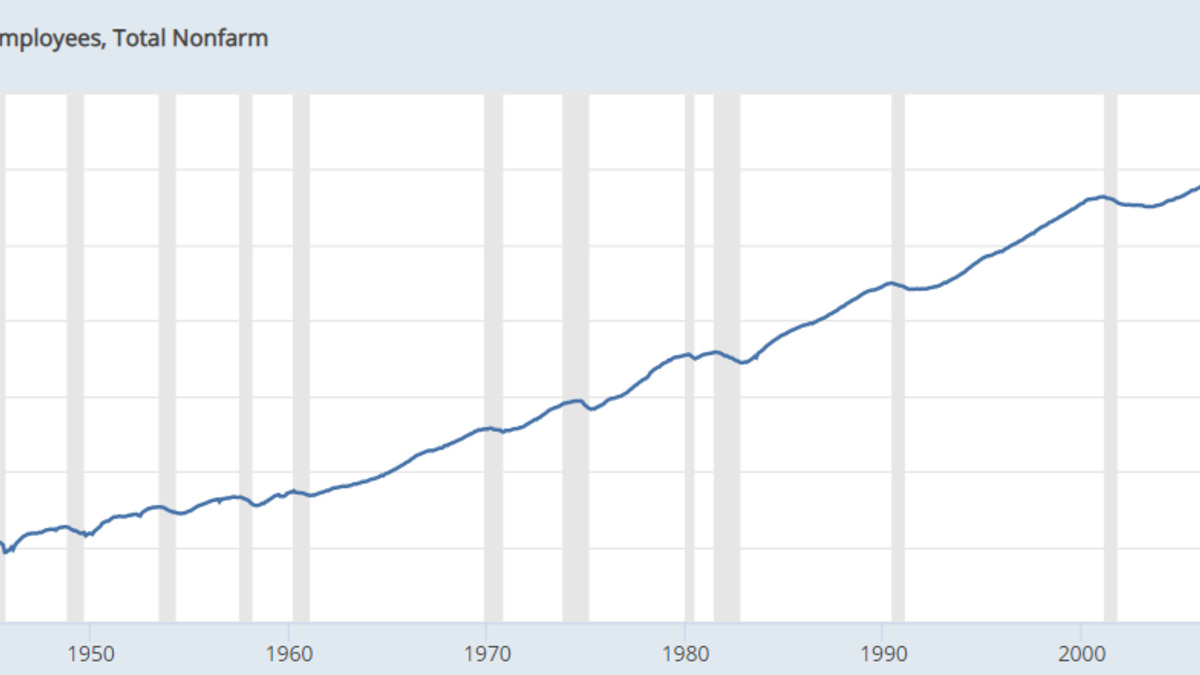 Monthly nonfarm payroll change over time. June's 57,000 reading sits well below recent years' averages.
Source: commons.wikimedia.org
Monthly nonfarm payroll change over time. June's 57,000 reading sits well below recent years' averages.
Source: commons.wikimedia.org
What the Numbers Say
AI Has Rewritten the Hiring Picture in Tech and Finance
The information and financial-activities sectors - the two industries where AI adoption moved fastest - have been shedding payrolls at 25,000 to 28,000 per month all through 2026, based on government data. That's a structural pattern spanning at least six months, not a one-quarter blip.
Outplacement firm Challenger, Gray & Christmas tracked 14,029 AI-attributed cuts in June alone. AI was cited in 31% of all layoff announcements that month. Year-to-date, the firm has logged 101,743 such announcements - already more than any full calendar year on record, with June's additions pushing that total past the 100,000 mark for the first time.
CEO John Challenger put the moment in context: AI is making an impact "in a way that no technology has before."
 Office roles in financial services and information technology have seen the steepest hiring slowdowns in 2026.
Source: unsplash.com
Office roles in financial services and information technology have seen the steepest hiring slowdowns in 2026.
Source: unsplash.com
The Hiring Freeze Is the Harder Number to See
Public layoff announcements are at least visible. The quiet halt to entry-level hiring isn't. Research from Anthropic's economics team found that hiring of workers aged 22-25 into AI-exposed occupations has slowed by roughly 14% since late 2022 - a cohort that never gets hired in the first place, and therefore doesn't appear in mass-layoff statistics. ServiceNow's CEO flagged the same dynamic in March, warning that graduate unemployment could push past 30% if the pattern holds.
Corporate AI adoption reached 20.6% in June, up from 19.5% in May, according to BLS supplemental surveys. But adoption doesn't translate uniformly into job losses. A Ramp/Revelio Labs study of more than 21,000 companies found that heavy AI spenders grew headcount by 10.2% over two years post-adoption, including 12% growth in entry-level positions. The companies that are cutting aren't the same companies as the ones buying.
Leisure and Hospitality: Seasonal Noise, Not Signal
The -61,000 figure in leisure and hospitality has a simpler explanation than it looks: seasonal hiring ran well below its typical summer pace. That sector drove May's stronger-than-expected numbers, and June reversed most of it. The BLS attributes the swing to a mismatch in seasonal adjustment, not a structural shift.
The caveat is that May's original figure - which looked solid at the time - was itself revised down 43,000. That's a significant revision to a report that had already been published and cited as evidence of a durable labor market. What looked strong in May doesn't look that way anymore.
What the Numbers Don't Say
The Challenger data is self-reported. Companies choose whether to mention AI when announcing layoffs, and the incentive to do so is not always honest. A firm restructuring after a missed earnings quarter, post-acquisition consolidation, or activist investor pressure may find it cleaner to blame automation than to detail specifics. AI has become a respectable-sounding explanation that few journalists can disprove.
The BLS hasn't established a formal causal link between AI and the current employment slowdown. Tariffs, trade uncertainty, and a pullback in corporate capital spending are also weighing on the numbers. Researchers at Stanford's Digital Economy Lab found that employment weakens specifically where AI automates tasks outright, but stays stable where AI augments worker capabilities - a distinction that aggregate payroll figures don't capture.
"If one job gets replaced by AI, it disappears... That's not quite what's happening."
- Kevin Buehler, CEO of Rogo
One real offset exists: construction tied to AI data center buildouts has added jobs. That's visible in the BLS infrastructure subcategories. It's just not large enough to show up in aggregate payroll totals.
 AI displacement is showing up more in hiring freezes and attrition than in dramatic layoff events.
Source: unsplash.com
AI displacement is showing up more in hiring freezes and attrition than in dramatic layoff events.
Source: unsplash.com
Who funded the Anthropic research is worth noting. Anthropic published the labor market study using its own usage data, which gives it a detailed but inherently narrow view of AI deployment in professional settings. It captures what people do with Claude, not what happens across every model launched across every enterprise.
So What?
For the Federal Reserve, 57,000 payrolls and a falling participation rate signal a softening labor market. Rate cut odds climbed after Thursday's release. The next FOMC meeting will carry more weight than it might have a month ago.
For workers in financial services, software, and customer support, the June data confirms what has been building for months. The sectors that moved fastest on AI adoption are the ones where hiring has dried up - not mostly through dramatic mass layoffs, but through slower backfilling, fewer entry-level openings, and the compounding effect of attrition. That process doesn't produce headlines the way a 10,000-person cut does. It just shows up, eventually, in numbers like these.
Sources:

