
Arm Claims Agents Need New Silicon - Intel Disagrees
Arm says its 136-core AGI CPU is purpose-built for agentic AI workloads. Intel's data center chief - Arm's former head of solutions engineering - says the claim overstates what's actually new.
 6 min read
One week after Arm launched the AGI CPU - a 136-core data center processor the company described as purpose-built for agentic workloads - Intel's head of data centers pushed back. The chip is fine, said Kevork Kechichian, but the premise isn't as novel as Arm wants you to think. Intel's own Clearwater Forest already shares the same design principles.
That rebuttal landed March 31 via The Register, and it raises a legitimate engineering question: when two chips converge on the same design choices, which one is actually doing something different?
TL;DR
- Arm's 136-core AGI CPU drops SMT and heavy SIMD, arguing those features waste power on agentic workloads that run orchestration logic, not matrix math
- Intel says Clearwater Forest already makes the same call - up to 288 E-cores, no SMT, limited SIMD - and launches in H1 2026
- Neither chip has public benchmarks yet; the real differentiation today is rack density and anchor customers, not architecture
What Arm Showed
The AGI CPU went public on March 24 at Arm's "Arm Everywhere" event in San Francisco. The specs are concrete: 136 Neoverse V3 cores across two dies on TSMC 3nm, 300W TDP, 3.7 GHz max and 3.2 GHz base clock, 825 GB/s aggregate memory bandwidth, 96 PCIe 6.0 lanes, and CXL 3.0 support. Two NUMA domains per socket.
The intentional omissions are what make it interesting. No SMT. No heavy SIMD (only dual 128-bit vector units, nothing like x86's AVX-512). Mohamed Awad, Arm's EVP of Cloud AI, was direct about why:
"When you increase the frequency, what else do you increase? Power. That's a problem. These boost modes are not sustainable across long periods of time."
The argument is grounded in a specific latency breakdown. Research cited at launch shows CPU-side tool processing accounts for 90.6% of total latency in agentic workloads. The GPU is waiting on the CPU to orchestrate, fetch context, and call tools - not the other way around. If that number holds, the right optimization is sustained CPU throughput, not burst GPU-style compute.
The rack density numbers are compelling. In a liquid-cooled configuration, an Arm AGI CPU rack can pack 45,696 cores - 2.03x denser than Nvidia's Vera ETL256. Air-cooled racks reach 8,160 cores per 36kW. Meta is the anchor customer; OpenAI, Cerebras, and Cloudflare are among the launch partners. OEM systems from ASRock Rack, Lenovo, and Supermicro are orderable now, with broader availability expected in H2 2026.
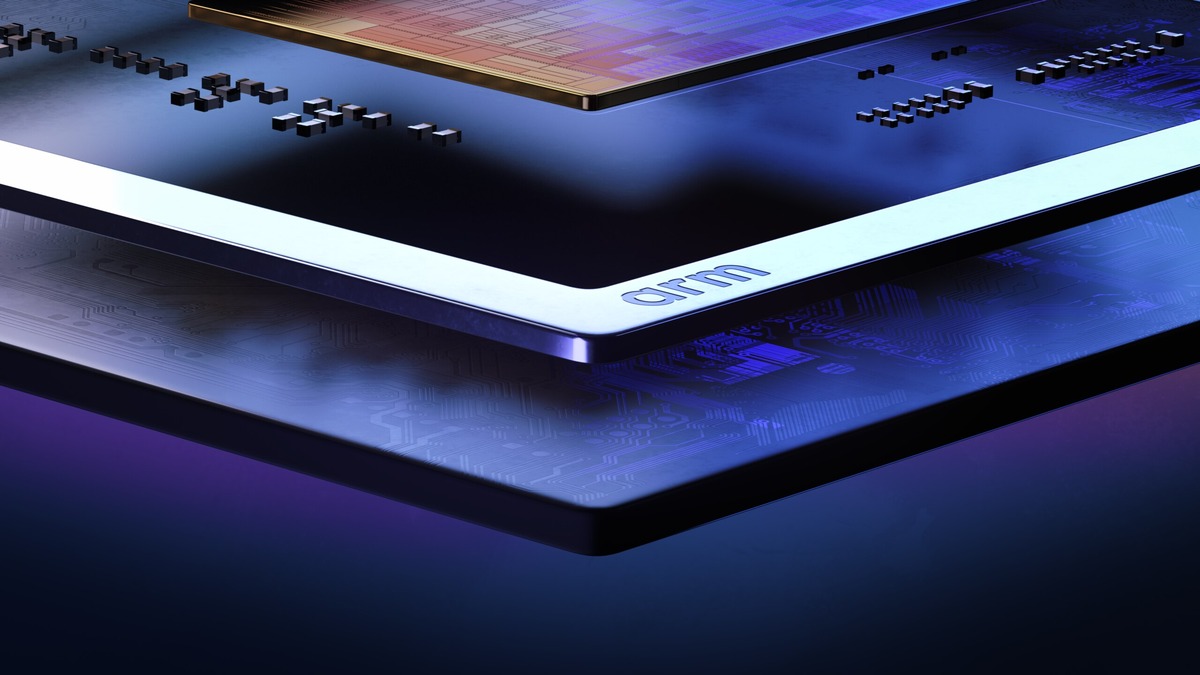 The Arm AGI CPU: 136 Neoverse V3 cores across two dies on TSMC 3nm, with no SMT and minimal SIMD by design.
Source: newsroom.arm.com
The Arm AGI CPU: 136 Neoverse V3 cores across two dies on TSMC 3nm, with no SMT and minimal SIMD by design.
Source: newsroom.arm.com
What We Could Verify
The AGI CPU isn't available for independent testing. Orderable isn't the same as available, and "H2 2026" means no third-party benchmarks exist. The 90.6% latency figure comes from Arm's own research and hasn't been independently reproduced in public. Arm hasn't published the source paper.
| Item | Status |
|---|---|
| AGI CPU test system | Orderable; broad availability H2 2026 |
| Intel Clearwater Forest system | H1 2026, limited early access |
| Independent CPU benchmarks | None published as of April 1, 2026 |
| 90.6% latency claim source | Arm internal research, no public paper |
| Meta deployment data | Under NDA |
A review of the published technical documentation from Arm's newsroom against Intel's published Clearwater Forest specs shows that every architectural claim Arm makes for the AGI CPU - no SMT, minimal SIMD, high core count, efficient power envelope - Intel makes for Clearwater Forest too.
The Gap
Kechichian's background matters here. Until summer 2025, he was Arm's EVP of Solutions Engineering. He knows the Neoverse architecture from the inside, and his response to the AGI CPU wasn't dismissive - it was specific.
He acknowledged the design logic. "Not having heavy SIMD engines is a good thing" for agentic workloads, he said, and added that orchestration tasks are "traditional data movement types of things." That's almost exactly the language Awad used to justify the AGI CPU's design. The two companies agree on the problem. They disagree on who solved it first.
Clearwater Forest has up to 288 efficiency cores on Intel's 18A process with backside power delivery, 12 channels of fast DDR5, no SMT on E-cores, and a QuickAssist accelerator that handles compression, decompression, and cryptography inline. The 17% IPC improvement over Sierra Forest is the headline number.
Kechichian did acknowledge one awkward data point: most of the early Clearwater Forest demand is coming from networking and packet processing, not agentic AI use cases. That's honest. If the chip were already winning agentic workloads, Intel's sales team would know it.
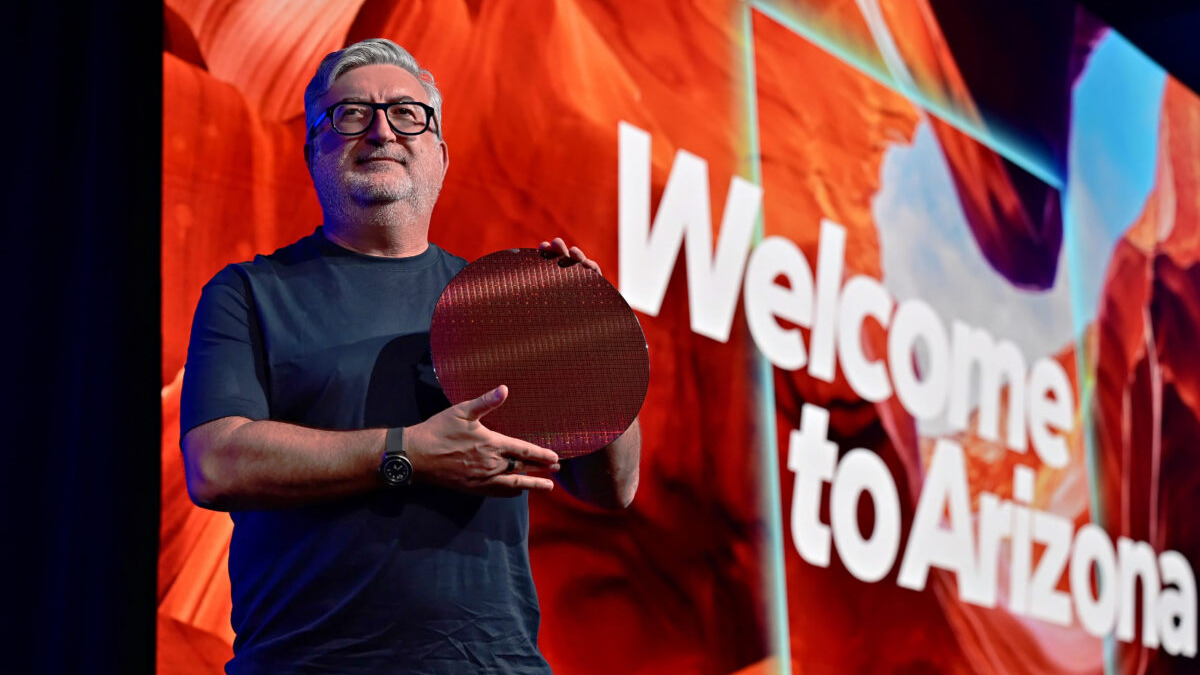 Kevork Kechichian, Intel's EVP and GM of Data Center - and former Arm EVP of Solutions Engineering - with a Clearwater Forest wafer.
Source: newsroom.intel.com
Kevork Kechichian, Intel's EVP and GM of Data Center - and former Arm EVP of Solutions Engineering - with a Clearwater Forest wafer.
Source: newsroom.intel.com
Where Arm pulls ahead is in rack density and ecosystem assembly. The liquid-cooled rack configuration is a real advantage - 45,696 cores versus Intel's undisclosed equivalent rack figure. And having Meta as an anchor customer is more than a marketing point; it means the chip has already been validated at scale for production AI infrastructure.
The CNCF's adoption of llm-d for Kubernetes-native LLM inference is the kind of software stack development that normally follows hardware choices. Whichever CPU wins the agent inference layer is likely to see that orchestration framework built around it first.
 Agentic AI workloads put new pressure on CPU core counts and sustained throughput, not GPU throughput - reshaping how data centers buy compute.
Source: unsplash.com
Agentic AI workloads put new pressure on CPU core counts and sustained throughput, not GPU throughput - reshaping how data centers buy compute.
Source: unsplash.com
Futurum Research projects the data center CPU market will reach $76.6 billion by 2029, a 34.9% compound growth rate. Arm has publicly targeted $15 billion in annual revenue by FY 2031 from its new direct silicon model. That target requires the AGI CPU to be more than a nice alternative to x86 - it needs to be the standard.
Verdict: The architectural debate is mostly settled in Arm's favor - the industry has landed on high core count, no SMT, minimal SIMD as the right design for agentic CPU workloads, and both chips reflect that. Arm's advantage is rack density, Meta at scale, and the momentum of being first to name the category. Intel's counter isn't wrong, but "we also have those features" is a harder message to sell than a chip with its own product name and 136 cores in the spec sheet.
Sources: The Register - Intel vs Arm clash · The Register - Arm AGI CPU launch specs · Arm newsroom - AGI CPU blog · Arm product page · Futurum Research analysis

