
Intel Arc Pro B70 Brings 32GB VRAM to Local AI for $949
Intel's Arc Pro B70 launched on March 25 with 32GB GDDR6 and 367 TOPS for $949, undercutting NVIDIA's RTX Pro 4000 by $850. The hardware case is strong. The software story is not.
 7 min read
Intel's Arc Pro B70 has been shipping since March 25, and it's the first time a sub-$1,000 GPU has landed on the table with 32GB of GDDR6 VRAM and a spec sheet built specifically for AI inference workloads. That matters because memory capacity is the hard constraint in local model deployment - not compute. A card that can't hold your model doesn't run your model, no matter how many TFLOPS Intel lists in the datasheet.
Key Specs
| Spec | Value |
|---|---|
| GPU Die | BMG-G31 (Big Battlemage) |
| Xe Cores | 32 |
| AI Performance | 367 TOPS |
| Memory | 32GB GDDR6 ECC |
| Bandwidth | 608 GB/s |
| TDP | 160 - 290W |
| Interface | PCIe 5.0 x16 |
| Launch Price | $949 MSRP |
| Available From | ASRock, Gunnir, MAXSUN, SPARKLE |
The Hardware Case
32GB at $949
The closest competition from NVIDIA is the RTX Pro 4000 Blackwell: 24GB, roughly $1,800. AMD's Radeon AI Pro R9700 lands at $1,299. The B70 ships with 8GB more memory than the NVIDIA card and costs $850 less. That's the entire pitch in two numbers, and Intel knows it.
For local LLM inference, VRAM capacity determines what you can run. With 32GB, a single B70 can hold Qwen 3.5 27B at 4-bit quantization with enough room for a usable KV cache, or run Qwen 3.5 FP8 weights at reduced precision without spilling to system RAM. Trying the same on a 24GB card involves uncomfortable tradeoffs on context length or generation quality.
367 TOPS and 608 GB/s
The B70 packs 256 XMX (matrix multiplication) engines with its 32 Xe cores, hitting 367 TOPS of AI compute. Memory bandwidth sits at 608 GB/s over a 256-bit GDDR6 bus. These numbers matter because bandwidth, not raw FLOPS, determines token generation speed in autoregressive decoding - the bottleneck for every LLM serving workload.
Intel's internal comparisons show the B70 achieving 1.8x higher inference performance than the previous Arc Pro B60 in MLPerf Inference v6.0 benchmarks. Against the RTX Pro 4000, Intel claims 85% higher token throughput in multi-user workloads with Ministral Instruct 2410 8B (BF16), and 2x better performance on Qwen3 in single-user tasks.
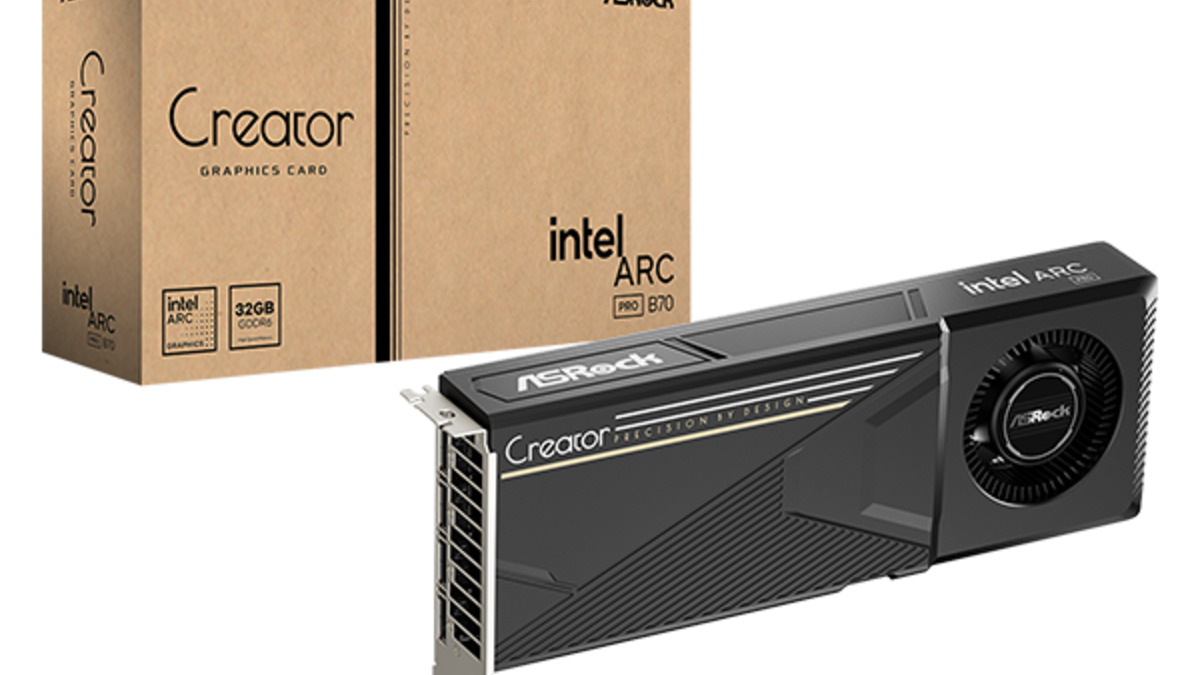 The ASRock Intel Arc Pro B70 Creator 32GB features single-fan cooling and a compact single-slot profile for multi-card workstation setups.
Source: asrock.com
The ASRock Intel Arc Pro B70 Creator 32GB features single-fan cooling and a compact single-slot profile for multi-card workstation setups.
Source: asrock.com
What You Can Actually Run
Context window headroom separates the B70 from smaller cards more than raw benchmark scores. Intel's own testing shows 93K tokens of usable context with Llama 3.1 8B (BF16) on a single B70, compared to 42K tokens on the RTX Pro 4000 before it runs out of memory completely. For AI agent workflows that need long tool call histories or multi-document reasoning, that gap is real.
| Configuration | VRAM | Models | Context |
|---|---|---|---|
| 1x B70 | 32GB | Up to 27B dense (4-bit) | 90K+ tokens |
| 2x B70 | 64GB | Up to 27B dense (BF16) or 70B (4-bit) | Extended |
| 4x B70 (Battlematrix) | 128GB | Up to 120B MoE | High concurrency |
Single-Card Performance
Community benchmarks from Level1Techs using vLLM show a single B70 delivering around 13 tokens/second in single-request mode on Qwen 27B FP8, climbing to 369 tokens/second at 50 concurrent requests. The numbers scale: this card is built for multi-user inference, not just a single developer chatting with a model. MLPerf v6.0 results put the B70 at 93.5 tokens/second on Llama 3.1 8B - slightly behind AMD's Radeon Pro W7900 at 101.8 tokens/second, but at roughly half the cost.
Scaling with Multiple Cards
Intel markets a "Battlematrix" configuration: four B70s in a single workstation. With 128GB of pooled VRAM, that system can load 120B parameter MoE models at high concurrency - territory that normally requires datacenter hardware. A community-built automation script (arc-pro-b70-inference-setup on GitHub) reports 540 tokens/second at 8 concurrent requests on a four-card setup, using tensor parallelism via vLLM. The four cards draw up to 720W combined at peak load, which is worth factoring into workstation design.
For a team running internal models or a developer building agent infrastructure without a cloud budget, a two-card B70 workstation at around $1,900 total card cost holds roughly 64GB - competitive with enterprise inference boxes costing several times more.
The Software Stack
 Multi-GPU workstation deployments are where the B70's cost advantage is most compelling - but they require careful software configuration to realize.
Source: unsplash.com
Multi-GPU workstation deployments are where the B70's cost advantage is most compelling - but they require careful software configuration to realize.
Source: unsplash.com
Intel's Official Path: oneAPI and OpenVINO
Intel ships two main inference paths: OpenVINO, a model optimization toolkit that compiles models to run efficiently on Intel hardware, and IPEX-LLM (Intel Extension for PyTorch), which adds an LLM-optimized layer on top of PyTorch's XPU backend with support for Ollama and llama.cpp. The vLLM XPU backend is functional but demanding to configure:
# vLLM on Intel XPU requires specific environment versions
# Ubuntu 24.04.3, Python 3.12, Intel oneAPI 2025.2+

pip install vllm[xpu]

# Set XPU device and run a model
VLLM_TARGET_DEVICE=xpu \
  python -m vllm.entrypoints.openai.api_server \
  --model Qwen/Qwen2.5-14B-Instruct \
  --device xpu \
  --tensor-parallel-size 2  # for 2x B70
Getting this working requires careful library path management. Community reports flag that the setup isn't production-ready out of the box, with version conflicts and driver interaction issues common on first install.
The Community Route: OpenArc and IPEX-LLM
OpenArc is the closest thing to a polished local inference server for Intel GPUs. Built on OpenVINO, it serves LLMs, vision models, Whisper, and TTS over OpenAI-compatible endpoints, with support for multi-GPU setups and speculative decoding. Models like Qwen 3.5 and Gemma 4 work out of the box. It's community-maintained, not Intel-official - which says something about where the tooling gap sits.
IPEX-LLM covers the Ollama path for users who want the familiar interface. Intel released OpenVINO 2026.1 with a new llama.cpp backend, which means llama.cpp integration is now a first-class option rather than a community patch.
Where It Falls Short
CUDA's Long Shadow
The B70's software ecosystem isn't broken - it's just two or three years behind NVIDIA's. CUDA has had a decade of optimization, and every major inference framework treats it as the default target. PyTorch XPU support landed officially in 2025, vLLM XPU kernels are still maturing, and FlashAttention's Intel port lags behind the CUDA version. The result is that even with identical model weights and similar hardware capability, NVIDIA cards frequently beat Intel on poorly-tuned inference stacks simply because the default code paths assume CUDA.
A developer willing to debug driver stacks and test framework versions can get the B70 running well. A developer who wants to run pip install vllm && python serve.py and call it done is better served by a RTX card - even at higher cost.
Power Draw and Setup Friction
The 160-290W TDP range is wide, and quad-card setups pull up to 720W under inference load. That's manageable for a workstation with proper PSU planning. The local LLM hardware hobbyist community has struggled with Intel Arc for exactly this reason: compelling specs, but setup time that doesn't fit the "ship a product" timeline.
Community automation scripts cut the setup time to 60-90 minutes on a clean Ubuntu 24.04.3 install. That's progress. But it's still not a box you hand to a non-engineer and expect to have running by afternoon.
The Intel Arc Pro B70 represents something the local AI community hasn't had before: a 32GB, sub-$1,000 GPU card with a coherent inference software story, even if that story still needs a few chapters written. For teams building internal inference infrastructure who have the engineering bandwidth to handle the setup, the cost advantage over NVIDIA's professional lineup is hard to ignore. The card starts at $949 from ASRock, Gunnir, MAXSUN, and SPARKLE. A smaller Arc Pro B65 (20 Xe cores, 197 TOPS) is arriving in mid-April for budget builds.
Sources:
- Intel Arc Pro B70 announced (Phoronix)
- Arc Pro B70 and B65 launch - Tom's Hardware
- Intel's $949 GPU: hardware wins, software loses - XDA Developers
- Arc Pro B70 for local LLM inference - Emelia.io
- B70 gives LocalLLaMA a new $949 target - Marvin-42 Insights
- Intel Arc Pro B70 inference setup (GitHub)
- Intel MLPerf Inference v6.0 results
- Intel Arc Pro B70 specifications
- OpenArc inference server (GitHub)
- vLLM XPU hardware support

