
Groq Raises $650M to Pivot From Chip Maker to Cloud
After licensing its chip technology to Nvidia for $20 billion, Groq is raising $650M from existing investors to rebuild itself as an AI inference cloud provider.
 5 min read
Groq is raising up to $650 million from existing investors to fund what the company is already calling its second act. The chipmaker that sold its technology to Nvidia for $20 billion in December is now betting that the real money isn't in designing silicon - it's in running the cloud that uses it.
TL;DR
- Groq is raising $650M from existing investors, backstopped by backers Disruptive and Infinitum
- Follows the December 2025 $20B licensing deal with Nvidia that sent founder Jonathan Ross and senior staff to the chip giant
- Groq is pivoting to an AI inference neocloud business - a market where CoreWeave already holds $90B+ in contracted revenue
- New leadership: Adam Winter (interim CEO), Matt Eng (CFO), with GroqCloud already serving 3.5M developers
The Deal That Set This Up
The December 2025 agreement with Nvidia was unusual even by AI industry standards. Groq called it a "non-exclusive licensing deal." Many analysts called it an acqui-hire. Either way, the result was the same: Nvidia gained access to Groq's Language Processing Unit technology and brought founder Jonathan Ross, president Sunny Madra, and much of the senior team into its ranks.
For a company Nvidia reportedly paid $20 billion to - around three times Groq's September 2025 valuation of $6.9 billion - this raised an obvious question: what's left?
The answer is GroqCloud. Groq's inference cloud kept running through the transition, and a February update showed real traction: 3.5 million developers using the platform. The product held together while the org chart was being dismantled around it.
Existing investors were also made whole. Cash distributions from the Nvidia deal went out to shareholders, and the $650M raise is structured so those same investors can reinvest pro-rata into the new entity. Disruptive and Infinitum are backstopping the round if other shareholders don't participate.
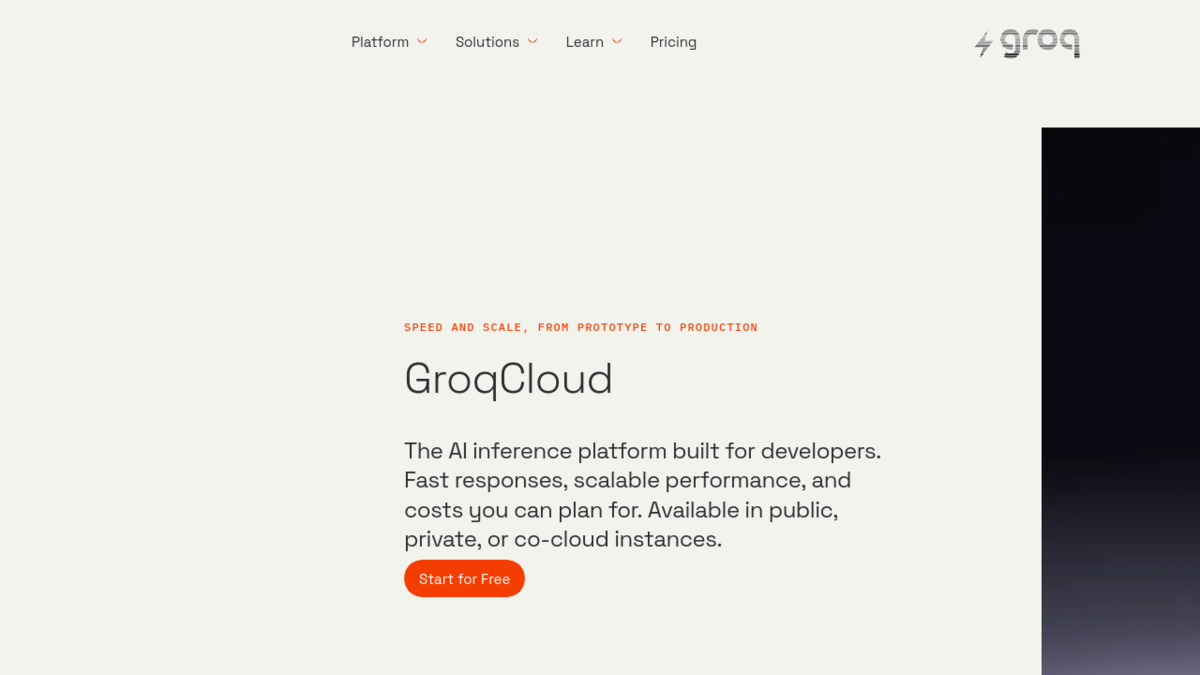 GroqCloud currently serves 3.5 million developers and becomes the primary business under Groq's restructured strategy.
Source: groq.com
GroqCloud currently serves 3.5 million developers and becomes the primary business under Groq's restructured strategy.
Source: groq.com
Groq 2.0: Inference, Not Silicon
The new Groq isn't building chips. It's selling inference capacity - the compute that fires when a user submits a query and needs an answer back in milliseconds. This is a direct pivot away from the company's original identity.
Until recently, Groq's appeal was its LPU: a custom-designed processor that handled AI inference faster than any GPU on the market. That hardware edge is now Nvidia's intellectual property. What remains is the cloud infrastructure built on top of those chips, and the developer relationships that built up over two years of GroqCloud's existence.
Adam Winter as interim CEO and Matt Eng as CFO are leading the restructured company. Neither is a chip architect, which probably reflects where the focus needs to go.
| Metric | September 2025 | May 2026 |
|---|---|---|
| Company type | AI chip maker | AI inference neocloud |
| Valuation | $6.9B | Undisclosed |
| Capital raised | $750M (Series D) | $650M (neocloud pivot) |
| CEO | Jonathan Ross | Adam Winter (interim) |
| Developer reach | Undisclosed | 3.5M+ on GroqCloud |
The inference cloud market they're entering has a clear leader. CoreWeave - backed by Nvidia and carrying over $90 billion in contracted revenue from Meta, Anthropic, and others - has spent years building GPU-dense infrastructure that AI labs need. Blackstone and Google recently committed $5 billion to build a competing TPU cloud, and Meta signed a $21 billion deal with CoreWeave to lock in capacity ahead of that competition intensifying. These numbers dwarf Groq's raise, but the market itself is also growing faster than any single provider can fill.
 The neocloud market is consolidating. ABI Research estimates around 150 inference cloud startups operating 18 months ago will narrow to roughly 10 dominant players.
Source: unsplash.com
The neocloud market is consolidating. ABI Research estimates around 150 inference cloud startups operating 18 months ago will narrow to roughly 10 dominant players.
Source: unsplash.com
Who Benefits
Existing Groq investors have the clearest path. They received cash from the Nvidia deal and now have the option to reinvest at what amounts to a fresh-start valuation. The old company's chip liabilities transferred to Nvidia. The new entity carries hardware risk on someone else's balance sheet.
GroqCloud developers get continuity. The platform has been running without interruption, and $650M buys sizable runway for capacity expansion, model additions, and enterprise sales.
Buyers of inference capacity benefit if Groq 2.0 competes seriously on price. CoreWeave's current position gives it pricing power. More providers competing for inference workloads puts pressure on margins across the sector.
Who Pays
Disruptive and Infinitum take the most concentrated risk as backstop investors. They're committing to cover the round regardless of how much existing capital recycles back in. Groq is entering a market where CoreWeave is entrenched, and the expected consolidation from 150 neocloud startups down to around 10 dominant survivors means the odds aren't with the late entrant, even at $650M.
Groq's differentiation story is also complicated. The inference speed that made GroqCloud's performance stand out in early benchmarks was built on LPU architecture that now belongs to Nvidia. GroqCloud still runs on that hardware, but the IP trail runs to a competitor. The pitch going forward has to center on developer experience, pricing, and execution rather than proprietary silicon.
There's one more wrinkle. The Nvidia-Groq chip collaboration announced earlier this year puts Nvidia in a structurally awkward position: simultaneously a technology licensor to Groq's new entity and a backer of CoreWeave, the cloud that Groq is now trying to compete with. What that means for Groq's long-term supply costs and GPU access is an open question that $650M in fresh capital doesn't answer.
The $650M buys Groq a credible launch into the inference cloud race, but 3.5 million developers and an LPU cloud whose core IP now sits in Nvidia's portfolio is a harder pitch than CoreWeave's $90 billion contract backlog - and harder still when CoreWeave's primary GPU supplier and Groq's primary licensor are the same company.
Sources:
- Groq raising up to $650 million from existing investors - Reuters via TradingView
- After Nvidia's $20B not-aqui-hire, Groq reportedly raising $650M - TechCrunch
- Groq Seeks $650M Amid Shift to AI Inference Neocloud Business - PYMNTS
- Groq Newsroom
- Neocloud: Four Trends for 2026 - ABI Research
- CoreWeave Surges as Meta and Anthropic Deals Cement Neocloud Dominance - FinancialContent

