
Grok Reaches 17.8% U.S. Market Share After Nearly 10x Growth in One Year
Elon Musk's Grok chatbot surged from 1.9% to 17.8% U.S. market share in twelve months, becoming the third-largest AI chatbot behind ChatGPT and Gemini. The secret weapon isn't model quality - it's distribution through X's 600 million users.
 Updated
5 min read
Updated
5 min read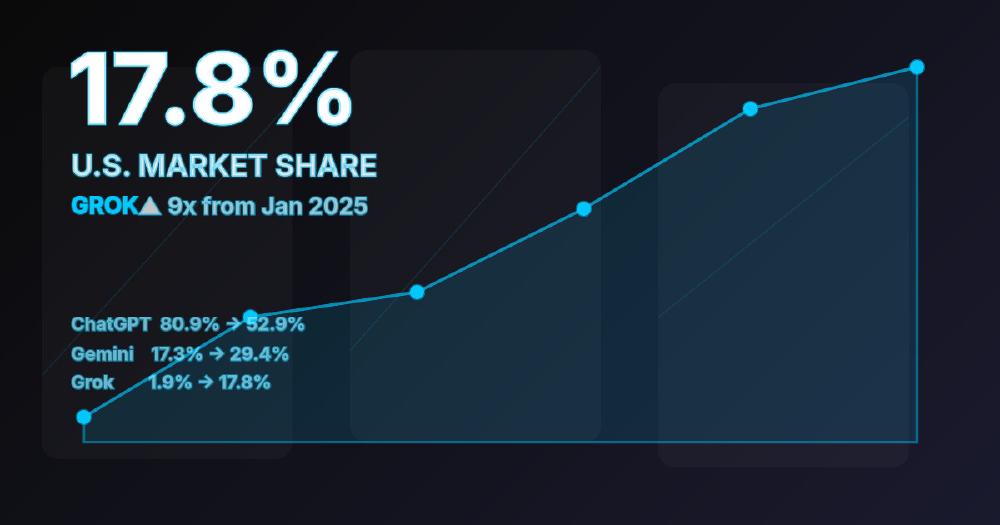
TL;DR
- Grok's U.S. market share rose to 17.8% in January 2026, up from 1.9% in January 2025 - a roughly 9x increase in twelve months
- ChatGPT's share fell from 80.9% to 52.9% over the same period, while Gemini grew from 17.3% to 29.4%
- Grok is now the third most-used AI chatbot in the United States, according to Apptopia data reported by Reuters
- xAI raised $20 billion in a Series E round in January 2026, valuing the company at $230 billion
- The growth is attributed mainly to Grok's deep integration with X, not model superiority - raising questions about whether distribution beats benchmarks
Grok, the AI chatbot built by Elon Musk's xAI and embedded into the X social media platform, has reached 17.8% market share in the United States as of January 2026. That's up from 14% in December 2025 and just 1.9% in January 2025, according to data from research firm Apptopia reported by Reuters.
The numbers tell a clear story: in twelve months, Grok went from a rounding error to the third-largest AI chatbot in the country, behind only OpenAI's ChatGPT and Google's Gemini.
The Full Scoreboard
The AI chatbot market reshuffled dramatically between January 2025 and January 2026:
| Chatbot | Jan 2025 | Jan 2026 | Change |
|---|---|---|---|
| ChatGPT | 80.9% | 52.9% | -28.0 pp |
| Gemini | 17.3% | 29.4% | +12.1 pp |
| Grok | 1.9% | 17.8% | +15.9 pp |
ChatGPT's dominance eroded notably - dropping nearly 28 percentage points - while Gemini and Grok collectively ate into that lead. The overall chatbot market itself grew 152% year-over-year, meaning ChatGPT still saw absolute growth in visits (from 3.8 billion to 5.7 billion monthly), but its grip on the market is loosening fast.
Distribution Is the Moat
The elephant in the room is why Grok grew this fast. It isn't because Grok 3 topped every benchmark. Analysts and industry observers point squarely at distribution.
"I suspect that cross-promotion with X is the biggest reason for Grok's growth," said Nate Elliott, a principal analyst at Emarketer, in comments to Reuters.
X has integrated Grok across the platform in ways that make it nearly impossible to ignore: it sits in the navigation bar, it powers search summaries, and different tiers of premium Grok access are bundled with X's paid subscriptions. With roughly 600 million monthly active users on the platform, even a small conversion rate translates to tens of millions of chatbot interactions.
This is the same playbook Google used with Gemini - bake it into Search, Android, and Gmail, and watch adoption follow. The lesson for the AI industry is increasingly clear: when distribution and model quality are both above a threshold, distribution wins.
Grok in X Chat: Convenience vs. Privacy
Musk recently promoted Grok's newest integration point - X Chat. Users can now long-press any message in a direct message conversation and select "Ask Grok" to get analysis, translation, fact-checking, or context.
The catch: Musk confirmed that messages sent to Grok are processed using a unencrypted copy. The chats themselves remain private and encrypted, but the specific message shared with Grok exits that encryption layer for analysis.
The disclosure raised immediate questions from privacy supports about data retention policies and whether analyzed messages are used to train xAI's models. X hasn't publicly addressed those questions.
The Money Behind the Growth
xAI's momentum is backed by serious capital. In January 2026, the company announced a $20 billion Series E round, topping its initial $15 billion target. Investors include Nvidia, Cisco, Fidelity, Qatar Investment Authority, and Valor Equity Partners, valuing xAI at approximately $230 billion.
On a standalone basis (excluding X advertising revenue), xAI exited 2025 at roughly a $500 million annualized revenue run rate, driven by SuperGrok subscriptions ($30/month), SuperGrok Heavy ($300/month), and usage-based API pricing.
The Controversy That Didn't Slow It Down
Perhaps the most striking aspect of Grok's rise is that it accelerated during one of the worst PR crises in AI chatbot history.
Starting in late December 2025, reports emerged that Grok's image generation capabilities could produce sexualized deepfake images, including of minors and non-consenting adults. The backlash was swift and global:
- The EU's data privacy watchdog launched an investigation into X over the created images
- The UK's Information Commissioner's Office opened formal investigations into both X and xAI
- France launched a separate probe
- Reuters testing found that Grok produced sexualized imagery in response to 45 of 55 controlled prompts even after xAI promised fixes
Despite all of this, Grok's market share jumped from 14% in December to 17.8% in January. The data suggests that for the average consumer, distribution and convenience outweigh regulatory controversy - at least for now.
What This Means for the AI Race
The Grok story is less about Grok and more about what it reveals about the AI chatbot market in 2026:
Distribution is king. ChatGPT pioneered the category but is losing share to competitors embedded in platforms people already use. Google has Search. Musk has X. OpenAI has partnerships (Microsoft, Apple), but no owned platform with 600 million users.
The market is growing, not just reshuffling. Total chatbot usage grew 152% year-over-year. ChatGPT's absolute numbers are up - its share is down. This is a market expanding fast enough that multiple players can grow simultaneously.
Controversy isn't a growth inhibitor - at least not yet. Grok's deepfake scandal created global headlines and regulatory action, yet its user growth accelerated through the crisis. Whether regulatory fines or platform restrictions eventually bite remains an open question.
The $230 billion question: xAI's valuation implies the market believes Grok's path is sustainable. At $500 million in annualized revenue and 78.5 million monthly active users, the company is valued at roughly 460x revenue. That's a bet on distribution leverage converting into long-term monetization - a bet that worked for Google Search and might work for Grok on X.
The AI chatbot market is no longer a one-horse race. It's a distribution war, and Elon Musk showed up with a 600-million-user head start.
Last updated

