
Google Funds AI Kids Studio Weeks After YouTube's Slop Crackdown
Google invested $1 million in Animaj, an AI animation studio making YouTube kids content, just seven weeks after YouTube CEO Neal Mohan declared war on AI slop - with early access to Veo, Gemini, and Imagen.
 6 min read
"The rise of AI has raised concerns about low-quality content, aka 'AI slop.'"
- YouTube CEO Neal Mohan, January 21, 2026
Seven weeks later, Google's AI Futures Fund invested $1 million in Animaj, a Paris-based AI animation studio that produces children's content for YouTube. The deal includes early access to unreleased Veo, Gemini, and Imagen models from Google DeepMind - the same generative AI technology that powers the slop YouTube says it's fighting.
TL;DR
- What they said: YouTube is cracking down on AI slop - 4.7 billion views wiped, 16 channels ended in January 2026
- What they did: Google's AI Futures Fund invested in Animaj, giving it early access to Veo, Gemini, and Imagen to make AI kids content for YouTube
- What we found: YouTube's AI disclosure rules don't apply to animated/cartoon content - exactly what Animaj produces
- Animaj claims 242 million monthly viewers and episodes in under 5 weeks; a NYT investigation found 40%+ of YouTube's recommended kids content is already unlabeled AI slop
The Claim
Google's position is that there's a difference between AI slop and AI-powered quality content. Animaj, they argue, is the latter. Jonathan Silber, co-founder of Google's AI Futures Fund, called the studio "a real blueprint for the future" of kids entertainment, saying it "exemplifies how AI can empower creators."
Animaj co-founder Sixte de Vauplane addressed the contradiction directly: "Google knows the problem and the issue of AI slop that is happening right now on YouTube. They know that right now, you don't have a lot of people and a lot of players in the kids media industry that have really proven their ability to use AI in a very good way. I think we are one of the few."
The pitch is that Animaj is different because it works with established IP (Pocoyo, Maya the Bee), employs human artists, and uses AI to accelerate production rather than replace creativity. Episodes go from concept to YouTube in under five weeks - roughly 4x faster than traditional animation.
The Evidence
The YouTube Crackdown Was Real
YouTube's January enforcement wave wasn't symbolic. The platform wiped 4.7 billion views in a single action, permanently ended 16 channels with a combined 35 million subscribers, and stripped roughly $10 million in annual ad revenue. The policy, renamed from "Repetitious Content" to "Inauthentic Content" in July 2025, broadened scope from upload patterns to creative authenticity.
Neal Mohan laid out the distinction in his January 21 letter: AI as a tool is acceptable. AI as a replacement for human creativity isn't. He noted that over 1 million YouTube channels used AI creation tools daily in December 2025.
Animaj Is a Serious Operation
This isn't a faceless content farm. Animaj raised $85 million in June 2025 from HarbourView Equity Partners, JP Morgan, and others. Co-founder Gregory Dray formerly ran YouTube Kids in Europe. The studio claims 242 million unique monthly viewers and 22 billion annual views, making it the 5th largest digital kids audience globally.
In February 2026, Animaj launched LUMEE, a joint venture with Hasbro for ad sales across Peppa Pig, PJ Masks, My Little Pony, Transformers, and Power Rangers content on YouTube - a combined 50+ billion annual views. It also has a music partnership with Sony Music Publishing.
The proprietary production tools - Sketch-to-Pose for character animation and Motion-In-Betweening for automated frame interpolation - are described as "built from how artists actually work." For features, de Vauplane claims AI could cut production timelines from six years to roughly 18 months.
 Pocoyo, one of Animaj's flagship children's brands. The studio uses AI to produce new seasons in under 18 months.
Source: animaj.com
Pocoyo, one of Animaj's flagship children's brands. The studio uses AI to produce new seasons in under 18 months.
Source: animaj.com
The Kids Content Problem Is Severe
A New York Times investigation looked at over 1,000 YouTube Shorts recommended to children and found that more than 40% of content recommended after popular kids' videos appeared to be AI-generated and often unlabeled. The content was described as "largely incoherent mush" - characters with warped faces or extra body parts, garbled text, and misinformation.
Jenny Radesky, a developmental behavioral pediatrician at the University of Michigan, warned: "The meaninglessness of these videos is a huge problem because they're just attention capture... the worst case is that it's so fantastical and full of attention capture that it is going to be cognitively overloading to the child."
YouTube suspended five channels from the Partner Program after the Times contacted them - suggesting the platform wasn't catching the content proactively.
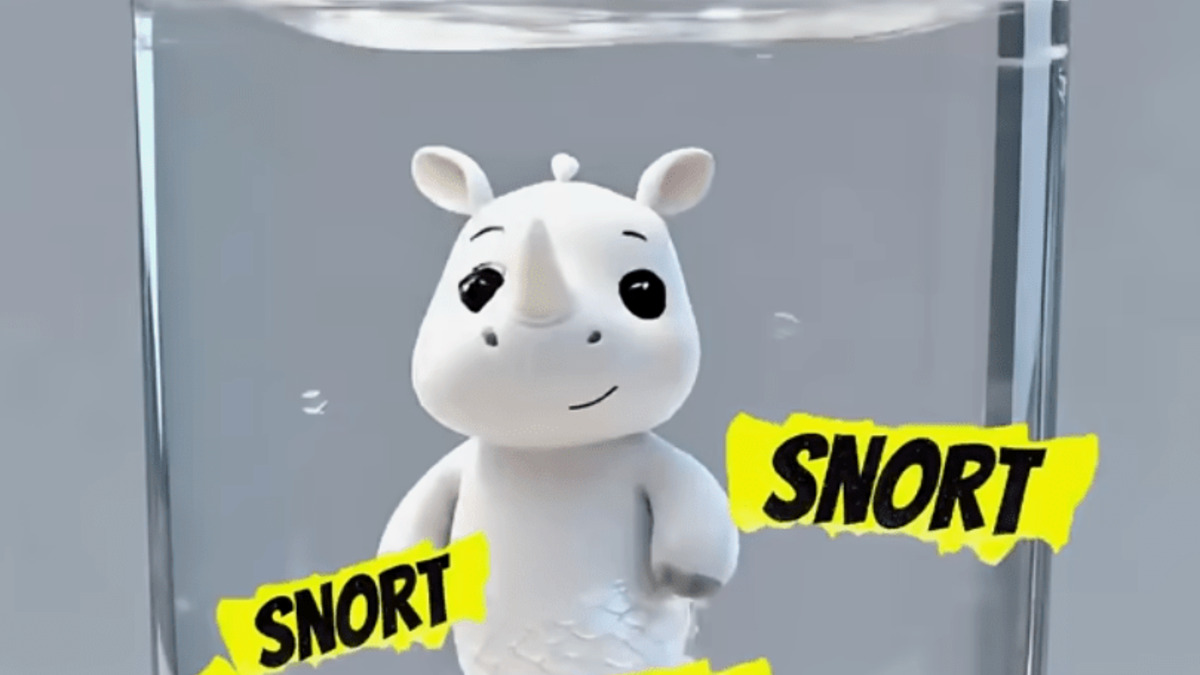 AI-generated "educational" content for children on YouTube, featuring bizarre imagery and nonsensical text.
Source: futurism.com
AI-generated "educational" content for children on YouTube, featuring bizarre imagery and nonsensical text.
Source: futurism.com
What They Left Out
The Disclosure Loophole
YouTube requires creators to disclose when they've used AI to create "realistic" content. That rule doesn't apply to animated or cartoon-style videos - exactly the format Animaj produces and precisely the format that AI slop channels use to target children. The policy gap means neither Animaj nor the low-quality AI channels it supposedly differs from are required to label their content as AI-created.
YouTube spokesperson Boot Bullwinkle, responding to the NYT investigation, confirmed the disclosure requirement applies only to "realistic content." For cartoon-style AI kids content, there's no disclosure obligation at all.
Google Is the Supplier
The deal doesn't just give Animaj money. It gives early access to unreleased versions of Veo (video generation), Gemini (multimodal reasoning), and Imagen (image generation) - with hands-on support from Google DeepMind and Google Labs teams. Google is simultaneously fighting AI-generated kids content and providing its most advanced generative AI tools to a company that makes AI-produced kids content.
The distinction Google draws - quality AI vs slop AI - is real in principle but unenforceable in practice. YouTube's automated content moderation systems can't assess whether an AI-generated children's animation has artistic merit or is algorithmically optimized engagement bait. Both use the same underlying technology. Both target the same audience. Both are exempt from the same disclosure rules.
The Scale Asymmetry
Animaj's $1 million from Google is small. The studio's 242 million monthly viewers and Hasbro partnership are not. If Animaj's AI-accelerated production model succeeds commercially, it creates a template that lower-quality producers will copy. The same Sketch-to-Pose and Motion-In-Betweening techniques that let Animaj produce episodes in five weeks can produce lower-quality versions in five days. Google's AI tools make the floor faster, not just the ceiling.
Google's bet on Animaj might be defensible in isolation. The studio has real IP, real partnerships, and real production values. But the timing - seven weeks after YouTube's CEO publicly declared war on AI slop - makes the contradiction impossible to ignore. Google is paying to clean up AI-created kids content on one side of the building while funding AI-produced kids content on the other. The only thing separating the two, according to Google, is quality. And quality is the one thing YouTube's content moderation systems have never been able to measure.
Sources:
- Google invests $1M in AI YouTube kids studio - Gizmodo
- Google AI Futures Fund backs Animaj - Tubefilter
- Neal Mohan's 2026 Letter on AI slop - YouTube Blog
- Google invests in AI animation studio for kids - Dexerto
- YouTube AI slop for children investigation - Futurism
- YouTube AI expansion alongside slop crackdown - Decrypt
- YouTube Inauthentic Content enforcement wave - Flocker
- HarbourView leads $85M Animaj round - Variety
- Animaj joins Google's AI Futures Fund - Animaj

