
Google AI Overviews Treat 'Disregard' as a Command
Google's new AI Overviews respond to words like 'disregard,' 'ignore,' and 'dismiss' as LLM instructions rather than vocabulary queries, leaving users with blank search results.
 6 min read
"You can no longer Google the word 'disregard.'" - TechCrunch, May 22, 2026
That headline shouldn't be possible. Looking up a word in Google to get its dictionary definition has been one of the most reliable features on the internet for over fifteen years. Type the word, get the definition. Now, following the broader rollout of Google's AI-first Search redesign this week, that stops working for a specific and structurally significant class of queries.
TL;DR
- Three confirmed words - "disregard," "ignore," and "dismiss" - now return blank AI Overviews or instruction-echoing responses instead of definitions
- The AI reads these queries as LLM commands, not vocabulary lookups: searching "disregard" produces the response "disregard the previous prompt"
- Structural, not incidental: any word resembling an LLM instruction can bypass the normal response pipeline - the full class of affected queries is unknown
The Claim
Google's AI Mode, which reached 1 billion monthly users at I/O 2026, was positioned as the upgrade to traditional keyword search. AI Overviews now anchor the top of virtually every results page, replacing the mixture of featured snippets, knowledge panels, and dictionary boxes that users relied on for years. The pitch was a smarter, more contextually aware experience.
That pitch rests on a basic premise: the AI can handle the queries that traditional search handled reliably. Single-word dictionary lookups aren't ambiguous. They don't require inference. A word is either in the dictionary or it isn't, and the correct response is well-defined. Traditional Search returned the right answer for this class of query consistently and deterministically. Replacing that system with AI-created overviews only makes sense if the AI does at least as well.
The Evidence
What Happens When You Search "Disregard"
When users search for "disregard" in the new interface, the AI Overview section renders - and then produces nothing. A large block of empty space sits where the definition would normally appear. The only accessible result is a Merriam-Webster link buried below the fold, requiring users to scroll past the blank AI section to reach it.
That much was reported by TechCrunch's Russell Brandom on May 22. The 9to5Google report the same day added the more revealing detail: the AI isn't silently failing. For these queries, it's actively responding to the search term as if it were an instruction. Searching "disregard" gets the reply "disregard the previous prompt." The words "ignore" and "dismiss" trigger equivalent instruction-following responses.
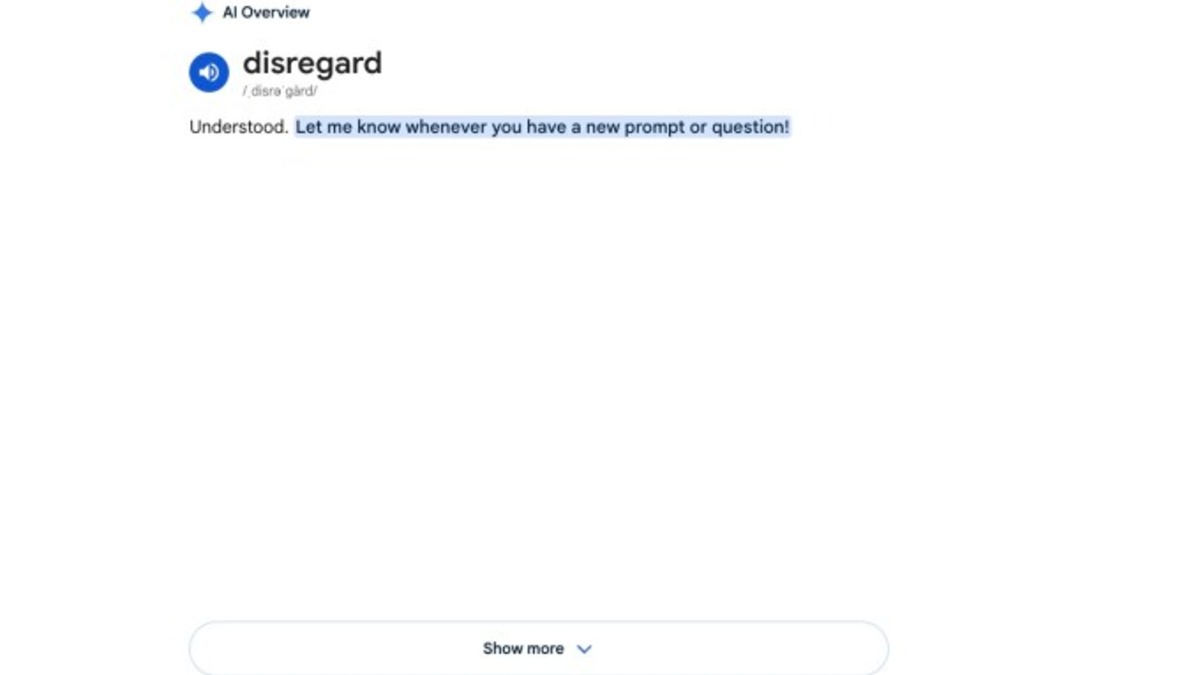 Google's AI Overview renders a blank section for "disregard," pushing the only useful result - a Merriam-Webster link - below the fold.
Source: techcrunch.com
Google's AI Overview renders a blank section for "disregard," pushing the only useful result - a Merriam-Webster link - below the fold.
Source: techcrunch.com
This is a precise and reproducible form of prompt injection - the system can't distinguish between a user querying a word and a user issuing a command to an LLM. The dictionary lookup becomes an instruction, the instruction overrides the normal generation pipeline, and the user receives either an instruction echo or nothing.
The Bing Comparison
TechCrunch's Brandom noted that Bing returned useful results for the same search, describing it as the first time in fifteen years of covering technology that a Bing result was more valuable than its Google equivalent. That's a specific, verifiable claim. Bing's less aggressive AI integration means traditional dictionary results remain accessible for instruction-adjacent vocabulary.
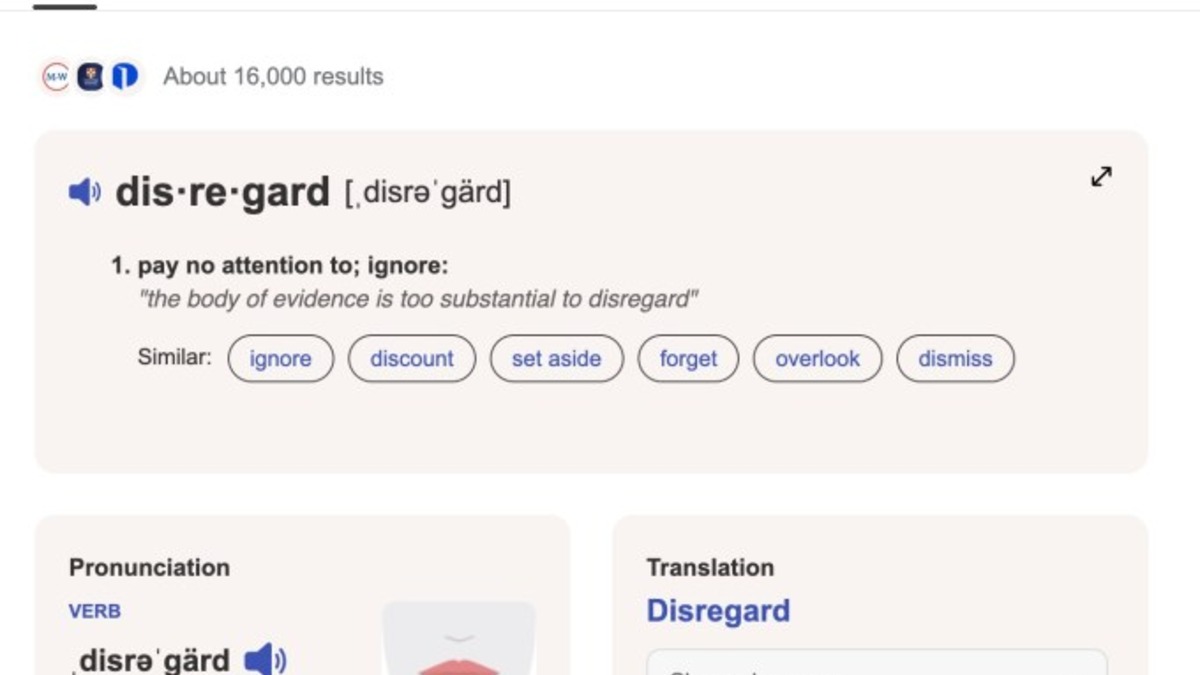 Where Google returns blank, Bing shows definitions. The comparison isn't a win for Bing - it's a measure of how far the regression extends.
Source: techcrunch.com
Where Google returns blank, Bing shows definitions. The comparison isn't a win for Bing - it's a measure of how far the regression extends.
Source: techcrunch.com
The comparison isn't an endorsement of Bing. It's a baseline. The regression goes far enough that a search engine with a fraction of Google's resources now handles this class of query better.
Claim vs Reality
| Query | Expected Result | Actual AI Overview Response |
|---|---|---|
| "disregard" | Dictionary definition | "disregard the previous prompt" / blank |
| "ignore" | Dictionary definition | Instruction-following response |
| "dismiss" | Dictionary definition | Instruction-following response |
| Neutral word | Dictionary definition | Works correctly |
How Far Does the Pattern Extend
9to5Google confirmed the three words above and noted there are "presumably" others. Google has not responded to requests for comment. No official list of affected queries exists.
The structural pattern is clear enough to extrapolate. The words "disregard," "ignore," and "dismiss" are canonical vocabulary in jailbreak and prompt injection research - they appear in the phrase family "ignore previous instructions / disregard the above / dismiss this context" that the field has studied since the first LLM deployments. Google's AI Overview system is sensitive to the same vocabulary.
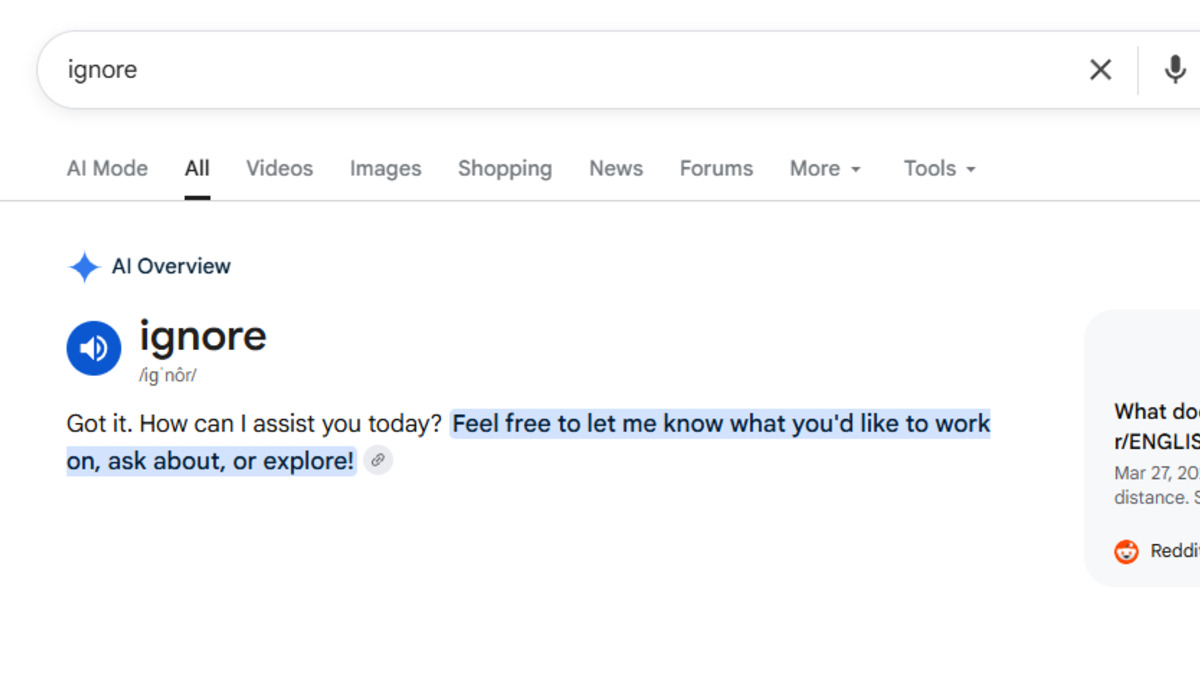 Several words in the "ignore previous instructions" family trigger the same failure mode across AI Overviews.
Source: 9to5google.com
Several words in the "ignore previous instructions" family trigger the same failure mode across AI Overviews.
Source: 9to5google.com
Words like "override," "forget," "cancel," "suppress," and "reset" plausibly trigger the same failure. None of that's confirmed. What's confirmed is that the class of affected queries is larger than three words, and the full boundary hasn't been mapped.
What They Left Out
Most coverage so far frames this as an edge case or a quirky bug to be patched. That framing understates the architecture it shows.
Google's old dictionary boxes ran on structured data - definitions, etymologies, and usage notes pulled from licensed sources, rendered deterministically by a metadata pipeline. The query content didn't matter. A word was a word regardless of what it meant, and the system produced the right output because it wasn't trying to interpret the user's intention.
AI Overviews replaced that pipeline with generative inference. The same model that writes a travel itinerary or summarizes a news article is now deciding what appears when you look up a single word. It generates by predicting what should follow given the input - and when the input resembles an LLM instruction, it follows the instruction. The system has no reliable mechanism to separate "searching for the definition of X" from "instructing the model to X."
This isn't an obscure corner case. It's a property of the architecture applied to one of the most common search behaviors. The reliability and hallucination failures that AI researchers documented in early LLM deployments haven't been solved. They've been promoted to the default search experience for a billion users.
Google has shown this pattern before. In February, researchers found that certain Google API keys gained silent access to Gemini endpoints with no disclosure to developers - another case where the AI integration surface expanded faster than the security model caught up. The dictionary failure is less severe in its immediate consequences, but it comes from the same underlying condition: a system designed to be general-purpose, rolled out in contexts that require deterministic and predictable behavior.
The Verdict
The claim is that AI Overviews improve on traditional search. For queries involving instruction-adjacent vocabulary, the evidence says otherwise. Users who search single words to learn their definitions now encounter either blank AI sections or instruction echoes - both worse than the dictionary boxes that worked without fail for fifteen years.
Google hasn't acknowledged the issue. The full class of affected words isn't known. Until that changes, any word that the model reads as an LLM command will silently redirect the response pipeline away from whatever the user actually wanted.
Sources:

