
GitHub Copilot Goes Metered - Agentic Devs See 25x Bills
June 30 closes GitHub Copilot's first full month under token-based billing. Some agentic developers are looking at monthly costs 25x higher than their old flat-rate plans.
 8 min read
Today is the last day of the first full billing cycle since GitHub switched Copilot to per-token pricing on June 1. For developers who stuck to autocomplete and occasional chat, the impact is minimal. For anyone running agent mode against a large codebase, the first bill is a shock: projected costs range from $600 to $1,200 per developer per month, up from a flat $39.
TL;DR
- GitHub Copilot moved from flat-rate plans to token-based AI Credits on June 1, 2026
- Code completions remain free; everything else - chat, agent mode, PR review - now burns credits at per-model rates
- One Pro+ user ($39/month) burned 53% of their 7,000-credit monthly allowance after four agent sessions in a single day
- Frontier models (Claude Opus 4.8, GPT-5.5) cost up to 15x more per token than economy alternatives
- Cursor and Windsurf both kept flat pricing and are seeing increased migration interest
What Changed on June 1
GitHub kept the subscription fees identical. What it replaced was the unit of consumption. Before June 1, Copilot plans counted "premium requests" - a blunt abstraction that treated a one-line autocomplete and a four-hour agentic refactor as the same thing. The new system counts input tokens, output tokens, and cached tokens separately, multiplied by model-specific rates, and converts the total to AI Credits at $0.01 per credit.
The monthly credit allotments embedded in each plan:
| Plan | Monthly cost | Included AI Credits |
|---|---|---|
| Copilot Pro | $10 | 1,500 |
| Copilot Pro+ | $39 | 7,000 |
| Copilot Business | $19/user | 1,900/user |
| Copilot Enterprise | $39/user | 3,900/user |
The included credits come with the subscription - they're not an add-on. Additional credits beyond the monthly allowance cost $0.01 each. Unused credits don't roll over.
What's Free, What's Not
Three features stay outside the credit meter for all paid plans: inline code completions, Next Edit Suggestions, and multi-line ghost text. Everything else - Copilot Chat, agent mode, multi-file edits, pull request summaries, and code review - now consumes credits.
GitHub's official announcement framed this as fairness: "a quick chat question and a multi-hour autonomous coding session can cost the user the same amount" under the old model. That framing is accurate. It just doesn't prepare developers for what the metered alternative actually costs.
Model Pricing: A 60x Spread
The credit cost per interaction depends almost completely on which model you pick. GitHub now exposes a wide menu with rates that vary by roughly 60x between cheapest and most expensive:
| Model | Input (per M tokens) | Output (per M tokens) | Tier |
|---|---|---|---|
| GPT-5 mini | $0.25 | $2.00 | Economy |
| Gemini 3 Flash | $0.50 | $3.00 | Economy |
| GPT-5.3-Codex | $1.75 | $14.00 | Mid |
| Claude Sonnet 4.6 | $3.00 | $15.00 | Mid |
| Claude Opus 4.8 | $5.00 | $25.00 | Frontier |
| GPT-5.5 | $5.00 - $10.00 | $30.00 - $45.00 | Frontier |
| Claude Fable 5 | $10.00 | $50.00 | Max |
A five-question chat session consuming roughly 4,000 input tokens and 800 output tokens costs about 22 credits ($0.22) on Claude Sonnet 4.6 and under 2 credits ($0.016) on GPT-5 mini. That's a 14x gap for identical output quality on simple tasks. At 20 daily sessions on Sonnet 4.6, that's $84 per month in credits, before the subscription.
The Agentic Multiplier
Agent mode is where the math breaks down completely. A single multi-file refactor session can consume tens of thousands of tokens per tool call, across dozens of calls, for hours. GitHub's own research found that agentic coding tasks can consume roughly 1,000x more tokens than a standard single-turn query.
One developer in the GitHub community discussion reported a Pro+ account ($39/month, 7,000 credits) losing 53% of its monthly allowance after running just four coding agents in a day - on a small project. Another user burned 8% of their credits in two hours of normal work and projected running dry before the end of Day 2.
The numbers developers are projecting for full agentic workflows:
- Daily chat user: +$3-5/month added to subscription cost
- Heavy chat (30-40 sessions/day on Sonnet 4.6): +$150-250/month
- Agentic team running agent mode daily: $600-$1,200 per developer per month
That last number - up from $39/month under the old flat Pro+ plan - is what's creating the loudest backlash.
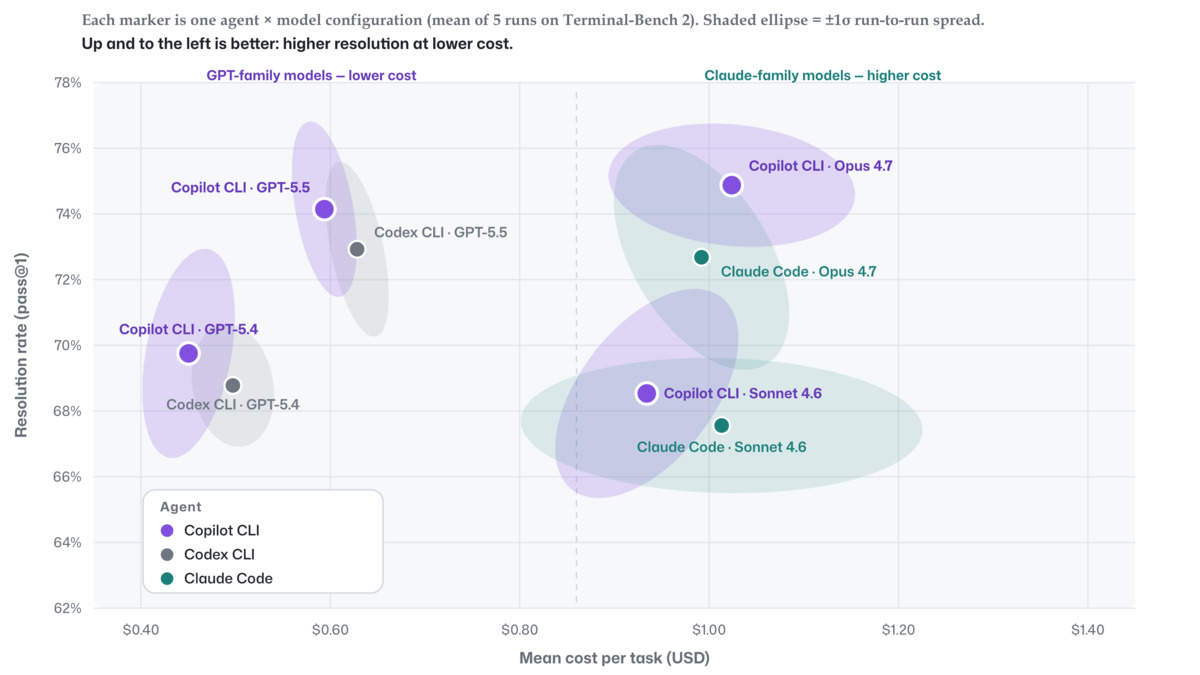 GitHub's own benchmark comparing resolution rate versus cost per task across models. GPT-5 mini delivers the best efficiency; Claude Opus reaches the highest resolution at a significant premium.
Source: github.blog
GitHub's own benchmark comparing resolution rate versus cost per task across models. GPT-5 mini delivers the best efficiency; Claude Opus reaches the highest resolution at a significant premium.
Source: github.blog
Developer Reaction
The GitHub community discussion thread reached hundreds of comments within days of the announcement. The reactions split into two camps.
One developer wrote: "What a joke. This new usage model is just stupidly expensive. I'm adjusting mine by cancelling." Others flagged the removal of free model fallbacks as the actual issue: "I was relying on gpt-5 mini after premium requests depleted...I already have Codex and Claude subscriptions. Only kept Copilot because of free models."
A different group pushed back. One experienced engineer argued that runaway bills stem from poor workflow design, not the pricing model: "The only way it gets crazy like that is if you are purely vibe coding with a ton of bloated iterations." Under the old plan, GitHub was effectively subsidizing that vibe coding. The meter just made the real cost visible.
Neither camp is wrong. The pricing model is economically defensible. The communication around it was not. Many developers learned about the scope of the change from their billing dashboard, not from the announcement.
This isn't the first time Copilot has quietly changed what it charges for. Earlier this year, Copilot started injecting promotional tips into pull requests, affecting over 11,000 tracked repositories before the feature was adjusted. A pattern of changes arriving before users expect them has eroded some goodwill.
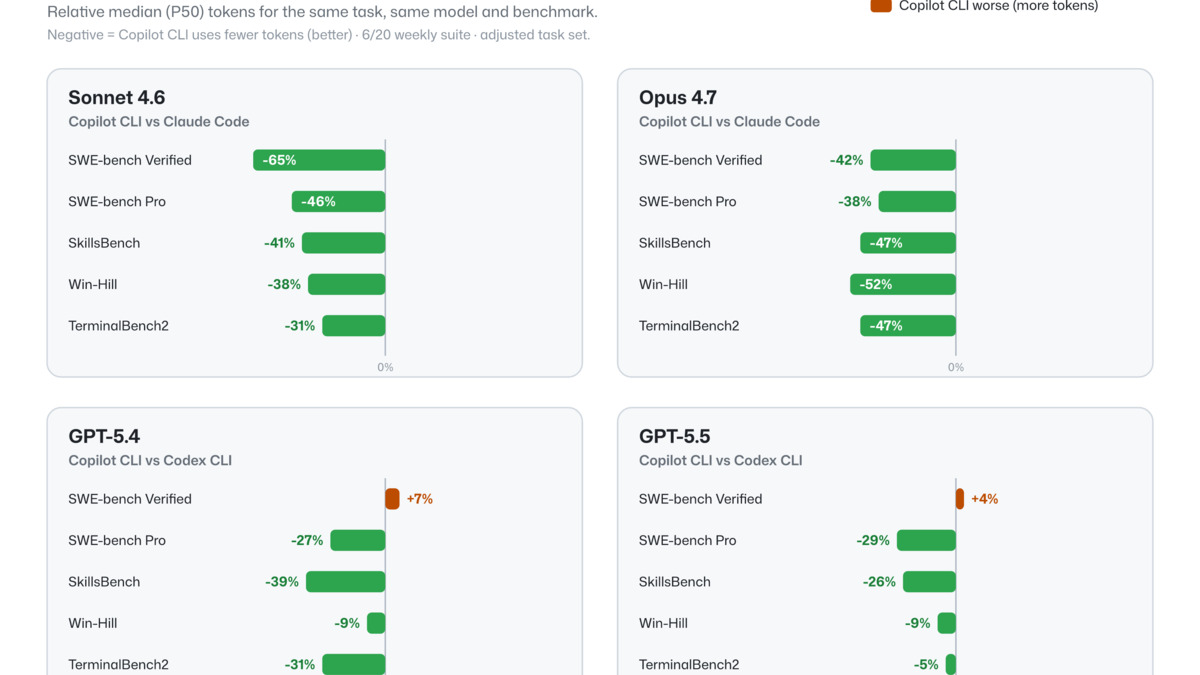 GitHub's internal data showing token consumption across SWE-bench, SkillsBench, and TerminalBench. Economy models like GPT-5 mini consume far fewer tokens per task - a gap that compounds fast in agentic sessions.
Source: github.blog
GitHub's internal data showing token consumption across SWE-bench, SkillsBench, and TerminalBench. Economy models like GPT-5 mini consume far fewer tokens per task - a gap that compounds fast in agentic sessions.
Source: github.blog
Where It Falls Short
The credit model has real gaps that GitHub hasn't fully addressed.
No credit rollover. Unused monthly credits expire at the end of each billing period. Developers who work in bursts - quiet weeks followed by intensive sprint weeks - will overspend or waste credits depending on timing. Legacy mobile plans abandoned this model years ago.
No free fallback model. Under the old plan, premium requests ran out and Copilot fell back to a cheaper model automatically. Now, all model usage costs credits. Some developers kept Copilot specifically because it provided model variety when direct API subscriptions ran out.
Context window costs are invisible. Reducing a context window from 100,000 tokens to 20,000 can cut input costs by 80%, but the UI gives no real-time feedback on token consumption during a session. You discover the cost after the session ends.
Annual plan holders are on a delayed timeline. Subscribers on annual plans stay on the old Premium Request model until their renewal date. This creates a confusing two-tier state inside the same product for months.
The deeper issue is that Copilot's billing now requires developers to actively manage model selection to control costs - a task that didn't exist before and adds friction to the workflow the product is supposed to simplify. This same dynamic has been observed with Claude Code, where phantom token inflation and billing surprises have frustrated developers accustomed to predictable subscription costs.
The Competitive Picture
Cursor and Windsurf both kept flat pricing and are the immediate beneficiaries. Cursor charges $20/month for its Pro tier with a generous credit allotment and a proprietary long-horizon coding model. Windsurf offers flat-fee coverage on its Pro tier with an autonomous-agent Max tier at $200/month. Both position predictable billing as a feature.
For developers willing to manage more complexity, Cline routes directly to provider APIs (Anthropic, OpenAI, Google) at published rates with no intermediary markup. The GitHub Copilot vs Cursor comparison on this site covers the workflow differences in detail. For a broader view of where the market sits, the best GitHub Copilot alternatives guide covers seven tested options with current pricing.
A hybrid approach some developers are landing on: keep Copilot Pro at $10/month for free inline completions - which remain unlimited - and add Cursor or Claude Code at $20/month for chat and agentic work. Total cost: around $30/month with no usage-based overages on either side.
GitHub's transition reflects something the flat-rate era was always going to hit: at the compute cost of frontier models running agentic sessions, unlimited subscriptions don't work at scale. The economics force per-token billing eventually. What GitHub got wrong is the timeline for communicating it and the absence of tools to help developers understand their exposure before the first bill arrived.
The five mitigation steps that cost nothing to apply today: set a monthly spending cap in GitHub billing settings, default to economy models for non-critical tasks, batch multiple questions into a single context window instead of opening new chat sessions, review the usage dashboard weekly for the first two months, and reduce the default context window size for large codebases.
Sources:
- GitHub Copilot moves to usage-based billing - GitHub Blog
- Models and pricing for GitHub Copilot - GitHub Docs
- GitHub Copilot usage-based billing community discussion
- 'What a joke': GitHub Copilot's token billing spurs consternation - TechCrunch
- GitHub Copilot switches to token billing - VaaSBlock
- GitHub Copilot token billing 2026: cost guide - DEV Community
- GitHub Copilot billing shock confirmed - TechTimes

