
Gemini in 4M Cars - GM Bets the Dashboard on Google
Gemini arrives in 4 million GM vehicles and 16 Volvo models via OTA update as GM phases out Apple CarPlay by 2028. The in-car AI platform war is now a real fight.
 6 min read
Google's Gemini AI assistant is arriving in around 4 million GM vehicles this week - not through some future car model, but through an over-the-air software update hitting existing Buicks, Cadillacs, Chevrolets, and GMC trucks already sitting in driveways. On the same day, Volvo confirmed a parallel rollout covering 16 models going back to 2020. The deployment is one of the largest simultaneous AI upgrades in automotive history, and it lands as GM moves to drop Apple CarPlay entirely by 2028.
The numbers matter less than the direction they signal.
| Automaker | Platform | AI Voice Assistant | CarPlay / Android Auto |
|---|---|---|---|
| GM (4M vehicles) | Android Automotive OS | Gemini (live Apr 2026) | Phasing out by 2028 |
| Volvo / Polestar | Android Automotive OS | Gemini (live Apr 2026) | Limited support |
| Renault | Android Automotive OS | Google Assistant | Supported |
| Honda | Android Automotive OS | Google Assistant | Android Auto retained |
| BMW / Mercedes / Audi | Proprietary infotainment | Proprietary assistants | Supported |
| Tesla | Proprietary | Tesla AI | Not supported |
| Ford | Sync 4 | Alexa / SYNC Voice | CarPlay + Android Auto |
Android Automotive OS now runs in more than 100 production models across Polestar, Volvo, Renault, GM, Honda, and a growing list including Mazda's 2026 CX-5 and the Acura ADX. S&P Global forecasts the platform will reach 18% of the global new-car market by 2027.
The OTA Land Grab
GM's 4 Million Vehicles
The rollout targets model-year 2022 and newer vehicles with Android Automotive OS installed. Drivers receive a message on their infotainment screen when the upgrade is ready. No dealer visit, no paid upgrade - OnStar connectivity and a signed-in Google account are all that's needed.
What Gemini replaces isn't just a voice command layer. Google Assistant in cars was already handling navigation, music, and climate control. Gemini adds multi-step conversational requests: asking for a coffee stop on the way to the post office, or getting fuel cost estimates for a long haul. It also draws answers from the vehicle's manufacturer-provided owner's manual, so "how do I turn off the traction control on this Silverado" gets a car-specific answer rather than a generic web result.
Commercial drivers on GM's fleet gain additional features: trailer-friendly parking searches and fuel cost optimization by route.
Volvo's Retrofit Play
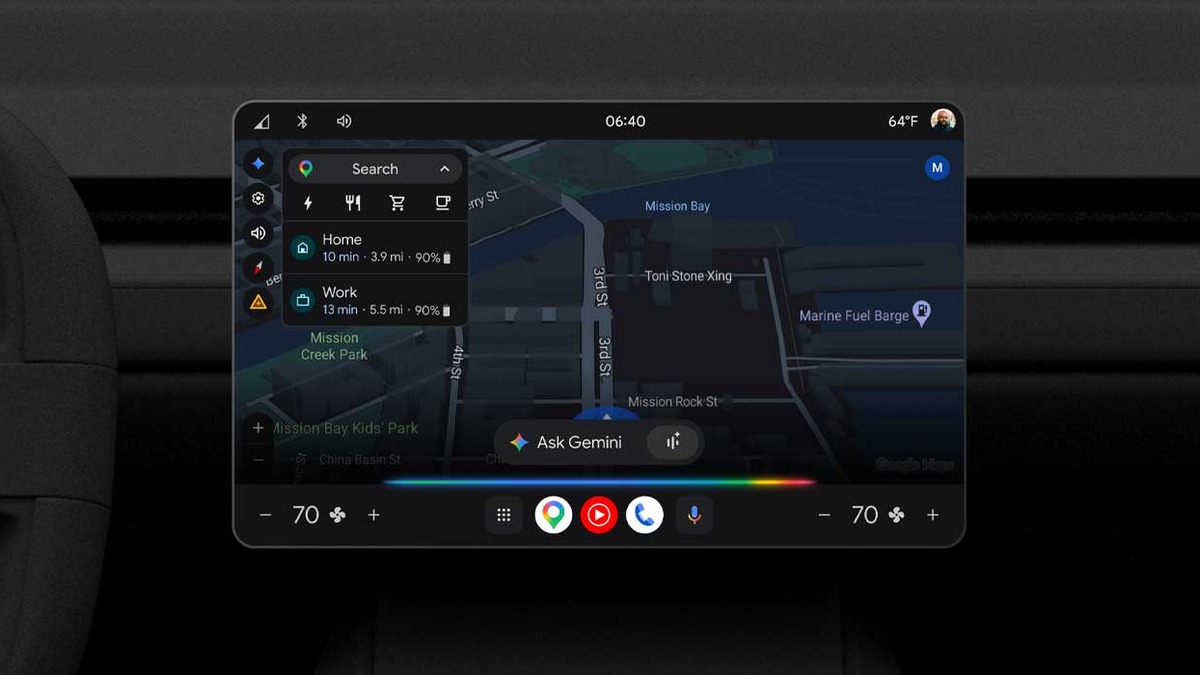 Google's four-color Gemini light bar replaces the Google Assistant interface in Android Automotive vehicles.
Source: 9to5google.com
Google's four-color Gemini light bar replaces the Google Assistant interface in Android Automotive vehicles.
Source: 9to5google.com
Volvo's timing is deliberately coordinated with GM. The company announced the same day - April 30, 2026 - that it's rolling Gemini to 16 models from 2020 onward: C40, EC40, EX40, XC40, S60, V60, V60 Cross Country, XC60, V90, V90 Cross Country, S90, XC90, EX90, ES90, EX30, and EX60. A five-year-old XC60 with Google built-in gets the same Gemini layer as a brand-new EX60, delivered over Wi-Fi at no cost.
"At Volvo Cars, we focus on developing human-centric technology that adapts to people, not the other way around," said Alwin Bakkenes, Volvo Cars Head of Global Software Engineering, in the company's rollout announcement.
Patrick Brady, Google's VP of Android for Cars, framed Gemini's vehicle value around reducing distraction - keeping "attention where it matters most." The argument isn't just feature parity with Siri or Alexa in cars. The claim is that conversational AI cuts driver distraction by eliminating the need to scroll through menus or memorize specific command phrases.
The Apple CarPlay Subtext
This rollout doesn't happen in isolation. GM is already on record dropping Apple CarPlay and Android Auto from all its vehicles by 2028. That decision was controversial when announced - many buyers explicitly choose vehicles based on CarPlay support - but this Gemini deployment is GM's clearest argument yet that its chosen platform can do the job.
The broader Apple-Google dynamic makes the automotive fight especially pointed. Apple has been licensing Google's cloud infrastructure for its own AI work, and there are reports Apple has access to distill Gemini for on-device Siri models. In the car market, by contrast, the two companies are competing directly for platform control, and GM is explicitly backing Google.
 The automotive infotainment battle is now an AI platform battle.
Source: unsplash.com
The automotive infotainment battle is now an AI platform battle.
Source: unsplash.com
Counter-Argument: Apple Isn't Going Anywhere
GM represents a big bet, but it's one company. Apple CarPlay ships in hundreds of vehicle models from virtually every major automaker. BMW, Mercedes, and Audi explicitly support CarPlay with no stated plans to change that. Ford offers both systems simultaneously. Most drivers using CarPlay don't experience it as a limitation - they experience it as their phone, extended.
The OEM pushback against CarPlay reflects commercial tension rather than consumer demand. Automakers don't want to cede the infotainment layer to Apple any more than publishers want to cede distribution to the App Store. Whether Gemini is compelling enough to compensate buyers for losing CarPlay is still a question GM is betting its showroom on.
Whether Gemini is good enough to compensate consumers for losing CarPlay is a question GM is now betting its showroom on.
Gemini 3.1 Pro is the model powering Google's most demanding applications. What's deploying in cars is a lighter, vehicle-optimized variant - but it shares the same underlying architecture and gets server-side updates without any hardware change to the vehicle.
What the Market Is Missing
The real prize in this contest isn't voice commands. It's data. A car running Android Automotive is a signed-in, located, always-on device sending location queries, route preferences, commercial stop patterns, and voice input through Google's infrastructure. GM has traded CarPlay - where Apple collects the behavioral signal - for Android Automotive, where Google does.
At 4 million vehicles in the US alone, growing toward 18% of global new-car production by 2027, Google is building a data network that doesn't need a smartphone as an intermediary. Whether Gemini's conversational features win over skeptical GM buyers is almost secondary to what Google captures from every driver who simply uses it.
The question GM buyers will start asking is different from the one the industry is focused on. Not "is Gemini as good as Siri?" but "do I care enough about CarPlay to change brands?"
Sources:
- 9to5Google: Gemini replacing Google Assistant on Android Automotive for 4 million GM cars
- Google Blog: Cars with Google built-in are getting Gemini
- TechCrunch: Google's Gemini AI assistant is hitting the road in millions of vehicles
- The Weekly Driver: Google Gemini Comes to Volvo Cars - 16 Models Get the Update, Back to 2020
- Android Authority: GM is dropping Android Auto to make way for Gemini
- Snapp Automotive: The state of Android Automotive in 2024
- Auto123: GM dropping Apple CarPlay, Android Auto fully by 2028

