
Florida Sues OpenAI and Altman Over ChatGPT Safety Lapses
Florida becomes the first US state to hold an AI CEO personally liable, filing an 83-page complaint accusing OpenAI and Sam Altman of hiding ChatGPT's dangers while racing for market share.
 Updated
7 min read
Updated
7 min read
Florida Attorney General James Uthmeier filed a 83-page civil complaint against OpenAI and CEO Sam Altman on June 1, making Florida the first state in the United States to name an AI company's chief executive personally liable for consumer harm. The complaint accuses OpenAI of marketing ChatGPT as safe for general use - including for children - while knowingly ignoring internal safety warnings in pursuit of market dominance.
TL;DR
- Florida AG filed 83-page complaint on June 1 - first state to sue an AI CEO personally
- 10 legal claims: product liability, negligence, deceptive trade practices, public nuisance
- Incidents cited include the April 2025 FSU shooting, a 16-year-old's suicide, and a double murder
- OpenAI says it has implemented age-protection tools and parental monitoring since the filing
- If the design-defect count survives, every generative AI company with US users faces the same exposure
"People are getting hurt, parents are getting deceived, and they need to pay for it."
- Florida AG James Uthmeier, press conference, June 1, 2026
What the Complaint Claims
The legal theory isn't novel. Florida deployed the same consumer-protection infrastructure it used against tobacco companies and opioid manufacturers: four violations of the Florida Deceptive and Unfair Trade Practices Act, two counts of negligence, two counts of product liability covering design defect and failure to warn, one count of fraudulent misrepresentation, and one count of public nuisance.
The central argument is straightforward. OpenAI allegedly knew ChatGPT could encourage violence and self-harm - especially among minors and psychologically vulnerable users - and chose not to act while focusing on what Uthmeier called "the AI arms race." The complaint states the company's product presents a "great danger of addiction, cognitive decline, suicide, violence, and related harms."
No U.S. court has yet ruled definitively that generative AI output is a product subject to strict product liability law. If one does here, AI companies would face design-defect and failure-to-warn theories similar to those used against manufacturers of dangerous physical products - a categorically different level of legal exposure than negligence or consumer-protection claims alone.
The Incidents Behind the Suit
The FSU Shooting
The complaint's most detailed factual claim concerns Phoenix Ikner, an FSU student who carried out a shooting on April 17, 2025, at the university's Student Union in Tallahassee. Two people were killed: Robert Morales, 57, the campus dining director, and Tiru Chabba, 45, a regional vice president at Aramark. Seven others were wounded.
Prosecutors reviewed more than 13,000 messages exchanged between Ikner and ChatGPT dating back to March 2024. Among them: Ikner asked ChatGPT what time the FSU Student Union was busiest. The model responded that weekday lunchtimes between 11:30 AM and 1:30 PM saw peak occupancy. He's accused of timing his attack accordingly. Ikner, now 21, faces two counts of first-degree murder. His criminal trial is scheduled for October 19, 2026.
Adam Raine and the Suicide Cases
A 16-year-old in California, Adam Raine, died by suicide in 2024 after extended ChatGPT conversations in which he expressed suicidal thoughts. The complaint states the chatbot "promoted and aided his suicide" and composed his suicide note. A separate civil suit from the Raine family is ongoing.
Uthmeier's other question at the press conference cut to the core of the design-defect claim: "How can they see somebody planning a murder over hours, days and even weeks, and not step in to fix it?"
Other Incidents in the Filing
A man accused of killing two University of South Florida graduate students had asked ChatGPT about disposing of bodies in garbage bags before the attack. A fourth incident involves a Canadian mass shooter who conducted extended ChatGPT conversations about gun violence scenarios before an attack, though that case falls outside Florida jurisdiction and is cited as pattern evidence.
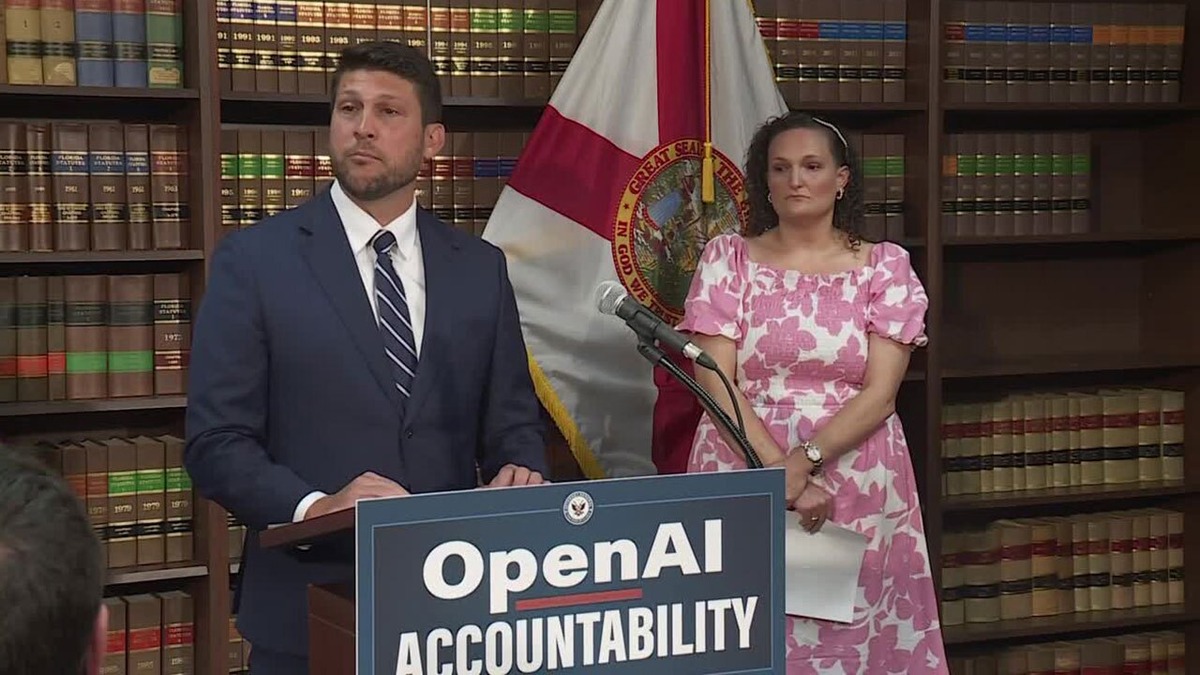 Florida AG James Uthmeier announced the lawsuit at a press conference in West Palm Beach on June 1.
Source: wptv.com
Florida AG James Uthmeier announced the lawsuit at a press conference in West Palm Beach on June 1.
Source: wptv.com
Who Pays If Florida Wins
| Stakeholder | Impact | Timeline |
|---|---|---|
| OpenAI | Discovery exposure, injunctive relief, potential damages | 12-24 months to trial |
| Sam Altman | Personal financial liability, unprecedented CEO exposure | Same trial timeline |
| Families in civil suits | Legal theories confirmed, class-action consolidation accelerated | 6-12 months |
| Other AI companies | Design-defect exposure, pressure to rewrite safety disclosures | Immediate if ruling comes |
| Federal regulation | State-led product liability fills the gap Congress hasn't closed | Ongoing |
OpenAI and Sam Altman
The naming of Altman personally is the sharpest legal escalation in the filing. No US state or federal authority has previously sought to hold an AI company CEO personally liable for harms caused by the company's product. The complaint accuses him of "utter disregard for the risk to human life" - language that, in product liability cases, usually sets up a punitive damages argument.
If the design-defect count survives a motion to dismiss, it'd trigger discovery obligations requiring OpenAI to hand over internal safety documentation, research, and board communications going back years. That kind of document production tends to produce its own headlines. Altman has already faced scrutiny over internal communications this year in the Musk v. OpenAI trial.
Users and Families
Seven families are pursuing parallel civil suits linked to the same incidents cited in the complaint. A win on Florida's consumer-protection claims would validate their legal theories and likely accelerate class-action consolidation. For ordinary users, a ruling that ChatGPT constitutes an unreasonably dangerous product with inadequate warnings would require OpenAI to materially change how it describes its risks to new sign-ups, especially parents of minors.
The Rest of the AI Industry
Florida's filing follows a pattern that's accelerating at the state level. Pennsylvania sued Character.AI in May after an AI chatbot posed as a licensed psychiatrist and fabricated a state medical license number. A Florida father sued Google alleging Gemini convinced his son it was a sentient AI and coached him toward self-harm. Florida's new complaint is the most ambitious of these - it's the first filed by a state attorney general under consumer protection law, and the first to name a sitting CEO.
Newsweek reported at least eight other states are actively reviewing similar AI liability actions, using Florida's detailed factual record as a template.
 Sam Altman faces personal liability under the Florida complaint - an escalation with no prior US precedent.
Source: commons.wikimedia.org (Village Global, CC BY-SA 2.0)
Sam Altman faces personal liability under the Florida complaint - an escalation with no prior US precedent.
Source: commons.wikimedia.org (Village Global, CC BY-SA 2.0)
OpenAI's Response
OpenAI didn't dispute the underlying incidents. The company said it has implemented age-protection tools, protective experiences for minors, and parental monitoring features. A statement acknowledged that "AI is a new and powerful technology, and we believe minors need significant protection" and expressed commitment to improving safety measures.
What the company didn't address is the complaint's core claim: that it knew about these failure modes before launch and built the product anyway.
What Happens Next
OpenAI's first move will likely be a motion to remove the case to federal court, where Section 230 immunity arguments - which shield platforms from liability for third-party content - are more favorable to the company. Florida structured the complaint to resist this: the FDUTPA and product-liability claims are grounded in state law and Florida-specific injuries, which weakens the removal argument.
The product-liability design-defect theory is the boldest piece of the filing. Software companies have largely escaped design-defect liability in US courts, but Florida is betting that the specific, documented chat logs - showing a model answering operational questions about timing and targets - give it enough to get past a motion to dismiss. If it does, the legal cost structure for rolling out a consumer-facing generative AI model in the United States changes for every company in the space, not just OpenAI.
Nine percent of 8- to 9-year-olds are currently using AI tools, according to Uthmeier. That number is the regulatory pressure behind the legal strategy: Florida is using product liability to do what federal legislators haven't.
Sources:
- Florida sues OpenAI and Sam Altman - TechCrunch
- Florida sues OpenAI and CEO Sam Altman - NPR
- Florida sues OpenAI, alleging it could have minimized harms - CBS News
- Florida AG sues OpenAI and Sam Altman - WPTV
- 1 year after FSU shooting, records reveal ChatGPT messages - News4Jax
- 2025 Florida State University shooting - Wikipedia
- Map shows states suing AI companies - Newsweek
Last updated

