
Eclipse Raises $1.3B to Back and Build Physical AI
Eclipse Ventures closed two funds totaling $1.3B to build and back physical AI companies in robotics, defense, and manufacturing as investor conviction shifts from software to machines.
 6 min read
Eclipse Ventures announced two new funds totaling $1.3 billion on Monday, the largest single fundraise in the firm's 11-year history. The capital targets physical AI - companies rolling out machine learning in robots, autonomous vehicles, and defense systems that operate in the real world, not in a browser.
The money splits into Fund VI, a $720 million early-stage vehicle, and Early Growth Fund III, a $591 million fund for companies approaching commercial scale. Both closes bring Eclipse's total assets under management to roughly $10 billion.
TL;DR
- Eclipse closes $1.3B across two funds: $720M early-stage (Fund VI) and $591M growth-stage (Early Growth Fund III)
- Focus on physical AI - robotics, autonomous vehicles, defense systems, industrial manufacturing
- Existing portfolio is defense-heavy: True Anomaly (autonomous spacecraft), Blue Water Autonomy (Navy ships), VulcanForms (15+ DoD programs including F-35 and Patriot components)
- Hybrid model: Eclipse co-founds companies from scratch, not just writes checks
The Defense Angle
Eclipse isn't pitching this as a generalist robotics fund. The firm's existing portfolio maps where money actually flows in physical AI right now: defense contracts and DoD programs.
What's Already in the Portfolio
True Anomaly builds autonomous spacecraft for the U.S. Space Force. Blue Water Autonomy builds unmanned ships for the Navy. Ursa Major makes advanced propulsion systems for hypersonics and defense. VulcanForms, which uses AI-driven metal fabrication, supplies 15 or more active DoD programs - including components for the F-35 and Patriot Air Defense systems. Gambit works directly on bringing autonomous capabilities to U.S. government defense equipment.
These aren't peripheral investments. They define what Eclipse has been building toward.
 Physical AI companies in Eclipse's portfolio span industrial automation, defense systems, and autonomous vehicles.
Source: pexels.com
Physical AI companies in Eclipse's portfolio span industrial automation, defense systems, and autonomous vehicles.
Source: pexels.com
Why Now
The thesis from founding partner Lior Susan and the broader Eclipse team rests on three converging conditions. Hardware costs - sensors, actuators, edge compute - have fallen sharply over the past decade. Machine learning has advanced to the point where real-time decision-making in physical environments is now commercially viable. And labor shortages in manufacturing, logistics, and construction have created concrete demand for automation that didn't exist at scale five years ago.
Eclipse partner Jiten Behl framed the moment plainly: physical AI has moved "from research curiosity to investable category" and represents "the first technological era where stuff is going to move from our screens into the physical world."
Build and Back - Not Just a Checkbook
Most venture firms write checks. Eclipse also builds companies. The distinction matters: Eclipse identifies gaps in the physical AI market, assembles founding teams, defines early product direction, and takes ownership before any external investor sees a cap table. Some of the firm's most valuable portfolio companies came through this internal incubation path.
Partner Aidan Madigan-Curtis - who previously scaled manufacturing at Apple and grew Samsara to over $1 billion in ARR - leads much of the hands-on operating work. Partner Greg Reichow brings comparable depth in hardware scale-up.
The growth-stage fund exists to solve a specific problem: physical AI companies run out of options precisely when they need the most capital. The transition from prototype to production - tooling costs, supply chain, safety certification - is routinely fatal for hardware companies backed by software-oriented investors who don't understand the cash intensity involved.
Cerebras, an Eclipse portfolio company that recently launched a $2 billion IPO roadshow on Nasdaq, is the most public example of Eclipse staying in through multiple rounds rather than exiting early.
Who Benefits
Founders in Capital-Intensive Sectors
Physical AI companies have almost nowhere to turn once they've consumed seed and Series A capital. The check sizes required to cross from prototype to production are too large for most funds and too hardware-intensive for most software investors. Eclipse's growth fund is designed specifically to bridge that gap - a feature that most generalist VC funds simply don't offer.
The U.S. Defense Industrial Base
The more consequential beneficiary may be the Department of Defense itself. The U.S. military has struggled for years to work commercially developed AI into procurement pipelines. Eclipse's portfolio is a workaround: companies designed from day one to operate within DoD procurement, built by founders with military backgrounds, with production capacity already confirmed at scale.
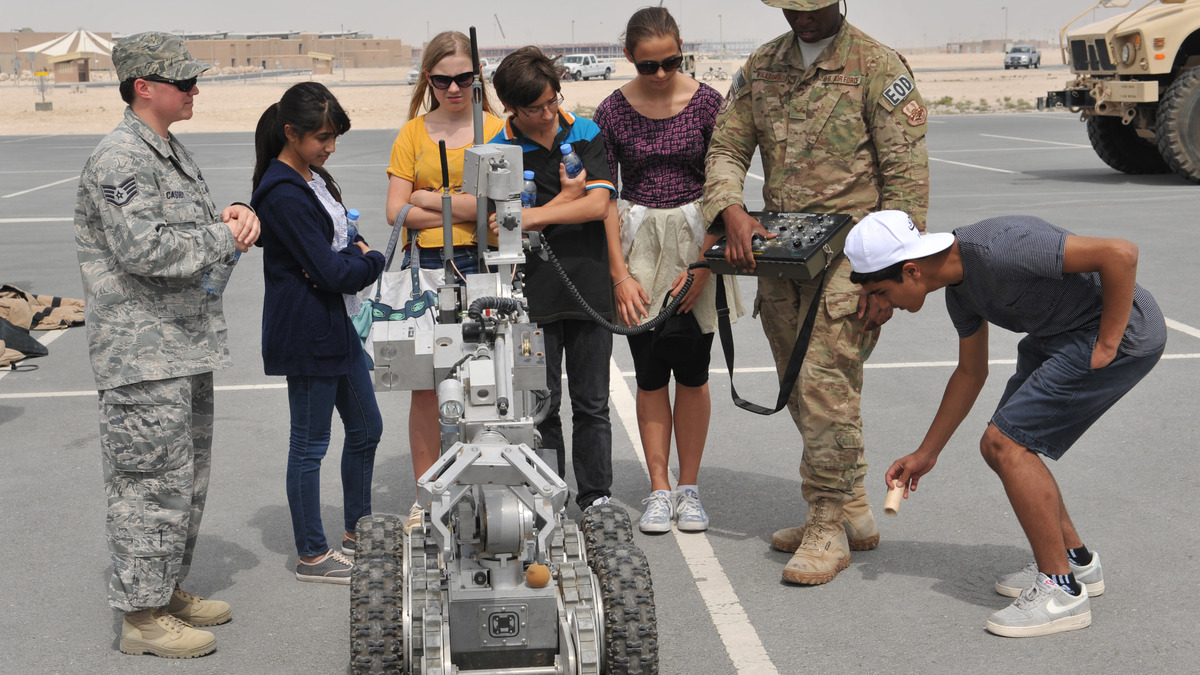 Physical AI in defense: autonomous systems like this Air Force robot represent a core market Eclipse's portfolio targets.
Source: commons.wikimedia.org
Physical AI in defense: autonomous systems like this Air Force robot represent a core market Eclipse's portfolio targets.
Source: commons.wikimedia.org
Limited Partners Betting Against Software Concentration
As the record Q1 2026 VC numbers showed, 80% of all venture capital last quarter poured into AI - but most of it concentrated in software and model training. Physical AI remains underfunded relative to market size, at least by Eclipse's reading. LPs get exposure to a category that software-only funds structurally can't access.
Who Pays
LP Capital Gets Locked Up
Fund VI and Early Growth Fund III will likely run on standard 10-year vehicles - which is punishing for hardware funds where companies may need 12-15 years to reach exit scale. LPs are betting on teams that can survive supply chain failures, regulatory delays, and military procurement timelines that don't respond to urgency.
The Competition Is Intensifying
Eclipse isn't alone in this bet, and the category is getting crowded fast:
| Firm | Fund | Size | Physical AI Focus |
|---|---|---|---|
| Eclipse Ventures | Fund VI + Early Growth III | $1.3B | Robotics, defense, manufacturing |
| Lux Capital | Fund IX | $1.5B | AI compute, quantum, robotics, defense |
| a16z | Physical AI | $600M | Industrial robotics, autonomous systems |
| Khosla Ventures | New fund (in progress) | $3.5B target | Deep tech, AI infrastructure |
Growing competition means more deal pressure on the best companies and, potentially, elevated valuations for hardware startups that can't always grow fast enough to justify them. The $11 billion physical AI investment surge that has been building since late 2025 has attracted capital faster than proven exit paths have emerged.
Workers in Targeted Industries
Manufacturing, logistics, construction, and agriculture collectively employ tens of millions of people in the markets Eclipse targets. None of that appears on a cap table, and Eclipse didn't address it in its fund announcement. The fund's thesis assumes automation demand from labor shortages - which means it profits from conditions that are already straining workers.
Eclipse has spent 11 years building a portfolio that tracks the defense-industrial AI buildout before most software investors noticed it was happening. The $1.3 billion close isn't a pivot - it's a scaling of something the firm has been executing quietly for a decade. Whether that head start is worth a decade of locked LP capital, against an increasingly crowded field of rivals who've now noticed the same opportunity, is the question the next few portfolio exits will answer.
Sources: TechCrunch · The Next Web · Crunchbase Q1 2026

