
DeepMind Maps Four Routes from AGI to Superintelligence
A 57-page DeepMind paper by co-founder Shane Legg identifies four pathways from AGI to superintelligence and six bottlenecks that could block each route.
 Updated
6 min read
Updated
6 min read
On June 12, fourteen researchers at Google DeepMind published a 57-page paper asking the question the industry has been carefully avoiding: what actually happens after AGI? The paper, "From AGI to ASI," maps four routes to superintelligence, identifies six specific obstacles that could slow each one, and arrives co-authored by DeepMind co-founder Shane Legg - who coined "machine superintelligence" in his 2008 doctoral thesis - and Marcus Hutter, who created AIXI, the theoretical framework for universal intelligent agents.
TL;DR
- Fourteen DeepMind researchers, including co-founder Shane Legg and AIXI creator Marcus Hutter, mapped four routes from AGI to ASI in a 57-page paper published June 12, 2026
- Four pathways: scaling, algorithmic innovation, recursive self-improvement, and multi-agent cooperation - each with distinct failure modes
- Six bottlenecks include the data wall, resource constraints, and what the authors call the abstraction barrier
- Core argument: AGI isn't the endpoint. It's the start of a transition whose speed and shape are still undetermined
How the Four Pathways Actually Work
What the Paper Doesn't Claim
Start with what this paper isn't: a prediction. The authors treat uncertainty as irreducible, not just incomplete. They write explicitly that "the question is no longer whether we reach AGI" but "what does the world look like as the transition unfolds." That's cartography, not a construction schedule.
The distinction matters because the paper got 54,000 views within days of publication, and much of the coverage framed it as a forecast. The authors reject that framing directly. Mapping possible routes to ASI isn't the same as claiming any particular route is inevitable or imminent.
The Four Pathways
Scaling is the most familiar: more compute, more training data, more parameters. The data wall is real - there's a finite amount of high-quality human-created text - but the paper treats this as an engineering constraint rather than a permanent ceiling. Synthetic data generation and multimodal training are the main workarounds it considers.
Algorithmic innovation covers something different: new architectures or training methods that extract more capability from the same resources. Chain-of-thought reasoning and mixture-of-experts designs (where specialized sub-networks handle different tasks and only a fraction activate per query) are cited as examples. The authors note that algorithmic gains compound with hardware gains. A 10x improvement in each doesn't produce 20x combined; under the right conditions, the stacking produces effects closer to 100x.
Recursive self-improvement attracts the most philosophical weight. The scenario: an AGI-level system adjusts its own training pipeline or architecture, producing successive generations of greater capability. The paper treats this empirically rather than speculatively - plausible but not inevitable, subject to physical constraints and alignment risk. A system has to correctly understand what "better" means for its self-modifications to stick, which is far from guaranteed.
Multi-agent cooperation is the one already running in production systems. Groups of specialized agents - one for research, one for verification, one for synthesis - handle tasks that exceed any individual model. The paper calls this "arguably the most immediately relevant to practitioners," and the benchmark data on agentic swarms backs that up.
The four pathways aren't mutually exclusive. The real route to ASI, if there's one, probably involves all of them interacting in ways the paper is careful not to predict.
Multi-Agent Cooperation: What "Already Live" Means
 Google DeepMind's London office. The "From AGI to ASI" paper was written by a 14-researcher team, most based there.
Source: cryptobriefing.com
Google DeepMind's London office. The "From AGI to ASI" paper was written by a 14-researcher team, most based there.
Source: cryptobriefing.com
The fourth pathway deserves its own examination because it's concrete in a way the others aren't. Production AI deployments already run multi-agent pipelines: one model searches, another assesses the results, a third synthesizes them. Each component model may sit well below any claimed AGI threshold. The collective sometimes doesn't.
The paper's observation is that this architecture scales. Better coordination mechanisms, deeper specialization, and faster interconnects push the effective capability of a multi-agent system beyond what its components could achieve individually. The transition from "useful tool" to something that warrants the word superintelligence might arrive incrementally, this way, across many deployments simultaneously - rather than in one dramatic breakthrough event.
| AGI | ASI | |
|---|---|---|
| Working definition | Matches or tops human performance across most domains | Surpasses large coordinated teams of human experts across virtually all domains |
| Speed | Comparable to human speed | Potentially 100x or more than human processing speed |
| Closest current examples | Frontier models in narrow domain clusters | No confirmed example |
| Key open problem | Reliable generalization across domains | Oversight at superhuman speed |
| Governance frameworks | Limited but developing | Minimal; the paper marks this as critical |
Why It Matters Now
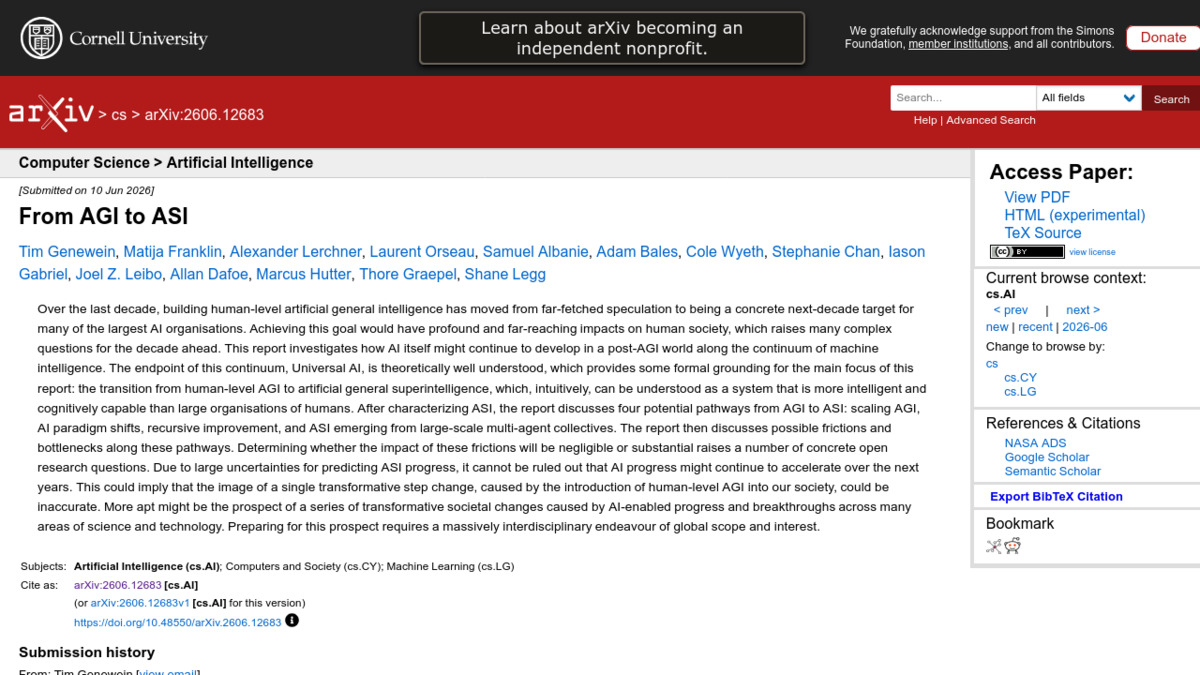 The paper on arXiv (arXiv:2606.12683). It crossed 54,000 views within days of publication, unusually fast for a preprint.
Source: arxiv.org
The paper on arXiv (arXiv:2606.12683). It crossed 54,000 views within days of publication, unusually fast for a preprint.
Source: arxiv.org
This paper arrived in a month when AGI claims were being made freely. Jensen Huang declared AGI had already arrived. A Nature commentary argued the same. The ARC-AGI-3 benchmark was designed specifically to test those claims against something harder to game.
DeepMind's paper sidesteps that debate and asks a harder question. Assuming AGI-level capability is either here or close, what does the path to something beyond it look like? The answer is more structured - and more sobering - than the benchmark leaderboard framing suggests.
Two specific concerns in the paper deserve attention.
First, the speed problem. The authors note that when digital systems operate 100x faster than humans, "any human review process becomes a bottleneck." This isn't about distant superintelligence. It's about agentic pipelines running today. A system that executes hundreds of steps per second has already outpaced any practical human oversight loop, regardless of where it sits on a capability benchmark. Nobody has a good answer for this yet.
Second, the abstraction barrier. The paper proposes that AI systems trained on human abstractions "might struggle to invent genuinely new ones." Current benchmarks measure performance within known frameworks. A model that tops every leaderboard might still be unable to produce the next scientific framework completely. The authors don't resolve this bottleneck; they mark it as an open research question, which is the honest position given how little empirical data exists on the question.
For readers tracking the technical constraints on the road to ASI, those two bottlenecks are the ones worth watching - not the question of which lab gets to claim the AGI label next.
What To Read Next
- Jensen Huang Says AGI Has Already Arrived
- Nature's Argument That AGI Is Already Here
- ARC-AGI-3: Can Any Model Actually Beat It?
Sources:
Last updated

