
Cursor Targets $50B Valuation - Enterprise Now Pays the Bills
Cursor is in advanced talks to raise $2B+ at a $50 billion pre-money valuation, nearly doubling its November figure as enterprise clients drive 60% of revenue.
 6 min read
Anysphere, the company behind Cursor, is in advanced talks to raise at least $2 billion at a pre-money valuation of $50 billion, according to sources who spoke to TechCrunch and Bloomberg on April 17. The round is already oversubscribed. Andreessen Horowitz and Thrive Capital - both returning backers - are expected to co-lead, with Battery Ventures joining as a new participant and Nvidia taking a strategic position.
If it closes at those terms, Cursor would nearly double its November 2025 valuation of $29.3 billion in under six months. Eighteen months ago, the company was worth $9.9 billion.
TL;DR
- Anysphere raising $2B+ at $50B pre-money valuation; round already oversubscribed
- a16z and Thrive Capital co-leading, Battery Ventures new, Nvidia joining as strategic investor
- ARR crossed $2 billion in February; company projects $6B+ by end of 2026
- Enterprise accounts now 60% of revenue and carrying positive gross margins
- Cursor building its own models to reduce dependency on Anthropic, OpenAI, and others
The Numbers That Got Investors Here
The case for a $50 billion valuation starts with revenue growth that has almost no precedent in enterprise software. Cursor crossed $500 million in annualized revenue by May 2025, reached $1 billion by October, and surpassed $2 billion in February 2026. The company now projects ending the year above $6 billion ARR - a tripling in under 12 months.
Sixty-seven percent of Fortune 500 companies use Cursor, generating around 150 million lines of enterprise code per day. Enterprise contracts account for 60% of revenue. Those enterprise accounts carry positive gross margins, which matters because Cursor's individual developer subscriptions still run at a loss.
| Round | Date | Valuation | Key Investors |
|---|---|---|---|
| Series - | Jun 2025 | $9.9B | a16z, Thrive Capital |
| Series - | Nov 2025 | $29.3B | a16z, Thrive Capital ($2.3B round) |
| In talks | Apr 2026 | $50B | a16z, Thrive, Battery, Nvidia |
The gross margin arc matters more than the headline ARR. For most of its short life, Cursor was a growth story with a margin problem: paying Anthropic, OpenAI, and other model providers a large share of every dollar it earned from developers. Two things changed that picture. Cursor launched its own Composer model in November 2025, reducing what it routes to third-party providers. It also integrated models from China's Kimi - cheaper per token than the US frontier providers - for tasks where raw coding performance is less critical.
The combination moved overall gross margins into slightly positive territory. Enterprise accounts, where clients pay annual contracts and run predictable workloads, now show meaningfully better margins than the developer consumer tier.
Who Benefits
The Founders and Existing Investors
Michael Truell and his three co-founders built Anysphere out of MIT without external funding until 2024. Their equity, and that of a16z and Thrive Capital who backed early rounds, has appreciated on a path that would be unusual in any market. At $50 billion, Anysphere would rank behind only OpenAI among US AI company valuations.
Truell, who's 25, has been unusually direct about his competitive strategy. Rather than pretending model providers are partners, he has publicly framed the company's goal as reducing its exposure to them. "We take the best intelligence that the market has to offer from many different providers," Truell told TechCrunch in December. "And we also do our own product-specific models in places." The Composer launch was the first concrete step. The funding round provides capital to accelerate that work.
Enterprise IT Buyers
More capital going into Cursor's enterprise engineering team benefits corporate customers directly. The company has been building spend controls, billing groups, usage dashboards, and compliance tooling - the infrastructure that large IT departments require before they can approve company-wide seat deals. With 67% of the Fortune 500 already using Cursor, renewal conversations are happening at scale for the first time.
Nvidia
Nvidia's strategic participation is worth reading carefully. The company invests in AI software startups partly to maintain demand for its GPUs. A Cursor processing 150 million lines of enterprise code per day runs on compute, and Nvidia has a clear interest in that compute budget. It's a different reason than the typical VC bet on returns - Nvidia is buying influence with a company that controls a meaningful slice of AI inference spend.
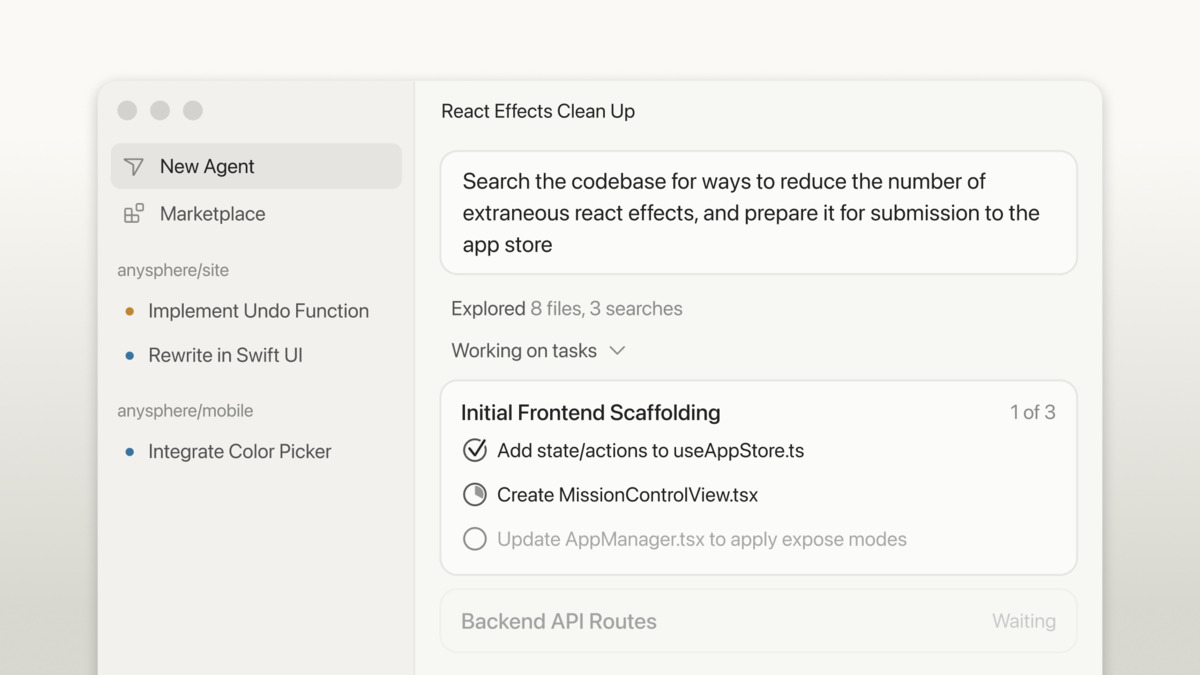 Cursor's Cursor 3 interface, launched in April 2026, allows developers to run multiple coding agents in parallel across local and cloud environments.
Source: cursor.com
Cursor's Cursor 3 interface, launched in April 2026, allows developers to run multiple coding agents in parallel across local and cloud environments.
Source: cursor.com
Who Pays
New Investors Buying at the Peak
The investors writing checks at $50 billion are making a specific bet: that Cursor can hold its market position as both model providers and hyperscalers push competing tools. That's harder than it sounds. Anthropic's Claude Code crossed $2.5 billion in annualized revenue by February 2026. OpenAI has unified Codex with its broader desktop strategy. Microsoft, which owns GitHub, is pushing Copilot into the same enterprise accounts that Cursor wants.
"It's pretty clear the market is standardizing on a couple solutions. It's a narrow field of folks really at scale here."
- Michael Truell, CEO of Anysphere, to Fortune, March 2026
Truell's framing is accurate, and it cuts both ways. If the market standardizes on two or three tools, Cursor could be one of them. Or Microsoft could bundle Copilot into existing enterprise agreements at a price Cursor can't match. New investors at $50 billion are paying for the optimistic scenario.
Anthropic and the Model Providers
Cursor's explicit goal of reducing reliance on Anthropic is a direct threat to Anthropic's model revenue. Cursor was one of Anthropic's largest API customers. Each Composer token that replaces a Claude token is revenue Anthropic doesn't see. This dynamic repeats across the AI stack: the most successful application-layer companies tend to eventually build their own models for the tasks they do at scale.
Individual Developers
The funding round doesn't change the economics of individual Cursor subscriptions right away, but the direction of travel is visible. Cursor's enterprise accounts carry positive margins. Its individual developer accounts do not. That cross-subsidy works until investors want profitability - which they'll eventually demand, especially with an IPO on the horizon. Individual pricing will likely go up before any Cursor listing.
 Enterprise sales cycles and Fortune 500 adoption drove Cursor's shift from a developer tool to a boardroom purchase - and brought a different class of investor with it.
Source: unsplash.com
Enterprise sales cycles and Fortune 500 adoption drove Cursor's shift from a developer tool to a boardroom purchase - and brought a different class of investor with it.
Source: unsplash.com
Counter-Argument: What Bears Will Say
The bear case on Cursor has been consistent since the company's first large valuation: the product's core function - helping developers write code with AI assistance - is a commodity waiting to happen. Every major model provider wants to control the coding interface. Apple Silicon, AMD, and Intel are all chasing inference cost reductions that would make running local models viable at enterprise scale, removing Cursor's control over model selection.
The company's response is to be the best end-to-end tool regardless of which model sits underneath it. Cursor's $2 billion ARR milestone was partly built on integrating the best available model at any given moment - switching from GPT-4 to Claude 3.5 to Gemini as each took the lead. The Composer model is an attempt to own the layer that matters most for code-specific tasks. Whether a proprietary coding model can stay competitive with Anthropic's and OpenAI's frontier research teams, with a fraction of the budget, is the real question.
At $50 billion, Cursor is a bet on enterprise software margins - and the terms will be set by whether Anysphere can make its own models good enough to stop paying the companies most likely to kill it.
Sources:

