
Cursor 3 Rebuilds the IDE Around Agents
Cursor's ground-up IDE rebuild ships parallel agent orchestration, Design Mode for frontend work, and cloud-to-local session handoff - all in one unified workspace.
 6 min read
Cursor shipped Cursor 3 on April 2, 2026 - a complete rebuild of the IDE designed from the ground up around agent orchestration. The company calls it "a unified workspace for building software with agents." The traditional code editor is still there, but it's no longer the center of gravity.
The new interface was built from scratch under a project the team calls "Glass." It's the same codebase that powers the cursor.com/agents web experience, so the desktop app and browser now share a single agent runtime.
TL;DR
- New Agents Window manages parallel agents across local, cloud, worktree, and remote SSH environments
- Design Mode lets devs annotate browser UIs directly to target code changes without describing them in text
- Cloud-to-local session handoff keeps agents running after you close the laptop
- Composer 2 scores 61.7 on Terminal-Bench 2.0 vs Claude Opus 4.6's 58.0
- Token costs dropped ~86% vs Composer 1.5; Pro plan stays at $20/month
The Agents Window
The centerpiece of Cursor 3 is the Agents Window - a new pane that runs with the traditional IDE rather than replacing it. Trigger it via Cmd+Shift+P and search "Agents Window." From there, multiple agents can run across different repos, environments, and platforms at once.
Cmd+Shift+P → "Agents Window"    # Open the agents panel
/worktree                         # Isolated git worktree from within the panel
/best-of-n                        # Run the same prompt across multiple models
Cmd+Shift+D                       # Toggle Design Mode in the browser pane
Shift+drag                        # Select a UI region in Design Mode
Cmd+L                             # Add selection to agent chat
Option+click                      # Add element to agent input
All agents kicked off from mobile, web, Slack, GitHub, or Linear appear in a unified sidebar in the desktop app. Cursor says more than 30% of the PRs it merges internally are now opened by agents running in cloud sandboxes - agents that attach video, screenshots, and logs to their own PRs.
Local-to-Cloud Handoff
Close the laptop and the agent keeps going. Return and the session is waiting. The handoff works in both directions: start an agent from mobile, move it to local for testing when back at a desk. This is a direct answer to OpenAI's Codex, which is cloud-only. Cursor's argument is that cloud scale and IDE depth shouldn't be mutually exclusive.
For enterprises with compliance requirements, Cursor shipped self-hosted cloud agents on March 25 - tool calls execute on internal infrastructure, nothing leaves the network.
Design Mode
Frontend developers get a browser annotation layer built into the Agents Window. In Design Mode, Shift+drag selects an UI region and sends it to the agent chat; Option+click targets individual elements. Hit "Apply" and the agent traces the selection back to the source code, edits it, and hot-reloads the browser pane.
This runs two loops simultaneously: a visual loop for style adjustments where you can watch changes in real time, and a code loop where the agent edits the underlying repo. Neither requires writing a text description of what you want to change.
Composer 2 Under the Hood
The Agents Window runs on Composer 2, Cursor's proprietary coding model released March 19. It's built on top of Kimi K2.5 from Moonshot AI, though the license situation around that base model created its own controversy - details covered in our earlier report.
Benchmark Numbers
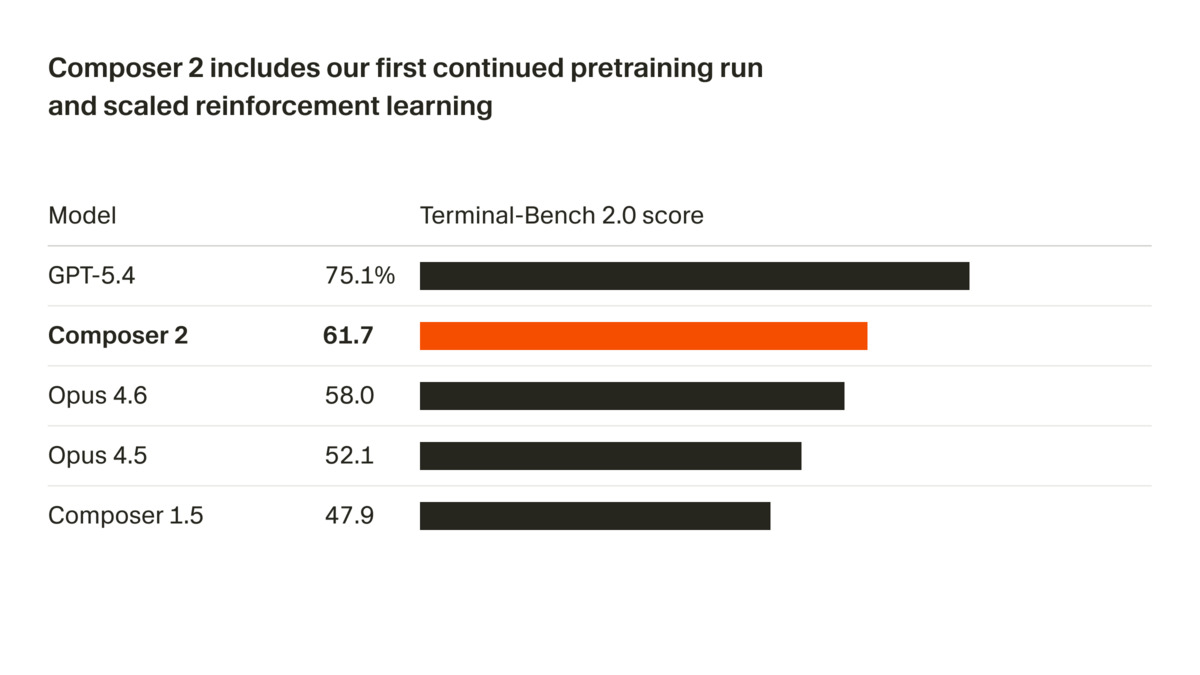 Composer 2 benchmark scores compared to Claude Opus 4.6, GPT-5.4, and prior Cursor models on Terminal-Bench 2.0.
Source: cursor.com
Composer 2 benchmark scores compared to Claude Opus 4.6, GPT-5.4, and prior Cursor models on Terminal-Bench 2.0.
Source: cursor.com
| Model | CursorBench | Terminal-Bench 2.0 | SWE-bench Multilingual |
|---|---|---|---|
| Composer 2 | 61.3 | 61.7 | 73.7 |
| Claude Opus 4.6 | - | 58.0 | - |
| GPT-5.4 | - | 75.1 | - |
| Composer 1.5 | 44.2 | 47.9 | 65.9 |
| Composer 1 | 38.0 | 40.0 | 56.9 |
Composer 2 beats Claude Opus 4.6 on Terminal-Bench 2.0 by 3.7 points and improves on its predecessor by 13.8 points. GPT-5.4 still leads on that benchmark, which matters for agentic tasks requiring tool use in a shell environment.
Token Pricing
Cursor dropped token costs substantially with the launch:
| Tier | Input | Output | vs Composer 1.5 |
|---|---|---|---|
| Standard | $0.50/M | $2.50/M | -86% |
| Fast (default) | $1.50/M | $7.50/M | -57% |
| Composer 1.5 | $3.50/M | $17.50/M | baseline |
The price cut is real. The billing model is also different: Cursor moved to credits-based metered billing in June 2025. Pro plans include $20/month of credits. One reviewer at Every.to reported spending around $2,000 over two days of normal development work on the metered plan, which is worth factoring into any cost comparison against flat-rate alternatives.
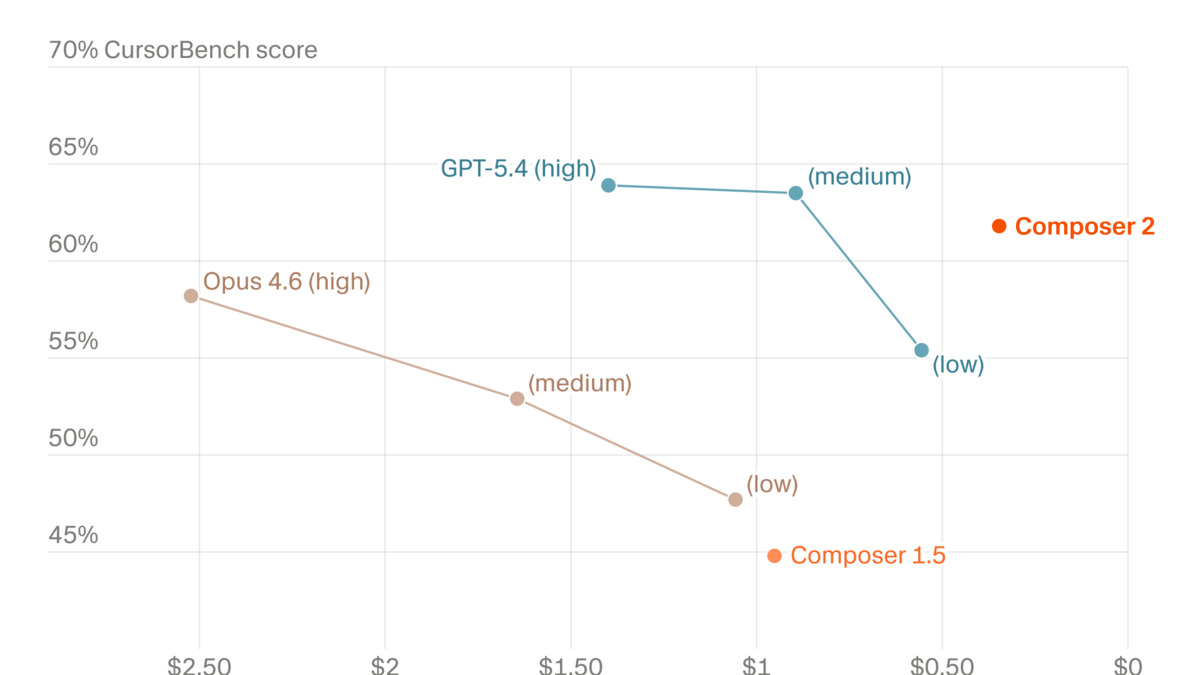 Performance per dollar comparison across major coding models, from Cursor's Composer 2 launch post.
Source: cursor.com
Performance per dollar comparison across major coding models, from Cursor's Composer 2 launch post.
Source: cursor.com
Automations and the Plugin Ecosystem
Cursor shipped Automations in early March - always-on agents that trigger without a human initiating each task. Supported triggers include Slack messages, Linear issues, GitHub events, PagerDuty alerts, and custom webhooks. Agents build memory across runs and can identify patterns over time - for instance, a daily review agent that finds untested code paths and submits its own PRs.
The Plugin Marketplace launched with 30+ integrations at launch from Atlassian, Datadog, and GitLab. Teams get a private plugin repository with versioning controls and per-team access restrictions. Installing a plugin is one click.
MCP Apps, which shipped in version 2.6 in early March, let interactive UI components render directly inside agent chats - Amplitude dashboards, Figma specs, and tldraw whiteboards appear inline rather than requiring a context switch.
Where It Falls Short
The Agents Window is truly new architecture, but early adoption feedback points at real friction. Users in the Cursor forum reported difficulty finding the Agents Window after upgrading. Branch selectors are absent from the initial release. Session persistence is inconsistent enough that multiple users flagged it within hours of launch.
The competitive picture is harder still. Developer surveys from early 2026 put Claude Code at 46% "most loved" vs Cursor at 19%. Users report Claude Code consumes 5.5x fewer tokens for equivalent tasks on complex jobs. The full comparison across Claude Code, Cursor, and Codex shows Cursor winning on simple utility functions at 42 accuracy points per dollar vs Claude Code's 31, but losing on complex tasks - 6.2 vs 8.5 accuracy points per dollar.
"Power users who already work in Claude Code or Codex won't use a new agent orchestration layer unless it's 10 times better than what exists," wrote analyst Dan Shipper at Every.to.
For heavy users, Claude Max's $200/month unlimited Opus plan still undercuts Cursor's per-token model in practice.
 Michael Truell, Cursor CEO, speaking at Fortune Brainstorm AI. Truell co-authored the Cursor 3 launch post with co-founder Sualeh Asif.
Source: techcrunch.com
Michael Truell, Cursor CEO, speaking at Fortune Brainstorm AI. Truell co-authored the Cursor 3 launch post with co-founder Sualeh Asif.
Source: techcrunch.com
Compatibility:
| Feature | Platform | Status |
|---|---|---|
| Agents Window | macOS, Windows, Linux | GA - April 2, 2026 |
| Design Mode | macOS, Windows, Linux | GA - April 2, 2026 |
| Cloud Agents | cursor.com | GA |
| Self-Hosted Cloud Agents | Enterprise | GA - March 25, 2026 |
| JetBrains (IntelliJ, PyCharm, WebStorm) | Desktop | GA via Agent Client Protocol |
| Mobile agent kickoff | iOS | GA |
| Automations | All platforms | GA - early March 2026 |
Cursor's bet is that developers won't abandon the IDE even as agents do more of the actual authoring work. The terminal-native camp - where Claude Code holds a commanding lead - disagrees. Cursor 3 is the strongest version of the IDE-centric argument yet, built for a developer who wants full LSP depth, a browser pane, and a plugin ecosystem with agent orchestration. Whether that combination beats the simplicity of a terminal-first agent at scale is the only question that matters now.
Sources:

