
Crusoe Eyes $3B Round to Triple AI Factory Valuation
Crusoe is in talks to raise roughly $3 billion at a $30 billion valuation, tripling what investors paid eight months ago as AI compute demand outstrips available infrastructure.
 5 min read
Eight months ago, investors valued Crusoe at roughly $10 billion. Now the company is in talks to raise $3 billion at a valuation of about $30 billion - a clean triple on a business that was focused on cryptocurrency two years before that, according to Bloomberg.
TL;DR
- Crusoe is in talks for a ~$3B fundraise at a ~$30B valuation (Bloomberg, July 2)
- That would triple its October 2025 Series E valuation of ~$10B in under a year
- 4.9 GW of contracted AI compute capacity; 40+ GW in project pipeline
- Named customers: Meta (1.6 GW contracted) and Oracle; backers include NVIDIA, Founders Fund, Mubadala Capital
- Final terms aren't set; Crusoe declined to comment on the report
The company builds what it calls AI factories: data centers where Crusoe owns the land, the power infrastructure, the construction, and the cloud layer. The pitch is differentiation from rivals like CoreWeave, which rely more heavily on leased capacity, and from Lambda, which splits between cloud and on-premise GPU services.
The Numbers Behind the Valuation
Crusoe's pitch for a $30 billion valuation isn't coming from nowhere. The company forecasts $998 million in revenue for 2025, a 262% year-over-year increase, driven in part by its role in building the first phase of the Stargate data center campus in Abilene, Texas. That site went live on September 30, 2025, on Oracle Cloud Infrastructure. Microsoft subsequently signed a deal for a 900 MW campus adjacent to the site Oracle and OpenAI had walked away from.
| Company | Valuation | Last Round | Capacity Model |
|---|---|---|---|
| Crusoe | ~$30B (in talks) | $1.38B Series E (Oct 2025) | Own everything: land, power, construction, cloud |
| CoreWeave | ~$43B (March 2026 IPO) | IPO | Leased capacity, multi-region InfiniBand fabric |
| Lambda Labs | ~$1.5B | Series C (2024) | Cloud and on-premise GPU, leased |
| Nebius | ~$5B | Post-Yandex restructuring | Mixed owned/leased, Europe-focused |
Crusoe currently has 4.9 gigawatts of contracted compute capacity and a pipeline exceeding 40 gigawatts. That pipeline number is a bet on sustained, decade-long AI infrastructure demand holding up.
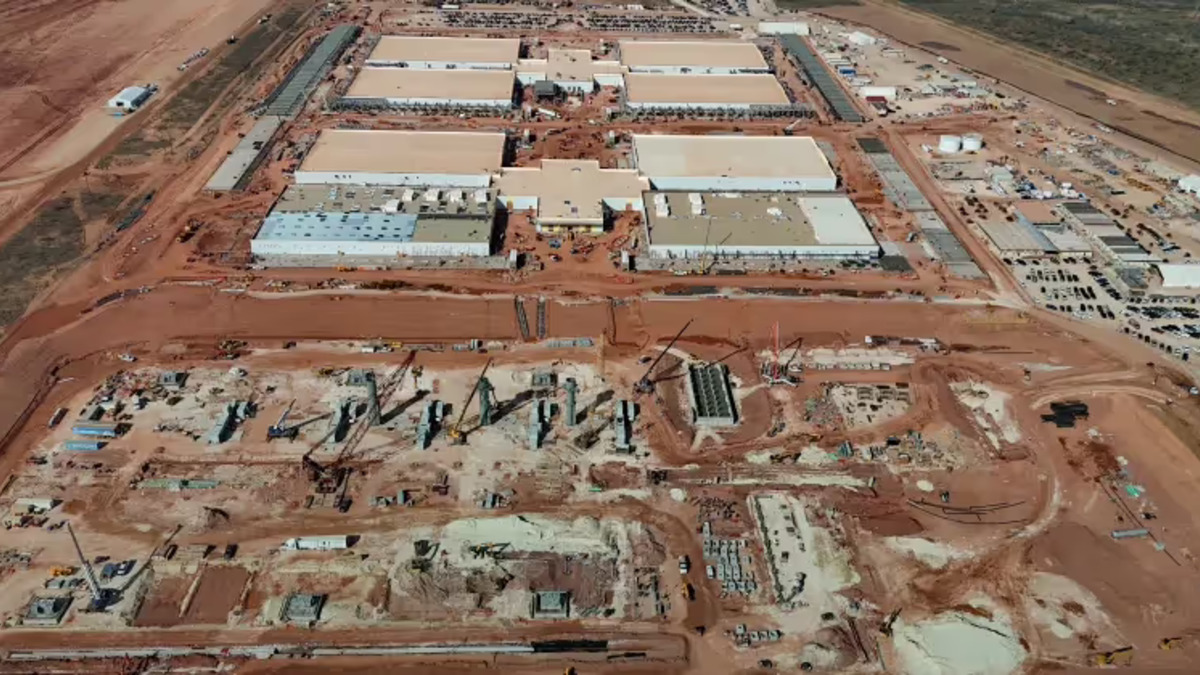 Crusoe's Abilene, Texas AI factory campus - the first phase of the Stargate project - is now operational and expanding to 1.2 GW total capacity.
Source: crusoe.ai
Crusoe's Abilene, Texas AI factory campus - the first phase of the Stargate project - is now operational and expanding to 1.2 GW total capacity.
Source: crusoe.ai
The company started in 2018 as a cryptocurrency operation that converted flared natural gas from oil fields into computing power. That business model - own the energy, own the computation - carried over when Crusoe pivoted to AI. Same thesis, better margins, longer runway.
A tripling in under a year is a pretty stark read on how investors are pricing that pivot.
The company has projects underway in Wyoming and Alberta, Canada, alongside the flagship Texas campus. It also runs Crusoe Spark, a modular data center unit manufactured at a 350,000 square-foot factory in Brighton, Colorado - a hedge against the limitations of gigawatt-scale single-site construction.
Who Benefits
Existing investors are the clearest winners from a $30 billion valuation. Valor Equity Partners and Mubadala Capital co-led the Series E at roughly $10 billion; they're looking at a 3x on paper in under a year. NVIDIA, Founders Fund, Fidelity, T. Rowe Price, and Tiger Global also participated in prior rounds.
Crusoe's enterprise customers benefit indirectly. Meta has contracted 1.6 gigawatts of compute across Crusoe's Texas and Missouri facilities; Oracle relies on Crusoe for its Stargate-phase infrastructure. A well-capitalized Crusoe can keep expanding those facilities without interruption. Supply continuity matters in a market where GPU time is the binding constraint on AI development schedules.
 Crusoe CEO Chase Lochmiller has led the company from flared-gas crypto mining to a core Stargate supplier worth tens of billions.
Source: crusoe.ai
Crusoe CEO Chase Lochmiller has led the company from flared-gas crypto mining to a core Stargate supplier worth tens of billions.
Source: crusoe.ai
The broader AI infrastructure market benefits from another data point. CoreWeave's IPO struggled partly because investors weren't sure whether neocloud economics worked at high valuations with heavy debt loads. Crusoe's fundraise, at a higher multiple but with a vertically integrated model and named hyperscaler contracts, offers a different read: infrastructure capacity as a durable asset, not a leveraged bet on GPU spot rates.
Who Pays
New investors entering at $30 billion are paying a 3x premium over where the company stood eight months ago. Whether that's justified depends on whether 40 gigawatts of pipeline converts to contracted revenue - and whether AI compute demand in 2027 and 2028 matches what the top labs are projecting.
The risks are concentrated. Crusoe's two named customers represent the bulk of its contracted capacity. That's customer concentration in a capital-intensive business where each new data center requires constant deployment before the prior one has fully ramped. A slowdown in AI spending from either Meta or Oracle - or a renegotiation of terms - would hit the valuation quickly.
There's also a question about whether owning every layer is the right model at scale. It gives Crusoe pricing power and margin now. As more capital floods into AI infrastructure, though, the supply constraint eases. The advantage narrows when there's more competition for the same GPU orders from hyperscalers willing to take their own construction risk.
The round hasn't closed. Final terms aren't set. Crusoe declined comment to Reuters. But if it does close at $30 billion, Crusoe will have gone from a crypto hedge against stranded natural gas to one of the most valuable AI infrastructure companies in the world in under three years - and the neocloud category will have its clearest valuation benchmark yet.
Sources:
- Crusoe Eyes $3B Funding Round to Expand AI Infrastructure - Business Review Live (citing Bloomberg)
- Crusoe Announces Series E Funding - Crusoe.ai Newsroom
- An Inside Look at the Abilene AI Data Center - Crusoe.ai
- Crusoe in talks to raise $3B at reported $30B valuation - AI Weekly
- Crusoe to triple valuation to $30B as AI infrastructure race heats up - Tech Funding News

