
Anthropic Ships Claude Tag - Slack Gets a Teammate
Anthropic's Claude Tag replaces the old Slack app with a shared @Claude identity that builds channel memory, works asynchronously, and runs on Claude Opus 4.8.
 7 min read
The Claude in Slack app most enterprise teams have been using since 2024 is being retired. Its replacement, which Anthropic launched on June 23, isn't an incremental update - it's a different model of what AI inside a workplace should look like.
Claude Tag gives every Slack channel a shared @Claude identity that carries context across days, works through tasks while you move on to something else, and keeps all its work visible to the whole team. It ships on Claude Opus 4.8, replacing a product that ran on whatever model version happened to be current.
TL;DR
- Beta available now for Claude Enterprise and Team customers; old Claude in Slack app retires August 3, 2026
- One @Claude per channel, visible to everyone, context persists across conversations and team members
- Runs on Claude Opus 4.8 with admin-controlled tool access, per-channel token spend limits, and audit logs
- Anthropic's own product team creates 65% of its code via their internal version of Claude Tag
Old App vs Claude Tag
The table below captures what actually changed between the two products:
| Dimension | Claude in Slack (old) | Claude Tag |
|---|---|---|
| Identity model | Per-user, per-session | Single shared org identity per channel |
| Memory | No persistent context | Builds over time from channel history |
| Collaboration | Private per-user | Multiplayer - whole team sees the work |
| Task execution | Synchronous, wait for response | Async - delegate and return later |
| Billing | Against individual users | Billed to the org centrally |
| Ambient behavior | Not available | Optional proactive monitoring |
| Admin controls | Minimal | Channel-scoped tools, token limits, audit logs |
| Underlying model | Various Claude versions | Claude Opus 4.8 |
| Status | Retiring August 3, 2026 | Beta for Enterprise and Team |
That retirement date is the operational detail that matters most for current users. Administrators have a 30-day window from launch to opt in, and Anthropic is offering introductory launch credits to eligible Enterprise and Team organizations.
 Claude Tag is Slack-native, runs on Opus 4.8, and is currently in beta for Team and Enterprise plans.
Source: aiandapi.com
Claude Tag is Slack-native, runs on Opus 4.8, and is currently in beta for Team and Enterprise plans.
Source: aiandapi.com
What Claude Tag Actually Does
The core mechanic is straightforward: type @Claude in a channel with a description of what you need, and Claude breaks the task into stages, works through them using whatever tools the administrator has connected, then posts results in a thread where everyone can read, follow up, or redirect.
Multiplayer by Design
Cat Wu, Anthropic's head of product for Claude Code and Cowork, drew the distinction clearly: "Claude Code, Cowork, and chat are very single-player, whereas Claude Tag is built to be interactive and multiplayer."
That framing separates Claude Tag from the AI chatbot assistant category. When someone in an engineering channel asks @Claude to draft a migration plan, the whole team sees the staged output, can pick up the thread, or steer Claude toward a different codebase. No context is buried in someone's private session.
Context That Persists
Claude Tag builds working memory from a channel's history and, with administrator permission, from connected data sources across the organization. It learns what the team does, what tools it uses, and what the recurring questions are. Users stop re-explaining context from scratch on every request.
Memory is scoped by channel and by administrative permission. A Claude instance configured for engineering can't read from a legal channel, and vice versa. Administrators define which tools, codebases, and data sources each instance can reach - separately per department if needed.
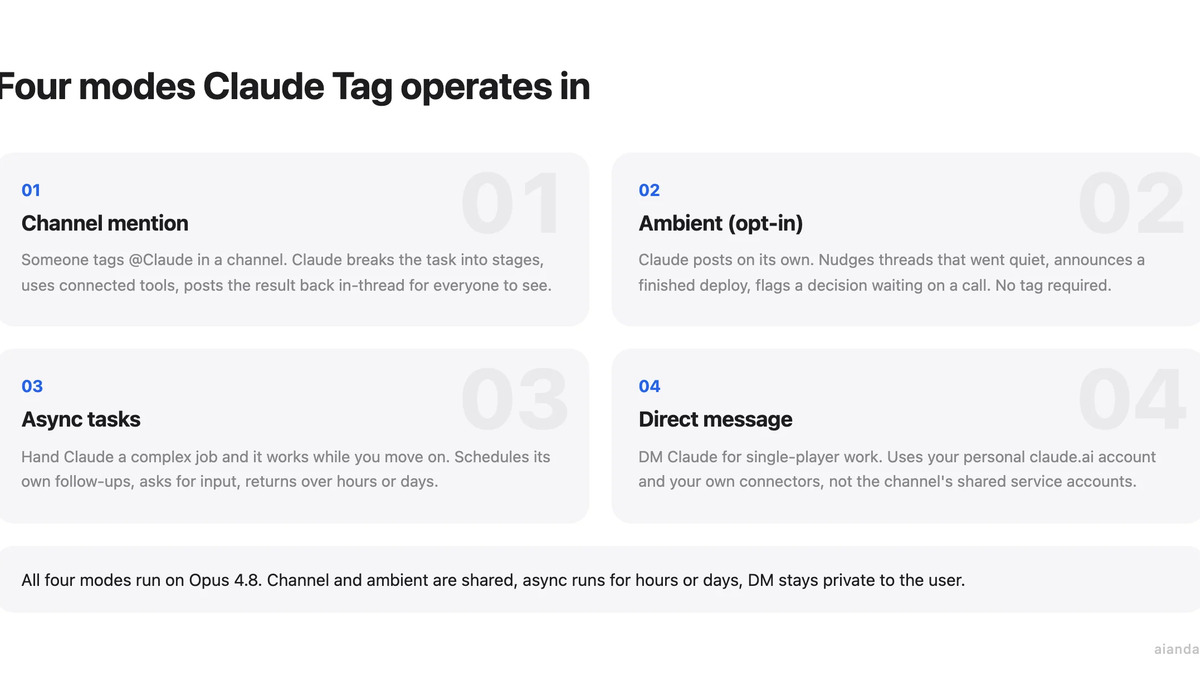 Claude Tag operates in four modes - direct channel mention, optional ambient monitoring, async long-running tasks, and private direct message.
Source: aiandapi.com
Claude Tag operates in four modes - direct channel mention, optional ambient monitoring, async long-running tasks, and private direct message.
Source: aiandapi.com
Ambient Mode and Async Tasks
Ambient mode - One of two opt-in behaviors that extend Claude Tag beyond direct @mentions: when enabled, Claude monitors the channel and posts when something needs attention, whether that's a thread that went quiet, a finished deploy, or a decision waiting on a call. No tag required.
Async tasks - For complex multi-step work, Claude schedules its own follow-ups and works over hours or days, returning with results rather than requiring the user to wait in real time. This is close to true task delegation, and it runs under the same admin-controlled permission scope with per-channel spend limits capping how much any instance can consume.
The Numbers Behind the Pitch
Anthropic didn't ship Claude Tag based on theory. Its own product team has been running an internal version, and the number they chose to publicize is striking: 65% of the code changes on Anthropic's product team are now produced by that internal deployment. Usage has spread beyond engineering into product metrics tracking, support ticket triage, and bug diagnosis.
65% of Anthropic's product team code is now created by their internal Claude Tag deployment - including, they say, most of the code that built Claude Tag itself.
The broader market context explains why Anthropic is betting on an enterprise-first product right now. According to Ramp's May 2026 AI Index, Anthropic surpassed OpenAI in business adoption for the first time, reaching 34.4% of firms against OpenAI's 32.3%. The engine behind that gain was mainly Claude Code - the agentic coding product that has become the fastest-growing tool in Anthropic's history. Claude Tag is the natural extension of that momentum from individual developer use into team-level coordination.
Rob Seaman, EVP of Slack, positioned Salesforce's stake plainly: "Slack is the only layer in the AI stack where teams work together."
Anthropic filed confidentially for an IPO in June and raised its Series H at a $965 billion post-money valuation. Claude Tag's ability to create measurable, org-wide productivity data is exactly the kind of enterprise adoption story that supports that valuation in public market terms.
What It Doesn't Tell You
Claude Tag's launch materials are polished, but several details are missing.
No Pricing Beyond Credits
Anthropic mentions introductory launch credits for eligible Enterprise and Team organizations but gives no per-token, per-seat, or per-channel pricing for Claude Tag beyond standard Claude Enterprise terms. For budget planning, that's a gap - especially given that ambient mode and async tasks produce token spend without anyone explicitly requesting work.
No Independent Performance Data
The 65% code-generation figure at Anthropic is internally measured and self-reported. There are no independent benchmarks, no latency numbers for channel-level tasks, and no comparison to what teams using GitHub Copilot Enterprise or Microsoft Copilot for Teams are seeing on equivalent workloads.
No Clarity on Context Limits
How much channel history does Claude Tag actually index? What happens when a channel has three years of messages? The announcement says Claude "builds context from channel history" but doesn't define what that context window looks like at organizational scale.
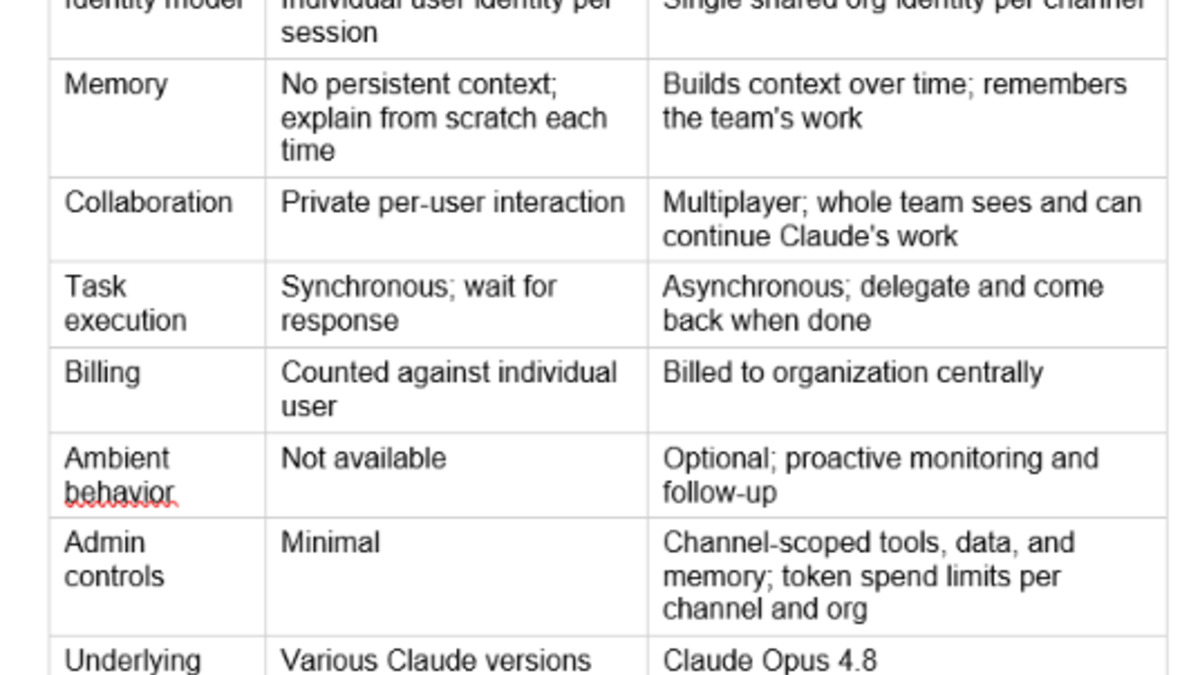 Feature-by-feature comparison showing the shift from per-user session model to shared org identity with persistent memory.
Source: buildfastwithai.com
Feature-by-feature comparison showing the shift from per-user session model to shared org identity with persistent memory.
Source: buildfastwithai.com
The Real Competition Is Larger Than Slack Bots
Anthropic positions Claude Tag against its own previous Slack app. The actual competition is: Microsoft Copilot for Teams and Copilot Studio, Salesforce Agentforce inside Slack, and enterprise knowledge layers from Glean, Databricks, and Snowflake - all of which also claim to learn company context over time. Claude Tag's strength is the underlying model capability; its weakness is that it's still in beta without customer-verifiable performance data.
For teams on Claude Enterprise or Team plans, the migration decision isn't optional for long - the old app retires August 3 regardless. The question is whether ambient mode, async task scheduling, and cross-channel memory hold up at scale after the launch credits run out. Anthropic's own product team is the only reference customer right now.
Sources:
- Introducing Claude Tag - Anthropic
- Anthropic launches Claude Tag - always-on AI teammate - The Next Web
- Claude Tag is learning your company - TechCrunch
- Anthropic and Salesforce announce new Claude to Slack integration - Salesforce Ben
- Ramp AI Index May 2026 - Anthropic beats OpenAI on business adoption
- Claude Tag embeds Anthropic AI in Slack - The Decoder

