
Claude Enters the Creative Studio - 9 MCP Connectors
Anthropic releases nine MCP-based connectors embedding Claude directly into Adobe, Blender, Autodesk, Ableton, and five other professional creative tools.
 7 min read
The claim is simple but its implications aren't: Claude can now open a Blender scene, read it, write Python to fix a broken rig, and push the result back - all from a chat window. Anthropic shipped nine connectors on April 28 under the banner "Claude for Creative Work," reaching into Adobe, Blender, Autodesk Fusion, Ableton, Splice, Affinity by Canva, SketchUp, and Resolume Arena and Wire in a single coordinated release.
TL;DR
- Nine MCP-based connectors embed Claude into major professional creative tools as of April 28
- Adobe integration covers 50+ Creative Cloud tools including Photoshop, Premiere, Lightroom, and InDesign
- Blender connector exposes the full Python API to natural language; Anthropic joins Blender's Development Fund
- Connectors are available on all Claude plans, including Free
- MCP is an open protocol - other LLMs can wire into these same connectors
This isn't the usual chatbot-plus-creative-tool pairing where you paste a screenshot in and get advice back. These connectors are bidirectional: Claude reads project state, calls tool-specific APIs, and writes changes back. The difference matters. Asking Claude to "batch-rename all layers in this Photoshop file" now actually does it, rather than explaining how you might do it yourself.
The Nine Connectors - What Each One Does
| Connector | What Claude Can Touch |
|---|---|
| Adobe for Creativity | 50+ tools across Photoshop, Premiere, Lightroom, InDesign, Illustrator, Firefly, Express, Adobe Stock |
| Blender | Full Python API - scene analysis, script generation, batch object changes, UI tool injection |
| Autodesk Fusion | 3D model creation and modification via conversational prompts |
| Ableton | Documentation-grounded Q&A for Live and Push; workflow guidance |
| Splice | Royalty-free sample catalog search from inside Claude |
| Affinity by Canva | Batch image adjustments, layer renaming, file exports |
| SketchUp | Conversation-to-3D-model workflow, early sketch generation |
| Resolume Arena | Real-time VJ control and live visual performance |
| Resolume Wire | Live visual automation and signal routing |
Installed from Claude's Customize panel, each connector appears as a tool block inside the chat interface. Claude decides which API to call, in what order, and with what parameters. For Adobe, that means chaining across apps - a user described wanting "a portrait retouched with balanced lighting, a blurred background, and cropped square," and Claude routed through Photoshop, then Lightroom, then Express without being explicitly told to.
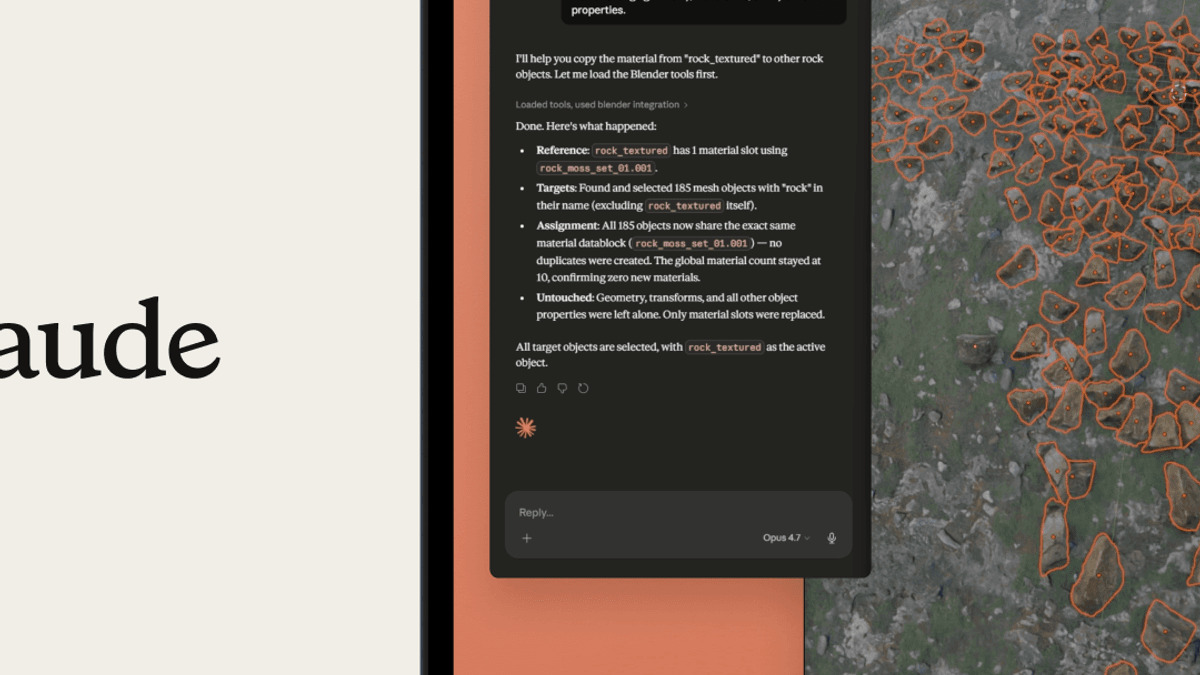 The nine connectors span 3D modeling, video production, audio, and still image tools. Source: nofilmschool.com
Source: nofilmschool.com
The nine connectors span 3D modeling, video production, audio, and still image tools. Source: nofilmschool.com
Source: nofilmschool.com
The Blender Case - Open Source Meets Frontier Model
The Blender connector is structurally the most interesting of the nine. Blender is free, open-source, and runs offline. Its Python API is extensive but steep for non-programmers. The connector bridges those two realities: you describe what you want in plain language, and Claude writes and executes the Python. Anthropic simultaneously joined Blender's Development Fund as a corporate patron - a financial commitment to sustaining the open-source project whose API makes the integration possible.
That combination - Anthropic funding Blender's open-source development to enable a commercial AI product - is an unusual posture. It is not charity. It's an infrastructure bet: the better Blender's Python API, the more capable the connector.
Adobe - Breadth vs Depth
The Adobe connector is the broadest by scope, touching more than 50 tools across 8+ Creative Cloud applications. The implementation follows a coordinator pattern: Claude acts as the orchestration layer, selecting and sequencing Adobe tools based on a high-level goal description. Adobe retains the execution layer; Claude provides only the intent and routing.
This is a deliberate architectural choice. Adobe's tools have years of refinement and professional-grade output quality. Claude doesn't try to reproduce them - it routes through them. Whether that division of labor holds up in complex multi-step workflows at professional studios remains an open question.
What It Does Not Tell You
The announcement is polished and the demos are compelling. Several things aren't in the press release.
Quality at Scale
The connectors are available to all Claude users - including Free plan - but the compute backing creative workflows isn't limitless. Multi-step Adobe pipelines or large Blender scenes may hit rate limits or latency walls before a professional studio would consider them production-viable. Anthropic hasn't published throughput guarantees or SLAs for connector usage.
MCP Is Open - So Are the Competitors
Claude connectors are built on the Model Context Protocol, an open specification. That means every other LLM can wire into these same connectors. Google's Gemini and OpenAI's models aren't locked out. Anthropic is betting that Claude's quality at complex, multi-step creative tasks is the differentiation - not the connector format. That bet is testable, and competitors will test it.
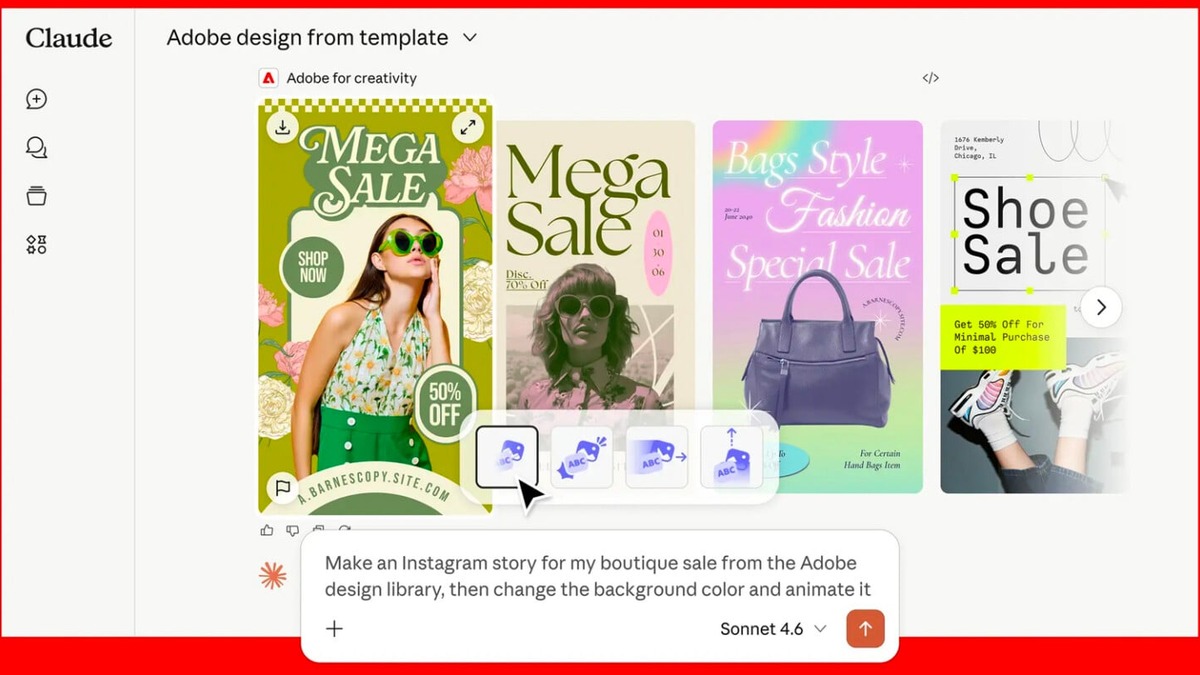 Claude orchestrates workflows across Photoshop, Premiere, and other Adobe apps using the new connector. Source: petapixel.com
Source: petapixel.com
Claude orchestrates workflows across Photoshop, Premiere, and other Adobe apps using the new connector. Source: petapixel.com
Source: petapixel.com
The Ableton and Splice Gap
Two of the nine connectors are read-only or query-only in their current form. Ableton grounds Claude in documentation - it answers questions about Live and Push, it doesn't compose or sequence music in your session. Splice lets Claude search its sample catalog but doesn't download or place samples. For producers who expected a true creative co-pilot inside their DAW, these two are closer to smart documentation lookups than agentic assistants. The guide to making music with AI covers the broader landscape of what is actually possible in audio production with current tools.
The Agency Question
Creative tools are unforgiving. A Photoshop action applied to the wrong layer, or a Blender script that batch-adjusts the wrong objects, can take hours to untangle. Claude can make mistakes. Anthropic hasn't described what guardrails, if any, exist to prevent destructive edits - whether connectors operate in sandboxed previews, whether there are confirmation steps before write operations, or how undo interacts with AI-driven changes.
Three Companies, Three Philosophies
Anthropic isn't moving alone. The April window saw three distinct strategies emerge for AI in creative work.
OpenAI deprecated Sora's standalone web and app experience on April 26 and consolidated creative capabilities inside ChatGPT. The bet is on one interface with the full AI stack inside it. Google distributed Gemini across Photos, Workspace, Search, and real-time generation features - reaching users where they already are rather than asking them to come to a dedicated creative surface.
Anthropic's path embeds Claude into tools creative professionals already have installed. It does not ask them to change where they work. It is the most respectful of existing workflows and the most dependent on those workflows remaining relevant.
| Lab | Creative AI Strategy | Where Work Happens |
|---|---|---|
| Anthropic | Embed in existing tools via MCP connectors | Adobe, Blender, Autodesk - wherever you already work |
| OpenAI | Consolidate inside ChatGPT | One interface, all capabilities |
| Distribute across owned surfaces | Photos, Workspace, Search, real-time |
There's no obvious winner in this comparison. The answer depends completely on whether the most valuable creative AI is one that meets you in your workflow or one that replaces it.
 Anthropic's patronage of Blender's Development Fund signals a longer-term bet on open-source creative infrastructure. Source: cgchannel.com
Source: cgchannel.com
Anthropic's patronage of Blender's Development Fund signals a longer-term bet on open-source creative infrastructure. Source: cgchannel.com
Source: cgchannel.com
What the Education Angle Reveals
With the tool integrations, Anthropic announced curriculum partnerships with three institutions: Rhode Island School of Design, Ringling College of Art and Design, and Goldsmiths, University of London. Art and design schools are explicitly in scope.
This is notable context. Design schools have been among the most vocal critics of generative AI - concerns about student work displacement, intellectual property of training data, and what authentic creative practice means when a model can approximate it. Anthropic going directly into those institutions with structured curriculum access is either a genuine engagement with that critique or a flanking move to normalize Claude in professional creative education before the skepticism solidifies. Likely both.
The structural comparison here isn't Adobe versus Blender. It's the question Elena keeps returning to when covering open-source versus proprietary AI dynamics: who controls the protocol? MCP is open. The connectors that run on it aren't owned by Anthropic. If these integrations prove truly useful, the network effect accumulates to the tool ecosystem first, and to whichever model happens to be best at driving it second.
Anthropic is betting that Claude - currently top of the creative writing leaderboard and Claude Opus 4.7 the strongest reasoning model available - holds that second position durably. It's the right bet to make. It is also the one most exposed to disruption, because the protocol makes it easy to swap the model underneath.
Sources:
- Claude for Creative Work - Anthropic
- Adobe for Creativity Connector - Adobe Blog
- Anthropic releases 9 Claude connectors - 9to5Mac
- Anthropic becomes Blender Corporate Patron - CG Channel
- Splice MCP Integration - Splice Blog
- Claude AI Orchestrates Adobe Workflows - PetaPixel
- Three Labs, Three Creative AI Strategies - Implicator AI
- The Agentic AI Revolution in Creative Tools - No Film School

